GAME ABOUT: HOW GLOBAL SPORTS EVENTS ARE RESHAPING CITIES, INVESTMENTS AND TOURISM | News
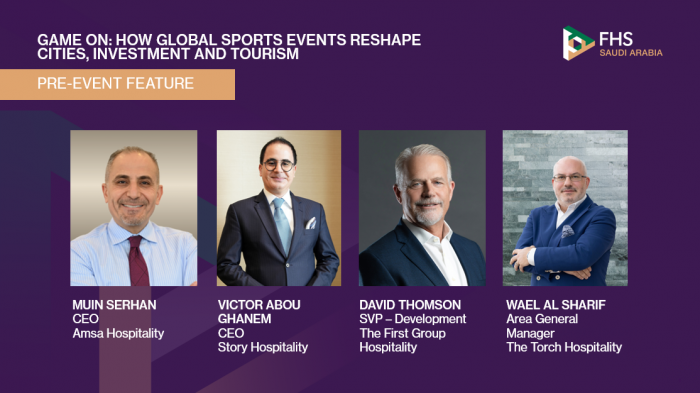
Saudi Arabia’s rise as a global sports destination is changing much more than just the events calendar. As the Kingdom prepares to host a growing portfolio of international tournaments, from Formula 1 and international football to golf, boxing and e-sports, sport is increasingly recognized as a powerful driver of tourism demand, attracting investment and positioning destinations for the long term.
As David Thomson, Senior Vice President – Development, The First Group Hospitality, puts it: “Mega events can put a city on the map. When managed well, they reposition a city in the minds of investors and travelers.”
Four leading hospitality executives share their perspectives ahead of the Future Hospitality Summit – FHS Saudi Arabia, taking place from June 22 to 24 at Mandarin Oriental Al Faisaliah, Riyadh.
Reputation takes precedence over turnover
Leaders agreed that the reputational dividend far outweighs the short-term financial returns. For Muin Serhan, CEO of Amsa Hospitality, “The biggest impact of global events is reputation. While the revenue is temporary, reputation only grows over time. When done well, a global event signals capacity, security and cultural openness, factors that investors keep a close eye on when entering a market.”
Victor Abou Ghanem, CEO of Story Hospitality, puts the opportunity in similarly expansive terms: “For destinations, a mega-event is the most expensive advertising campaign you’ll ever run, and the only one that the entire world publishes for free. If you think of the event as a short-term P&L, you probably can’t justify the cost. If you think of it as a 10- to 20-year brand-building moment, the logic changes completely.”
Wael Al Sharif, Area General Manager of The Torch Hospitality, underlines the scale of the opportunity specific to Saudi Arabia: “Brand building dramatically outweighs direct revenue. For Saudi Arabia as it prepares for Riyadh Expo 2030 and FIFA 2034, these platforms accelerate Vision 2030’s tourism diversification goals by decades, creating irreversible shifts in perception.”
Planning for the long game
Leaders agreed that engagement should begin well before the cameras are turned on. As Wael Al Sharif puts it: “Involvement must begin at the master planning stage. Early collaboration with city developers and event organizers ensures that hospitality infrastructure is aligned with existing objectives, avoiding isolated development and maximizing post-event utility.”
Victor Abou Ghanem is direct about the consequences of being late: “By the time logos are unveiled and tickets go on sale, many of the big decisions – venue locations, infrastructure routes and zoning plans – are already set. For hotel and real estate players, it’s ideal to have a seat at the table when master plans are drawn up and transport lines are discussed.”
Build smart and stay relevant
On supply and long-term value, leaders agreed: build for the normal year, not the peak. David Thomson puts it simply: “Capacity decisions should be based on long-term commercial viability, not short-term demand peaks. Good design, flexible use of space and selecting the right locations are essential to keeping built assets relevant long after the event has ended.” Muin Serhan underlines this point: “Operators should prioritize conversion-ready assets, mixed-use developments and properties that can be retrofitted to meet changing demand patterns.” Victor Abou Ghanem shares his rule of thumb: “Owners should view the event as a bonus, not as the basis.”
The commercial price, leaders agreed, is past the RevPAR peak. “Short-term interest rate premiums are welcome, but they are not the main prize,” says Muin Serhan. “If the experience converts first-time visitors into returning guests, the commercial impact will last long after the event.” Wael Al Sharif points to Saudi Arabia’s own mega-projects as evidence of where the broader value ends up: “In KSA, projects like Qiddiya and Diriyah demonstrate [the mixed-use value] perfect.”
Legacy over hype
The answer, the leaders agreed, comes down to one word: legacy. For Victor Abou Ghanem, “cities that win in the long term design the event as one chapter in a larger urban story. They invest in transportation that locals actually use, sites that can be downsized or repurposed, and tourism strategies that will last for decades.” David Thomson applies a commercial lens: “Cities that think beyond the event itself, match supply with realistic post-event demand and phase development responsibly. When expansion is just to satisfy short-term hype, oversupply and margin pressure usually follows.” Muin Serhan adds that the human dimension is just as important as the physical one: “Consistency is what ultimately turns new visitors into loyal guests.”
Turning two weeks into two decades
The executives were asked to summarize the opportunity in one sentence.
Muin Serhan: “Align infrastructure, hospitality and place-making with a long-term economic strategy, so that the global attention generated for two weeks becomes the basis for two decades of tourism growth.”
Victor Abou Ghanem: “You turn a two-week event into an opportunity for twenty years by treating it not as a party, but as a starting point to reimagine how people live, move, stay and invest in your city, long after the final whistle.”
David Thomson: “To turn a two-week event into a 20-year opportunity, hotels, shops, entertainment and other facilities must be developed that will continue to attract visitors long after the last match.”
Wael Al Sharif: “By treating mega-events as transformation accelerators rather than standalone spectacles – by embedding infrastructure in permanent mixed-use ecosystems, by harnessing global attention to reposition perception and by designing for adaptable post-event utility – destinations turn temporary gatherings into lasting competitive advantages that compound over decades.”
FHS Saudi Arabia will hold a special session on the topic titled: ‘Game On: How Global Sports Events Reshape Cities, Investment and Tourism’, which will be moderated by Alex Malouf, Founder and Managing Director of Narrative Shapers with panelists Samer Alkharashi, Director of the UN Regional Tourism Office for the Middle East, and Ahmed AlAredhi, Chief Experience Officer, Jeddah Central Development Company. For more information about the full program, visit https://www.futurehospitality.com/sa/agenda