Trump’s U.S.-Iran framework agreement, explained : NPR
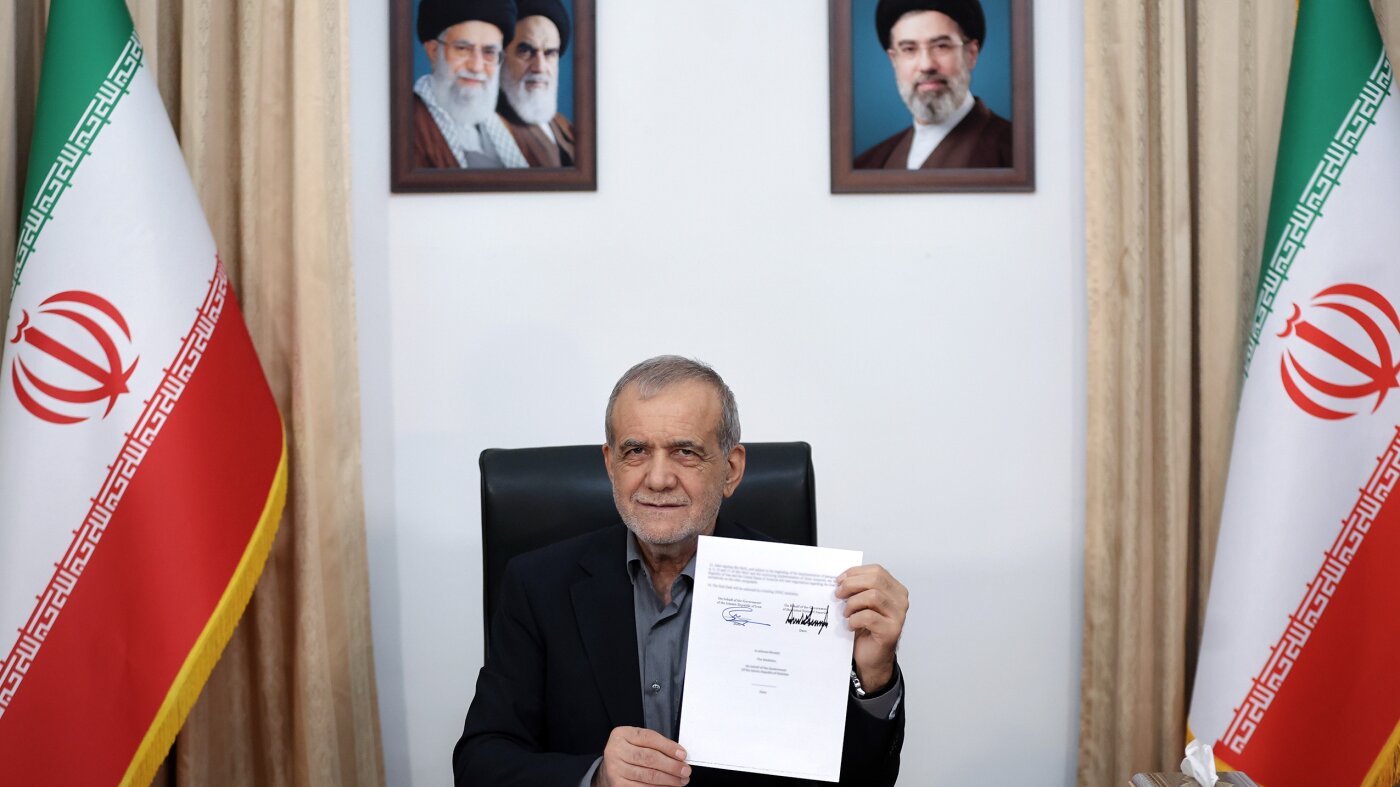

In this photo provided by the Islamic Republic News Agency (IRNA), Iranian President Masoud Pezeshkian displays a memorandum of understanding signed with U.S. President Trump aimed at ending the war and launching negotiations on a broader agreement, in Tehran, Iran, early Thursday.
Iranian Presidency Office via AP
hide caption
toggle caption
Iranian Presidency Office via AP
Vice President JD Vance has delayed his trip to Switzerland to negotiate the terms of a peace agreement with Iran on Friday.
It’s unclear exactly why the talks were called off at the last minute, with hundreds of journalists already waiting in the alpine city of Lucerne.
But the delay raises questions over the sturdiness of the memorandum of understanding to end the war, signed by Trump on Wednesday.
It came as Israel continued to heavily bombard Lebanon, despite the agreement promising to end all military operations, including in Lebanon.
Lebanese media said at least 18 were killed in overnight strikes, and Israeli said four of its soldiers had been killed in fighting in southern Lebanon.
Here are more details about the agreement and challenges they face in this latest effort to end the conflict:
US lifts naval blockade
There was immediate progress after the preliminary agreement to end the three-and-half month conflict that has killed thousands of people across the Middle East, rocked the global economy and pushed millions more into poverty around the world, according to the United Nations.
The United States lifted its naval blockade on Iran.
The short memorandum of understanding also promises to end military operations on all fronts and reopen the Strait of Hormuz, the crucial waterway through which much of the world’s oil, gas and fertilizer must pass to reach global markets.
The agreement prompted President Trump to celebrate on Truth Social writing: “Ships of the World, start your engines. Let the oil flow!”
But there are still many potential pitfalls. Even before the agreement was signed, Trump made its fragility clear: “It’s a memorandum of understanding,” he said at the G7 summit in France. “If I don’t like it, if they don’t behave, we’ll go right back to dropping bombs right smack in the middle of their head.”

The document doesn’t solve the underlying reason for why the United States and Israel went to war with Iran. It creates a 60-day window — extendable by mutual agreement — for the two sides to resolve the enmity that goes back many decades.
Israel remains defiant against the deal
The preliminary agreement promises to end all military operations, including in Lebanon. Israel has invaded and taken large swaths of southern Lebanon in an offensive it says is targeting the Iranian-backed militia Hezbollah, which has killed more than 3,800 people, according to Lebanon’s Health Ministry.
Iranian Foreign Minister Abbas Araghchi has made clear that Iran considers Israel’s withdrawal from southern Lebanon essential. “Without the withdrawal of Israeli forces from the territories they occupied during this war, the war has not fully come to an end,” Araghchi said.
Israel wasn’t involved in the negotiations with Iran — though Trump said at a press conference this week that he had sent Israel a copy of the document before he signed it. Israeli Prime Minister Benjamin Netanyahu has remained defiant, saying his troops will remain in southern Lebanon for as long as Israel’s security requires it.
The conflict in Lebanon is causing an extraordinarily open rift between Trump and Netanyahu. “He’s a very difficult guy,” Trump said of the Israeli prime minister recently said to The New York Times.
On Thursday, Israel’s military released a new map showing an expanded area of southern Lebanon occupied by its troops, which it describes as a buffer zone.
“Trump’s agreement does not bind us,” Israel’s far-right national security minister, Itamar Ben-Gvir, wrote on social media on Monday. “We are not partners to this agreement that does not ensure our security.”
Vice President Vance hit back at critics in the Israeli government, warning at a press conference that “Donald J. Trump is the only head of state in the entire world who is sympathetic to the nation of Israel at this moment in time.”
Trump signed the deal to avoid “economic catastrophe”
The agreement promises “the immediate and permanent termination of military operations on all fronts” — including in Lebanon, where Israel has continued its offensive. Iran and the United States also promise “not to initiate” any further war or operation against each other. Not long after Trump signed the memorandum, U.S. Central Command said Thursday it had ended its naval blockade of ships to and from Iranian ports, as promised in the agreement.

Iranian state media reported the country’s national security council will suspend tolls paid by ships for 60 days, per the deal, but that ships must still request Iran’s permission — through a newly established Persian Gulf Strait Authority, before passing through the Strait of Hormuz, which was once considered an international waterway.

Increased ship traffic through the strait will come as a relief to Trump, whose approval ratings have been sliding as Americans see soaring gasoline prices and spiking inflation. Last month Trump insisted he doesn’t think about Americans’ financial situation in his approach to Iran.
But this week he acknowledged at a news conference that he had signed this agreement because he “didn’t want to see an economic catastrophe.”
The memorandum gives major concessions to Iran
Trump has repeatedly called the Iran nuclear deal — formally known as the Joint Comprehensive Plan of Action (JCPOA) — presided over by President Barack Obama in 2015 the “worst deal ever,” and Trump abandoned the agreement in his first term in office. But the framework agreement signed this week hands major financial concessions to Iran that could ultimately go much further than the Obama-era arrangement.
The document says the U.S. will work with regional partners to create a fund of “at least $300 billion” for Iran’s reconstruction and economic development. Vice President Vance has said Gulf Arab nations would invest that amount.
It also promises that the U.S. will unfreeze Iranian funds and assets that amount potentially to tens of billions of dollars. Mohsen Rezaei, military adviser to Supreme Leader Mojtaba Khamenei, told CNN Iran wants to see the release of $24 billion.

These commitments do depend on further negotiations. But the Trump administration also plans to issue sanction waivers to allow Iran to immediately sell its oil. The waiver concedes a major point of potential leverage at the start of these 60-day talks.
And the interim deal also opens the door to ending all U.S. and international sanctions on Iran. Iran has been under a plethora of U.S. sanctions since the 1979 Revolution. The penalties have kept Iran cut off from the global economy, preventing it, for example, from accessing the international banking sector. This new pledge goes far beyond the JCPOA deal, which removed some sanctions in exchange for Iran reducing its stockpile of uranium.
The negotiation over Iran’s nuclear program
President Trump has boasted he will achieve a much “better” agreement than the JCPOA. The substantive talks on this are yet to begin, but so far, the commitment Iran has made in the memorandum that it “shall not procure or develop nuclear weapons” is the same promise it has made for years, including in the 2015 nuclear accord.
The details of Iran’s nuclear program are complex and technical. The JCPOA was negotiated over years by the U.S., U.K., France, Germany, Russia and China, with nuclear physicists and non-proliferation experts, and ran to 159 pages. Trump’s framework was negotiated bilaterally by Steve Witkoff and Jared Kushner — a property developer and the president’s son-in-law. An Iranian diplomat who spoke to NPR on condition of anonymity because they were not authorized to speak publicly told NPR they believed the last round of talks with the Trump administration did not progress because “the Americans at the table did not understand the subject.”
The U.S. had been negotiating with Iran over its nuclear program before abruptly launching the bombing campaign with Israel on Tehran that began this war on Feb. 28. For this latest round of talks, Witkoff and Kushner visited the national lab in Oak Ridge, Tenn., earlier this month for consultations with a team of technical experts that could play a role in nuclear negotiations with Iran.
Has Iran come out of the war stronger?
Trump began the conflict promising to set conditions for regime change in Iran. “I say tonight that the hour of your freedom is at hand,” he told Iranians in a televised address on Feb. 28. “When we are finished, take over your government. It will be yours to take.”
It was a nightmare scenario for the Iranian regime, to face down the bombardment from two of the world’s most powerful militaries. The war killed more than 3,300 Iranians, according to state media, including top leaders, and pounded the country’s infrastructure and armed forces. But the regime’s survival, and its ability to target U.S. assets in the region and control the Strait of Hormuz, empowered Iran.
The country has learned “that threatening the Strait of Hormuz works,” Bill Cassidy, Republican senator from Louisiana, said in a blistering attack on the Trump administration. He called the offensive against Iran “the worst foreign policy blunder in decades.”
Iran’s response forced the Trump administration to set aside the goal of regime change to focus on seeking a way to reopen the vital strait.
“The only ‘achievement’ of the ceasefire is the likely reopening of the Strait of Hormuz — which was open before the war started. And we will apparently pay Iran to do so,” Antony Blinken, who was secretary of state under former President Joe Biden, posted on X.
Trump has countered critics by saying on social media that anyone who thinks he hasn’t “been tough enough on Iran,” when the stock market is high and oil prices are falling, is either jealous, bad or stupid. And Vance called on critics to “have a little bit of faith in the president of the United States.”
But in a hard accounting of the war, the facts are undeniable: Iran’s closure of the Strait of Hormuz gave it the leverage to secure from Trump concessions that unlock vast sums of money — even more, potentially, than under Obama.
And regarding Iran’s nuclear program, the Iranians so far appear not to have offered Trump any more concessions than they did at the Geneva talks two days before the U.S. and Israel launched their offensive in February.
Now new negotiations are set to begin, and the Iranians will be coming to the table having shown Trump, and the world, the power they can wield over the global economy.
Source link