Tohono O’odham sue DHS over border wall that would divide tribe
WASHINGTON – The Tohono O’odham Nation has filed a lawsuit to stop the Department of Homeland Security from building a border wall across its territory, claiming that would violate tribal sovereignty.
The nation, which straddles 62 miles of Arizona’s border with Mexico, has long opposed construction of a wall on its land.
Tribal leaders say they have long worked with DHS both to secure the border and to identify alternatives to a physical barrier that would cut off thousands of tribal members on either side.
“We have tried to work with the department on the border wall issue, but it insists on rushing forward with construction. We have been left with no other choice but to file suit to protect our land, our culture, and our rights,” Tohono O’odham Nation Chairman Verlon Jose said in a statement Wednesday announcing the lawsuit, which was filed the previous day in the U.S. District Court for the District of Columbia.
Jose highlighted the tribe’s uses of vehicle barriers, technology and personnel in coordination with federal immigration officials.
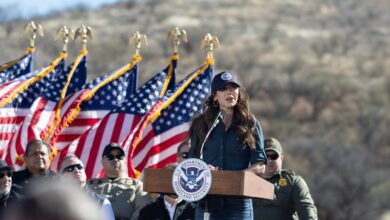
The Trump administration struck a conciliatory tone but made no indication it would back down. The DHS issued a response noting Homeland Security Secretary Markwayne Mullin’s Indigenous heritage.
“Secretary Mullin is a citizen of the Cherokee Nation and made clear during his confirmation hearing that he respects tribal sovereignty,” the statement said. “DHS is committed to ongoing coordination with stakeholders, including tribal nations, throughout planning and construction activities. DHS values its relationship with the Tohono O’odham Nation and remains focused on open communication and minimizing impacts.”
Until about 20 years ago, the federal government focused construction of fencing around urban areas, such as San Diego and El Paso. President Donald Trump made building a border wall a central campaign promise in 2016.
The remote span covered by the Tohono O’odham reservation was relatively low priority, and not a huge magnet for smuggling of drugs or migrants.
The push for a new section of wall across the tribe’s land comes despite the Trump administration’s boasts that illegal border crossings per month have dropped by as much as 95% in the last year.
When Trump signed the Secure America Act on June 10, providing Homeland Security funding through the end of his term, he asserted that his administration has created the “most secure border in history.”
The Tohono O’odham emphasized in its court filings that, thanks in part to its own efforts, border detentions have dropped on tribal land by 95% as well.
The Gadsden Purchase of 1854 placed about half of the tribe’s territory south of the border, without the tribe’s input.
Until the creation of the Border Patrol in 1924, tribal members were able to move freely across the border on tribal land.
The lawsuit notes that thousands of members live on tribal land south of the border, in 17 communities.
“Nation members regularly cross the border at multiple points (with the Department’s knowledge) for important religious, family, and practical reasons,” it says.
The lawsuit asserts that a wall would reduce the tribe’s territory, and offers details about the many measures the tribe has taken to support border security.
Since 1974, the tribe has allowed federal border authorities to operate from permanent installations on its land.
Customs and Border Protection has installed 160-foot towers at 10 sites since 2012 with surveillance cameras, night vision, thermal sensors and ground sweeping radar.
CBP also operates all-terrain pickup trucks on tribal land. Federal authorities maintain vehicle checkpoints on the main highways between the reservation and Phoenix and Tucson.
“In 2006, the Nation agreed to the construction of vehicle barriers and a patrol road along the vast majority of the border, with the exception of those areas where vehicle access is impossible due to mountainous terrain,” the lawsuit says. “The vehicle barriers have eliminated unauthorized vehicle transit across the border. More generally, the measures that the Nation and Border Patrol have put in place on the Reservation have proven to be highly effective in preventing, deterring, and intercepting illegal crossings and smuggling within the Reservation.”
The chairman called the lawsuit a last resort.
“We would prefer to be using our precious resources to improve the lives of our Nation members,” he said.
At a 2024 congressional hearing on cartel operations in Indian country, Jose cited the $3 million in funds the tribe spends annually on border security.
“Working in concert with CBP, our own Tohono O’odham law enforcement officers are regularly involved in drug interdiction and immigrant apprehension actions,” he testified. “We have supported CBP efforts on our reservation by providing lands for a checkpoint, forward operating bases, and integrated fixed towers to facilitate critical electronic surveillance efforts.”
In its lawsuit, the tribe told the court it has taken such measures in part to preclude the need for a wall.
“We are hopeful that DHS will reconsider moving forward with a border wall and instead implement modern border protection measures,” Jose said. “But if they insist on an illegal wall, we will stand up for what is right.”
The nation, which straddles 62 miles of Arizona’s border with Mexico, has long opposed construction of a wall on its land.
Tribal leaders say they have long worked with DHS both to secure the border and to identify alternatives to a physical barrier that would cut off thousands of tribal members on either side.
“We have tried to work with the department on the border wall issue, but it insists on rushing forward with construction. We have been left with no other choice but to file suit to protect our land, our culture, and our rights,” Tohono O’odham Nation Chairman Verlon Jose said in a statement Wednesday announcing the lawsuit, which was filed the previous day in the U.S. District Court for the District of Columbia.
Jose highlighted the tribe’s uses of vehicle barriers, technology and personnel in coordination with federal immigration officials.
The Trump administration struck a conciliatory tone but made no indication it would back down. The DHS issued a response noting Homeland Security Secretary Markwayne Mullin’s Indigenous heritage.
“Secretary Mullin is a citizen of the Cherokee Nation and made clear during his confirmation hearing that he respects tribal sovereignty,” the statement said. “DHS is committed to ongoing coordination with stakeholders, including tribal nations, throughout planning and construction activities. DHS values its relationship with the Tohono O’odham Nation and remains focused on open communication and minimizing impacts.”
Until about 20 years ago, the federal government focused construction of fencing around urban areas such as San Diego and El Paso. President Donald Trump made building a border wall a central campaign promise in 2016.
The remote span covered by the Tohono O’odham reservation was relatively low priority, and not a huge magnet for smuggling of drugs or migrants.
The push for a new section of wall across the tribe’s land comes despite the Trump administration’s boasts that illegal border crossings per month have dropped by as much as 95% in the last year.
When Trump signed the Secure America Act on June 10, providing homeland security funding through the end of his term, he asserted that his administration has created the “most secure border in history.”
The Tohono O’odham emphasized in its court filings that, thanks in part to its own efforts, border detentions have dropped on tribal land by 95%, as well.
The Gadsden Purchase of 1854 placed about half of the tribe’s territory south of the border, without the tribe’s input.
Until the creation of the Border Patrol in 1924, tribal members were able to move freely across the border on tribal land.
The lawsuit notes that thousands of members live on tribal land south of the border, in 17 communities.
“Nation members regularly cross the border at multiple points (with the Department’s knowledge) for important religious, family, and practical reasons,” it says.
The lawsuit asserts that a wall would reduce the tribe’s territory, and offers details about the many measures the tribe has taken to support border security.
Since 1974, the tribe has allowed federal border authorities to operate from permanent installations on its land.
Customs and Border Protection has installed 160-foot towers at 10 sites since 2012 with surveillance cameras, night vision, thermal sensors and ground sweeping radar.
CBP also operates all-terrain pickup trucks on tribal land. Federal authorities maintain vehicle checkpoints on the main highways between the reservation and Phoenix and Tucson.
“In 2006, the Nation agreed to the construction of vehicle barriers and a patrol road along the vast majority of the border, with the exception of those areas where vehicle access is impossible due to mountainous terrain,” the lawsuit says. “The vehicle barriers have eliminated unauthorized vehicle transit across the border. More generally, the measures that the Nation and Border Patrol have put in place on the Reservation have proven to be highly effective in preventing, deterring, and intercepting illegal crossings and smuggling within the Reservation.”
The chairman called the lawsuit a last resort.
“We would prefer to be using our precious resources to improve the lives of our Nation members,” he said.
At a 2024 congressional hearing on cartel operations in Indian country, Jose cited the $3 million in funds the tribe spends annually on border security.
“Working in concert with CBP, our own Tohono O’odham law enforcement officers are regularly involved in drug interdiction and immigrant apprehension actions,” he testified. “We have supported CBP efforts on our reservation by providing lands for a checkpoint, forward operating bases, and integrated fixed towers to facilitate critical electronic surveillance efforts.”
In its lawsuit, the tribe told the court it has taken such measures in part to preclude the need for a wall.
“We are hopeful that DHS will reconsider moving forward with a border wall and instead implement modern border protection measures,” Jose said. “But if they insist on an illegal wall, we will stand up for what is right.”
Related

Source link