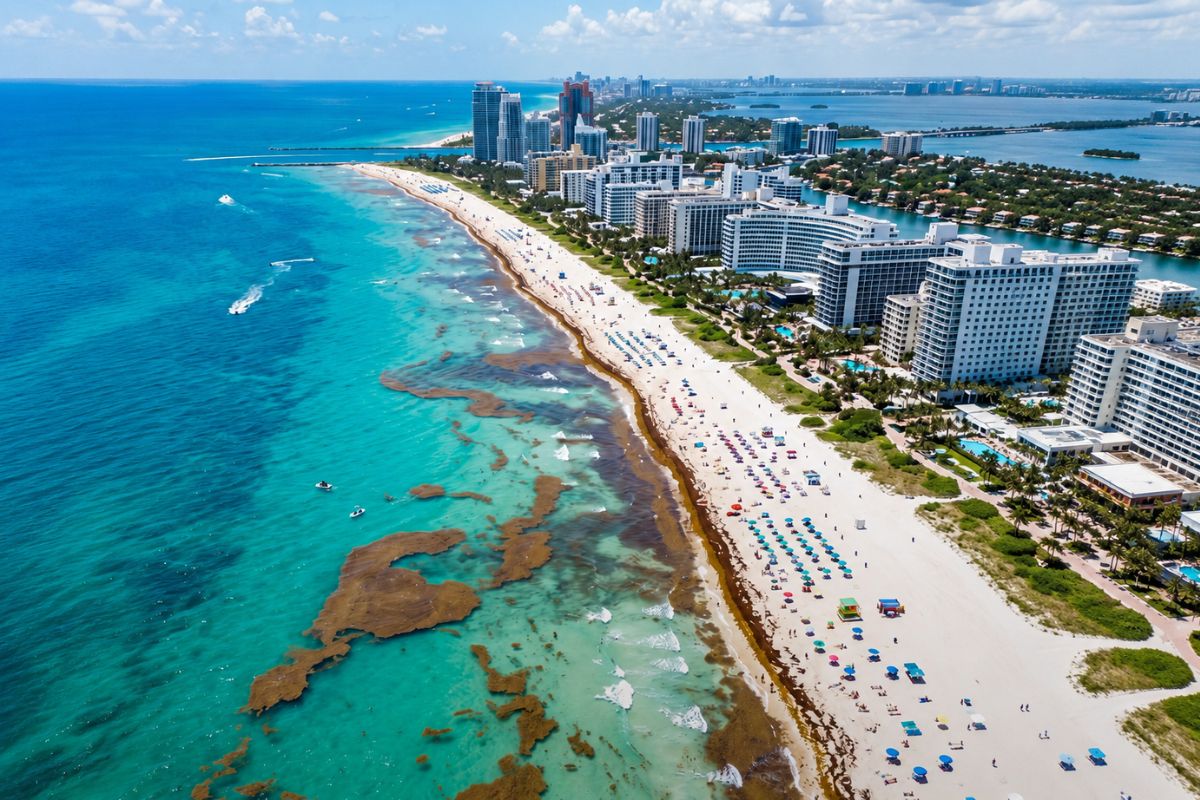
Miami Beaches are bracing for the worst Sargassum season ever
Scientists are sounding the alarm now that biomass is increasing by 31%!
South Florida’s coastline is facing what researchers are calling an unprecedented environmental and economic crisis. Scientists warn that 2026 is on track to be the worst sargassum season everwith projections suggesting seaweed levels could even exceed 2025 historic highs.
In January, NASA satellites discovered a quantity of sargassum greater than any previously recorded January in history. By March, biomass within the Greater Atlantic Sargassum Belt had reached its peak 19.6 million tonnes – an increase of 31% compared to the same period in 2025when the annual total over the tropical Atlantic Ocean reached 50 million tons, according to data from The University of South Florida Optical Oceanography Laboratory.
Dr. Chuanmin Hu, a professor of oceanography at the University of South Florida and a pioneer of satellite monitoring of the phenomenon, offered a stark assessment. “As a scientist, it is disturbing to see how we have recorded more and more historical data over the past two or three years,” he told CBS Miami. He was equally direct about the limits of intervention: “No one can stop the enormous amount of sargassum in the ocean. All we can do is prepare.”
Tourism dollars are at risk when coastlines turn brown
The effects are already visible along Miami’s iconic coastline. Last week, three tractors spent more than an hour raking the beach at South Pointe Park in Miami Beach as beachgoers navigated dense piles of seaweed that turned the shoreline water a murky brown. At Crandon Park Beach, a commercial film crew was forced to move cameras to remove mounds of sargassum from their footage.
Miami-Dade County taxpayers spend nearly $4 million annually to remove algae from about 17 miles of public beaches – a cost that has steadily risen since systematic cleanups began in 2019. The deeper economic toll, however, is much greater. Di Jin, a scientist at the Woods Hole Oceanographic Institute Ocean Discovery Center estimates that Florida’s tourism and fishing industries absorb approximately 20% of the total amount of water $2.7 billion in losseswith total projected statewide economic damage potentially reaching $10 billion by 2026.

The reputational damage increases the financial pressure. Brena Watson, a traveler from St. Louis who had been considering a beach vacation in Miami, told reporters she was now weighing Las Vegas or New York. “We don’t need that in our lives. A beach holiday should be clean, beautiful and enjoyable,” she said.
A health hazard that goes beyond the smell
The crisis extends beyond aesthetics and economics. When sargassum decomposes in tropical heat on the coast, it is released hydrogen sulfide (H₂S) — a colorless, poisonous gas recognizable by the smell of rotten eggs. Research published in Harmful algae discovered that in early 2026 cleaning workers in the Mexican Caribbean were exposed to H₂S concentrations that peaked at 50.8 parts per million during the 2025 season, with nearly half of all measurements exceeding the Mexican occupational safety standard of 1 ppm.
The US Environmental Protection Agency has documented thousands of cases of acute exposure in the Caribbean and points to an increased risk for people with asthma, the elderly, pregnant women and infants. The seaweed also bioaccumulates heavy metals, including arsenic, raising further concerns about coastal food chains.
Climate change and nutrient runoff stimulate flowering
Experts attribute the accelerating crisis to a convergence of factors: the drainage of nutrients from the Amazon, changing ocean currents and warming of the sea surface linked to climate change – all of which are creating increasingly favorable conditions for sargassum growth. The NOAA classifies pelagic sargassum as critical habitat for sea turtles and other marine species, meaning the seaweed cannot be legally removed before it has already washed ashore, limiting the time for preventative action.
The phenomenon is not limited to Florida. In 2025, eastern Cuba issued a maximum public health warning as sargassum flooded the beaches. This year, the entire Caribbean basin is following the same trajectory – with South Florida once again directly in its path.