Hannah Dreier on wildfire fighters and deadly smoke risks they face
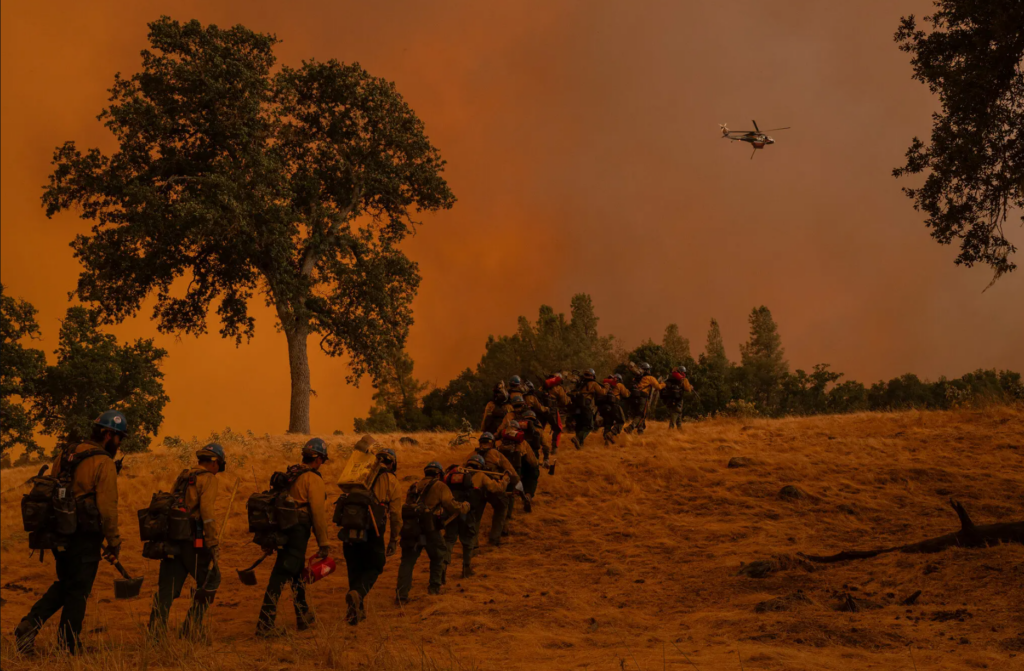
The New York Times investigation that led to major legislation compensating wildfire fighters who had worked for years in toxic smoke and developed cancer and other debilitating illnesses began with a reporter’s observation: They weren’t wearing masks.
That led Hannah Dreier down a monthslong reporting journey as she conducted more than 400 interviews, made public records requests to eight government agencies, analyzed thousands of pages of medical and service records and created a database of every national wildfire fighting crew deployment over two decades.
Following the publication of Dreier’s series, “Exposed and Expendable,” Congress passed legislation requiring the government pay $450,000, tax-free, to federal wildland firefighters who become disabled or die from smoke-related cancers. The U.S. Forest Service also began providing masks to firefighters battling large fires.
For her reporting and impact, Dreier was awarded the 2026 Goldsmith Prize for Investigative Reporting from the Shorenstein Center on Media, Politics and Public Policy, where The Journalist’s Resource is housed.
I recently spoke with Dreier for an hourlong, behind-the-scenes look at how this investigation came together. Watch the full video below and keep reading for five tips pulled from our conversation.
1. Simple questions can lead to big stories.
Back in the Times newsroom following maternity leave, Dreier noticed maskless firefighters on TV news coverage of the 2025 Los Angeles wildfires, despite official health guidance recommending that the public use masks or respirators.
Her question? Why.
“I thought that it might be worth looking into,” she said. “Why that was — why are firefighters out there with no protection? And what might the health risks be?”
Dreier expected a quick answer. Then she learned that Canada, Australia and Greece give wildfire fighters respirator masks with replaceable filters. Firefighters in countries using masks were not suffering from increased heatstroke, one reason the Forest Service gave Dreier for why they didn’t offer masks.
“Getting to that point took a while,” she said of confirming that other countries provide masks. “But once we figured that out, I thought, ‘This has got to be a bigger story.’”
Forest Service researchers had recommended the agency provide masks because of the negative health effects from smoke, she reported. Still, wildfire fighters in the U.S. were continuing to inhale poisons without protection. In fact, Forest Service wildfire fighters were “not allowed to wear masks on the front line, even if they want to,” Dreier wrote.
And the agency, which employs most wildfire fighters in the country, was in a media lockdown. No one there would help her connect with firefighters.
“I couldn’t get any access through the agency,” she said. “I realized I had to basically go out and just start meeting people where they worked.”
That meant going into wildfires herself to interview firefighters. That was possible thanks to a law in California that gives members of the press access to emergency areas.
2. Recast abstractions so they’re familiar to a broader audience.
Many Americans viewed the Los Angeles wildfires through images seen on T.V. news, as Dreier initially did. Those images, though arresting, were far away. For most, the wildfires were an abstraction being fought by anonymous men and women.
The investigation turned out to be a climate change story, Dreier said, with fires becoming more intense and fire season lasting longer as Earth warms.
It was also a workplace safety story, with many wildfire fighters loving the work despite facing immediate and long-term dangers and having limited other employment options.
Those two angles, climate change and workplace safety, gave the story heft and resonance that fleeting images on TV news couldn’t convey.
“The people doing this work are really proud, and it’s incredibly brave, important work,” Dreier said. “They also, to me, seem like people without a lot of options and who were pretty disempowered. These are basically kids who are not going to know what the chemical composition of smoke is unless their employer is telling them. And in this case, they just were not being told anything.”
She added:
“When I started talking to sick firefighters and they started telling me that even though they had severe lung damage, or even though they, you know, maybe had had a cancer diagnosis and were in remission, they were going to go back to the job because they needed the money. That’s when I realized how much this was really sort of a socioeconomic story in addition to everything else.”
3. Meeting sources where they are conveys authenticity.
It wasn’t easy for Dreier to build rapport with firefighters inside the wildfires.
They’d joke that if they talked to the press they’d have to buy the whole crew a beer, she said. She heard it over and over. But Dreier didn’t take the joke to mean the firefighters wouldn’t talk to her — just that they wouldn’t talk in front of their crew. So she’d try to get their phone numbers, then reach them when they were back at their camps.
“That was really helpful because it allowed me to have these more intimate conversations over the phone,” Dreier said. “I think people also respected that we had bothered to go all the way out to an active wildfire and been in this risky situation together.”
4. Intimate narratives enhance data and documents.
One of the first records requests Dreier put in was for national crew deployment data over two decades from the Forest Service. The agency refused. So Dreier went to the Interior Department instead, which had the same data and provided it.
“We needed to know who’s fighting fires,” Dreier said. “We needed to know, how often are they going out there? Just to get the universe of how many wildfire workers are there, and to be able to say that the reliance on contract crews has been skyrocketing.”
That led Dreier to Luis Martinez, an undocumented immigrant and contract firefighter facing cancer without health insurance while raising his 11-year-old son. Dreier was struck by Martinez’ story — by his dedication to the work and to his son, she said.
“You’re basically auditioning characters,” Dreier said of meeting sources. “You’re looking for the people who are going to be able to anchor a whole story. Part of what I’m doing is also keeping a running list of people who I think might be a main character.”
5. When you’re ready to publish, think about how to bring your reporting to the communities your sources are part of.
It’s common for wildfire fighters to take videos of themselves with billowing smoke in the background. The firefighters are usually young men on two-week deployments, Dreier said. The videos they make are one way they pass their downtime. Back at camp, they upload them to social media.
“They’re taking these videos of themselves with all this black smoke behind them, and they’re just taking it for fun,” Dreier said. “For me, I’m like, that is a documentation of an occupational hazard.”
The Times put together features explaining Dreier’s reporting that were made for social media platforms — mostly TikTok and Instagram — where firefighters virtually gather.
“People risked their careers, really, to talk to us and to go on the record,” Dreier said. “I wanted to do everything we could to make sure that this was also going back into that community.”