Case-Shiller: Home values decline in real terms for the 11th month in a row

House prices rose just 0.8 percent in April, but Case-Shiller data show values fell for the 11th month in a row in real terms as inflation outpaced growth.
U.S. home prices rose just 0.8 percent year over year in April, according to the S&P Cotality Case-Shiller National Home Price Index. It’s a figure that sounds like growth, but functions as stagnation once inflation is taken into account.
That’s because April was the eleventh month in a row in which house prices fell in real terms, with inflation of 3.8 percent roughly three percentage points higher than nominal price increases. The national index rose only slightly from the annual pace of 0.7 percent in March, extending a period in which the housing market was treading water instead of building wealth.
A grim regional price distribution
The regional split tells the sharper story. Chicago posted the strongest annual gains of the 20 cities tracked, up 6.5 percent, followed by New York with 3.8 percent and Cleveland with 3.2 percent.
Seattle was the weakest market, down 2.3 percent year-over-year, while Denver, Tampa, Dallas and Phoenix all posted declines between 1.6 percent and 1.9 percent.
That’s a difference of almost nine percentage points between the best and worst performing metropolises in one month, a difference that has become the norm rather than the exception.
‘Geographical spread remains pronounced’ said Nicholas Godechead of fixed income tradable bonds and commodities at S&P Dow Jones Indices. “Midwest and Northeast markets continue to show moderate growth, while many Sun Belt and Western metros see continued declines.”
The pattern is maintained across the wider composites.
The 10-City Composite rose 1.8 percent annually, up from 1.5 percent in March, while the 20-City Composite rose 1.1 percent, up from 0.9 percent. Both remain well below the pace needed to avoid inflation.
Month by month, the picture becomes murkier, depending on which adaptation you read. On a non-seasonally adjusted basis, the National Index rose 0.8 percent from March, reflecting the market’s typical spring rebound.
However, excluding seasonal effects, the National Index actually fell 0.1 percent, while the 20-City Composite was essentially flat at -0.04 percent.
Godec pointed to the six-month trend as the most useful signal. Over the past six months there has been a national increase of 1.35 percent, offsetting a decline of 0.5 percent in the previous six months.
“This represents a modest change in direction, but remains limited in the context of rising costs,” Godec said.
Higher rates keep price growth in check
Mortgage rates do a lot of the work to keep that shift modest.
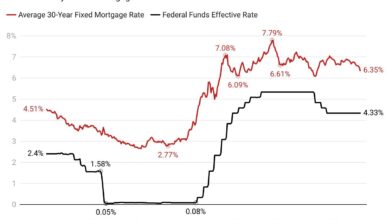
After falling below 6 percent earlier this year, the 30-year yield climbed back to 6.3 percent in April, Godec said, keeping borrowing costs high enough to limit price growth even in markets with real demand.
“In this environment of higher interest rates, house price growth remains subdued, with the housing market largely treading water in nominal terms and declining in real terms,” Godec said.
A separate release from the Federal Housing Finance AgencyData on purchases alone from Fannie Mae and Freddie Mac show that prices actually fell 0.1 percent month-over-month in April, although they were still 2 percent higher than a year earlier.
FHFA’s data showed even greater regional divisions than Case-Shiller’s.
Seasonally adjusted monthly changes ranged from -0.8 percent in the Mountain division to +1.0 percent in New England, while twelve-month changes ranged from +0.2 percent in the Pacific division to +4.4 percent in the East North Central division.
FHFA’s next report, covering May data, will be released on July 28.
Email Nick Pipitone