Army detonates nearly five tons of lead-based explosives in Iowa : NPR
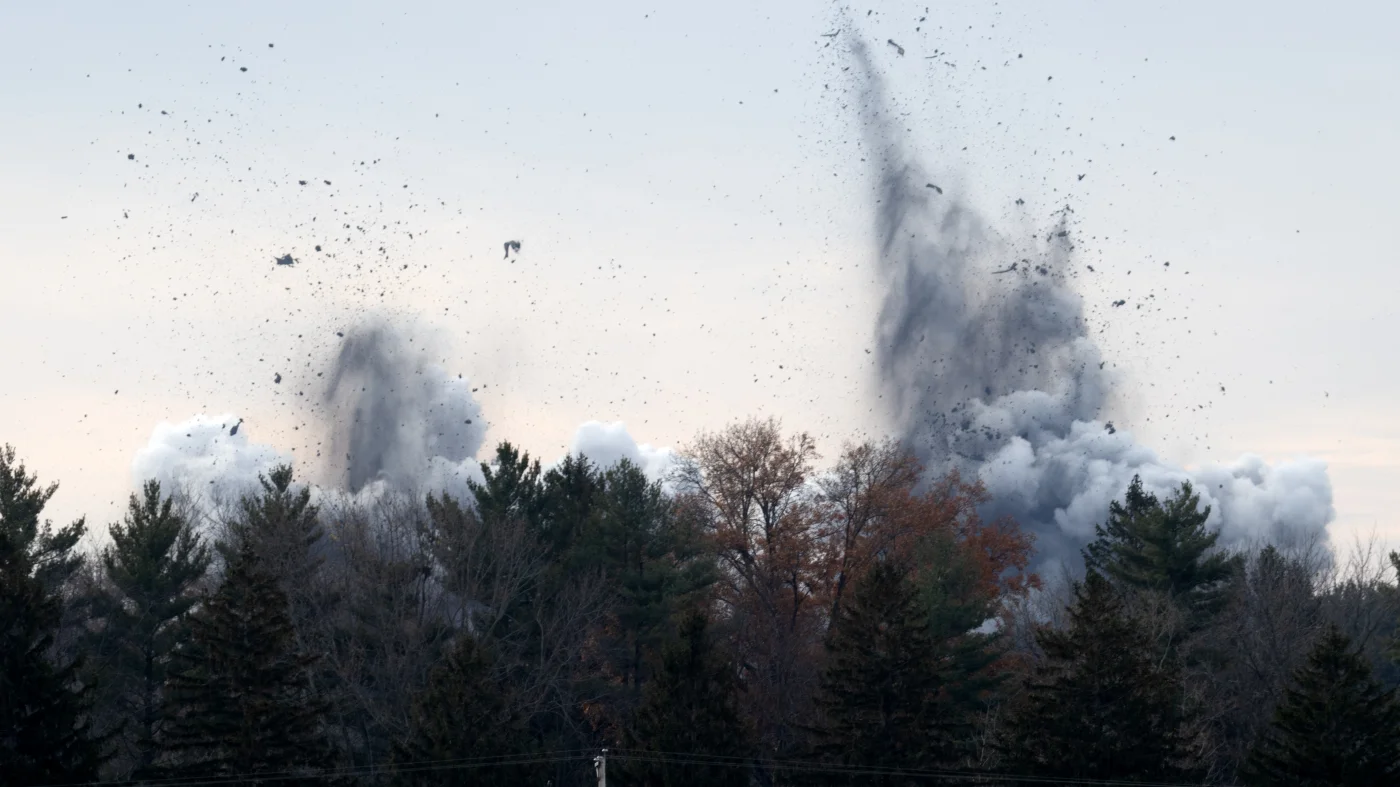

Debris flies into the air after the Army detonated several tons of highly-volatile, degraded lead azide on the grounds of the Iowa Army Ammunition Plant on Wednesday in Middletown, Iowa. The detonation was delayed several times due to concerns of environmental and health impacts.
Scott Olson/Getty Images
hide caption
Scott Olson/Getty Images
The controlled detonation of more than 60 barrels — roughly five tons — of unstable lead azide at the Iowa Army Ammunition Plant in Middletown, Iowa is complete.
The U.S. Army set off the huge explosion in Middletown, Iowa on Wednesday in a bid to dispose of the lead azide, an explosive the military has used since World War I.
“Initial analysis shared with us by federal partners and Iowa Homeland Security and Emergency Management indicates that the mitigation measures appear to have been successful and the explosion was well-contained. Our state agencies will continue monitoring efforts,” Missouri Governor Mike Kehoe posted on X.
The initial detonation was scheduled last Friday, but was changed three times since due to lawsuits by environmental groups to block the detonation.
Some residents have voluntarily evacuated. FEMA has called on residents within the 20 miles southwest of the plant to stay indoors with windows closed to avoid airborne lead dust, noise and vibration.
According to Centers for Disease Control and Prevention, children and those pregnant face the biggest danger from the explosion as there is no safe level of lead exposure whether it is airborne or accumulates as dust on surfaces.
The Army says the lead azide, which is used to ignite munitions, had been stored for decades at the Middletown plant. The crystals formed at some point in recent years inside the containers where they were stored. This change makes lead azide acutely sensitive to movement and changes in temperature.
At a press briefing on Tuesday administration officials said the possibility of a chemical treatment was ruled out. The munitions had degraded to the point where it was too dangerous to move them, or even open their containers without risk of an accidental detonation.
Iowa Public Radio compiled maps and information released by the U.S. Army on Tuesday, showing areas in southeast Iowa and northern Missouri may be affected by the planned explosion.
The Iowa National Guard has deployed 100 soldiers to support local efforts and federal agencies with community outreach to 150 households, according to a statement issued by Iowa’s Governor Kim Reynolds.

A warning sign at a local Casey’s gas station informs patrons of its adjusted hours due to the planned detonation of a stockpile of lead azide at the nearby Iowa Army Ammunition Plant in Middletown, Iowa, Wednesday, Nov. 25, 2026.
Austin Johnson/AP
hide caption
Austin Johnson/AP
Plans to detonate the unstable chemicals have rattled Iowans who were only told about the planned explosion at the plant last week.
Professor Andew Whelton at Purdue University, who has done environmental disaster planning, including for the U.S. Army told NPR that the timing “should have been planned better.””Because that didn’t happen, because the messaging was just so poor, you had anxiety, you had stress, you had businesses planning to shut down,” he said. “Some farmers have said ‘we cannot bring all of our cattle. We do not have the facilities for that,” Whelton added.
FEMA said they were reaching out directly to homes in the area most at risk to offer evacuation help. NPR’s reporters called the FEMA hotline and were eventually told it would take several hours for a callback about evacuation help.
Trump administration officials say the detonation is the only safe way to dispose of the thousands of pounds of ordinance that was moved to a bunker in Iowa 17 years ago. In March, authorities determined that the substance had gotten too unstable to move, setting the Army and other agencies in a race for time to destroy the unstable chemicals at risk of explosion.
On Tuesday, the acting Army Secretary and leaders of FEMA and the ATF pushed back on the notion that this is a surprise. They pointed out they have been holding town-hall meetings, but they admitted that the timing of the explosion has been a moving target.
At first, the U.S. military says it was trying a non-explosive way to neutralize the materiel, then working to build berms and other counter-measures all while monitoring the weather conditions and the growing risk of an uncontrolled explosion.
Tom Croci, an official with the Environmental Protection Agency said the agencies focused on setting “the right parameters with the Army to make sure that a supervised controlled detonation was happening in the most optimal environment and at the most optimal timing.””So that was some of the back and forth to make sure that we had that right,” he added.
Whelton of Purdue University said he was concerned about follow-through with the toxic sampling, and the clean up and remediation that disasters like this really need.
Whelton said the government does not have a great track record with the long term effects of toxic exposure, referencing examples like the chemical spill in East Palestine and the clean-up or the Los Angeles wild fires.
Two Iowa environmental groups sued to block the blast. President Donald Trump told the Army on Monday to wait for court approval and sign-off by Iowa Democrat Governor-elect Rob Sand, who Trump said he would blame if anything went wrong. However, a federal appeals court cleared the way for the blast Monday.
Source link