How epic wildlife migrations are being hit by development and climate change : NPR
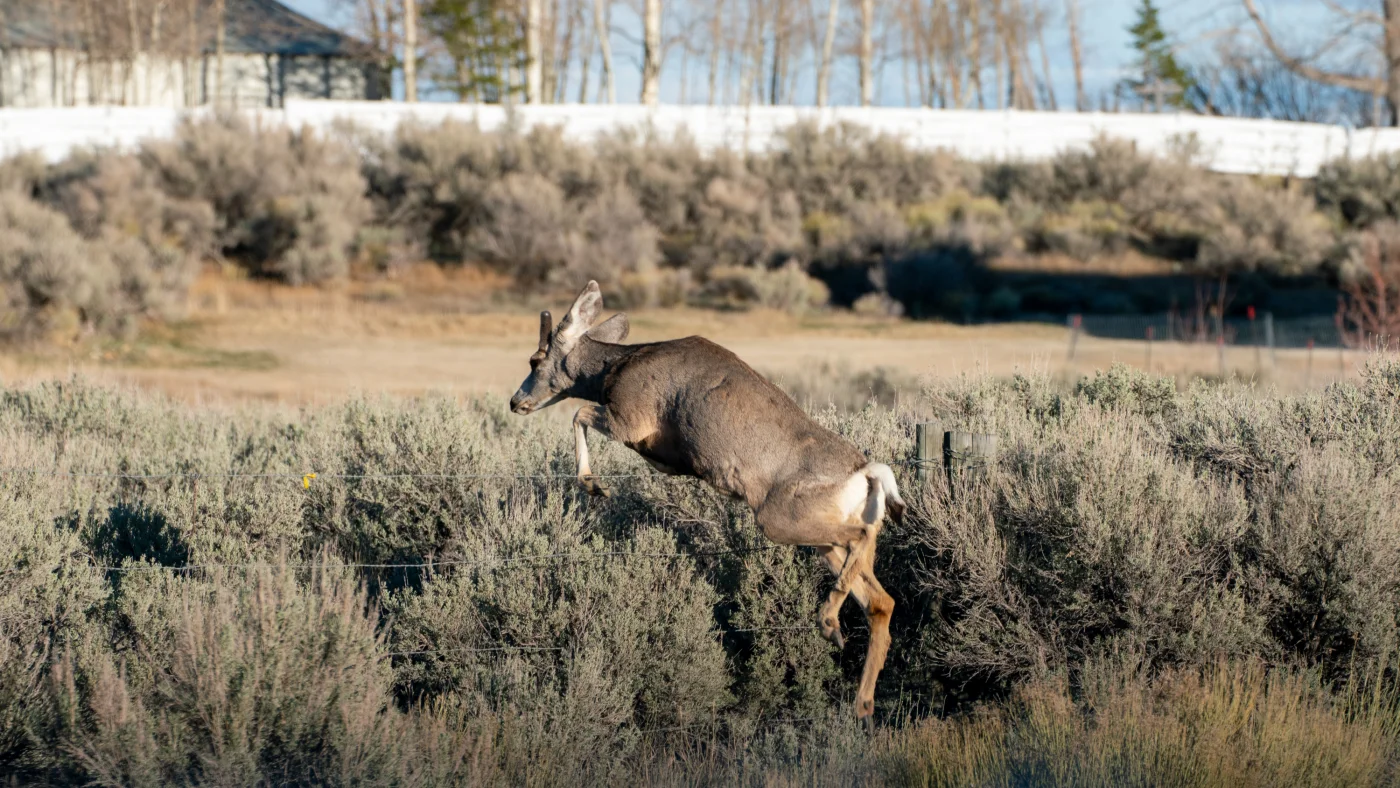

A mule deer jumps over a barbed wire fence in Pinedale, Wyoming. Roads, fences and buildings are making it more difficult for migratory species like mule deer to adapt to unpredictable seasons as the climate gets warmer.
Ryan Kellman/NPR
hide caption
Ryan Kellman/NPR
On a spring morning, a mule deer and her fawn follow a well-worn trail through the Wyoming sagebrush. They’re on a 150-mile journey, one of the longest land migrations in the lower 48 states.
Like many other migrations in the U.S., the mule deer’s epic journey is hidden in plain sight. Mule deer move in small groups instead of large herds, following pathways likely used for millennia. They’re part of the Greater Yellowstone Ecosystem in western Wyoming, a place where elk, deer and pronghorn antelope still have the space to move across vast landscapes.
They migrate with careful seasonal choreography, timed to reach the best feeding grounds in summer and avoid the harshest winter weather. Still, as the climate gets hotter, that timing is being tested.
Droughts are getting more intense in the Western U.S., limiting the food supplies for deer. Their migrations are also being constricted by development, forcing them to navigate a complex maze of fences, roads and subdivisions. Research shows mule deer may be able to adapt to increasingly unpredictable seasons, but development is limiting that ability.
Wyoming is working to keep migration routes from being severed. It’s one of the few states that has protected migratory corridors for wildlife, restricting development in the most crucial paths. Landowners and conservation groups are also permanently preserving open lands and working ranches.
The question is whether that work can keep pace with growth. Wyoming’s migratory wildlife are on the decline. The state’s mule deer population was more than 500,000 in 1990. It’s now half of that number.
“The history of wildlife migration is one of loss – we’ve lost migrations around the world,” says Matt Kauffman, wildlife biologist with the U.S. Geological Survey and the University of Wyoming. “We are in this little race to map the migrations and figure out what tools we need to keep those landscapes open, as the American West continues to change.”

Matthew Kauffman and Ashley Townsend of the Wyoming Migration Initiative check a motion capture trail camera. Their research has revealed how deer carefully follow the first bloom of spring as it moves across the landscape, so they can eat the most tender plants.
Ryan Kellman/NPR
hide caption
Ryan Kellman/NPR
On the path of mule deer
In the foothills outside Pinedale, Wyoming, Kauffman and research associate Ashley Townsend make their way through the sagebrush, scanning for a radio signal. They pick one up – a beep, beep, beep – from a mule deer with a tracking collar, which the team put on months earlier.
“This was a fawn, a nine-month-old fawn that we caught on winter range,” Kauffman says, scanning the horizon.
This year, Kauffman and his colleagues tracked the spring migrations of about 100 mule deer with GPS collars. It’s part of the Wyoming Migration Initiative, a multi-year project run by the University of Wyoming, that has revealed migration routes in unprecedented detail. The deer make far more arduous journeys than once thought, crossing highways, rushing streams and ice-covered lakes. One mule deer set a record, migrating more than 240 miles one way.
Kauffman says for mule deer, the need to migrate is hard-wired. This herd these deer are part of spends summers in the mountains south of Grand Teton National Park, where the food supply is ample. But deep snow in the winter makes it impossible to stay, so the deer migrate south to Wyoming’s Red Desert. There, the deer have very little to eat.


Ashley Townsend searches for the signal from a mule deer’s tracking collar. The fawn was on the spring migration, but the signal showed it had stopped moving. All that remains is the collar and some bones and fur.
Ryan Kellman/NPR
hide caption
Ryan Kellman/NPR
“These animals are basically coming out of, if not starving, losing fat all winter,” he says. “They come into it with a lot of fat and they’re burning those fat stores all through winter. At the end, animals are always in their worst shape.”
In the spring, the deer set off to find food, but long-distance migration comes with risks, like for the fawn Kauffman has been tracking. The signal from the tracking collar shows it hasn’t been moving, a sign that the fawn may have died.
After homing in on the tracking signal for about 10 minutes, the team finds the collar on the ground, next to a few bones left by scavengers.
“She probably started migrating a few weeks ago from the desert, but yeah, she didn’t make it,” Kauffman says.
In years with harsh conditions, thousands of deer can die in Wyoming, which was seen in 2022-23, when a severe winter brought cold temperatures and heavy snowfall. Drought can also take a heavy toll on the population. The best insurance deer have against tough years is to build up fat reserves by eating as much as possible.
“The fatter animals survive the harsh winters better,” Kauffman says. “The fatter animals survive the dry summers better. Fat is really the currency of life and of reproduction.”

Mule deer are hit by cars and trucks more often than any other species in Wyoming. Roughly 7,600 vehicle collisions with wildlife are documented every year in the state.
Ryan Kellman/NPR
hide caption
Ryan Kellman/NPR
Surfing the green wave
In their quest to bulk up, migration can give deer an edge, because underfoot is the best possible food – the young plants and grasses that emerge after the snow melts.
These tender shoots are protein-rich and have little fiber, so they’re easy for deer to digest.
“It’s like this sort of spring salad mix,” Kauffman says. “We like the spring salad mix because it’s nutritious. It’s sort of sweet, easy. And that’s the same thing that mule deer like.”
The land begins to green up at lower elevations and, over weeks, spreads to higher elevations where the snow melts later. The deer follow this progression of green closely to eat the best food, what Kauffman says is known as “surfing the green wave.”
“I like to say they’re choreographing their movements,” he says. “If you’re ahead of the wave, you move less quickly and let the wave catch you. And if they’re behind the wave, they move more quickly to catch it.”

Pronghorn antelope populations are also declining in Wyoming. Pronghorn can run up to 60 miles per hour, making them the fastest land mammal in North America.
Ryan Kellman/NPR
hide caption
Ryan Kellman/NPR
Some years, following this spring green-up is trickier for deer. Kauffman says in drought years, the green wave doesn’t last as long, or it can be spotty, making it hard to find. Droughts in the Western U.S. are getting more intense as the climate gets hotter.
Kauffman says mule deer have the flexibility to adapt to shifting green waves, even as climate change makes them less predictable. But another challenge may be holding them back.

Left: Outside of Pinedale, overpasses and underpasses have been constructed to help migrating wildlife safely cross the highway. There’s evidence these migration routes have been used for thousands of years. Right: Housing and other kinds of development represent another obstacle on the migration path.
Ryan Kellman/NPR
hide caption
Ryan Kellman/NPR
An obstacle course of development
“So this is a bottleneck, because just over that ridge are the subdivisions,” Kauffman says, pointing to where newer homes were recently built in Pinedale. The bottleneck is a narrow strip of land where 5,000 mule deer must pass between buildings and fences.
Throughout their migration, deer navigate a maze of development. There’s evidence that some routes in Wyoming have been used by wildlife for thousands of years, which were well-known by Native American tribes. As European settlers moved in, roads and fences crisscrossed the landscape and growing communities constricted the paths. Mule deer are often wary of human infrastructure, which changes their behavior during migration.
“They hold up and then eventually race through the developed portion,” Kauffman says. That hesitation can make it harder to stay with the spring green-up, something his team observed when they tracked a group of mule deer approaching a natural gas development.

Both housing development and oil and gas projects are growing within Wyoming’s wildlife migration routes. “The challenge of sustaining these migrations is figuring out how to keep these landscapes stitched together, so we don’t create this obstacle course that is too difficult for animals,” Kauffman says.
Ryan Kellman/NPR
hide caption
Ryan Kellman/NPR
“They held up at the edge of the gas field, and then the green wave passed them by,” he says. “And then eventually they sped through the development but were basically mismatched with the green wave after that point.”
Kauffman says development makes mule deer less flexible at a time when a changing climate requires them to be more flexible.
“We need to just make their migrations less difficult,” he says. “We need to remove obstacles so that they have the best chance to match their seasonal movements with whatever climate change comes at them with.”

Wyoming has protected one migratory wildlife corridor for pronghorn antelope, as well as three for mule deer. Development is not allowed in the most tightly constricted areas, but is allowed with consultation from wildlife officials in other parts of the route.
Ryan Kellman/NPR
hide caption
Ryan Kellman/NPR
Protecting ranchland from development
To keep migration routes open, Wyoming is working with landowners like rancher Maggie Miller.
“I’ve never seen a winter, spring like this, never ever,” she says, walking near her ranchland outside of Pinedale. The snow has already melted during an extremely warm spring. “I have never been up here with bare ground in April.”
Miller has run Grindstone Cattle Company for 27 years, which has been in her husband’s family since the 1800s. She’s watched as small towns like Pinedale have grown and expanded over the years. So, she started looking for ways to preserve her land.

Right: Rancher Maggie Miller put conservation protections on some of her land, preventing future development. “To be able to preserve this land is to keep it as it is – wild,” she says. “You don’t see these places anymore.” Left: A deer walks between a road and a cluster of buildings.
Ryan Kellman/NPR
hide caption
Ryan Kellman/NPR
“I don’t ever feel that I own this or I own that,” she says. “I feel it belongs to the wildlife and it’s just one of those last special places.”
She protected some of her land from future development with a conservation easement. Along with a nearby ranch, Miller sold the land’s development rights to the Wyoming Stock Growers Land Trust, a restriction that prevents development if the 19,000 acres are ever sold.
Miller also started thinking about the miles of fenceline that cross her property, which can slow down wildlife or can even be deadly. Deer can get caught and entangled in the barbed wire.

Wildlife-friendly fences have a smooth bottom wire, as well as space for wildlife to go under safely. The top railing is also highly visible for species that jump over. “We have far more demand than we have funding available to complete this work,” says Jill Randall of the Wyoming Game and Fish Department (below).
Ryan Kellman/NPR
hide caption
Ryan Kellman/NPR
“The deer and the antelope run into a lot of different kinds of fences – they’re traps,” she says. “So we’ve been replacing all our ancient fences with wildlife-friendly fences.”
The fence changes are simple – the bottom wire is smooth, not barbed, so animals like pronghorn antelope can go under safely. The top wires are spaced closer together, so when deer jump over, their legs are less likely to get caught. Miller says the biggest challenge in converting her fences is the cost – around $25,000 a mile. She and other landowners had the costs offset by a state and federal program to address fences within migration areas. So far, more than 900 miles of fence have been converted.
“Obviously, you have to have a landowner that is willing and interested in doing it, but we have so much interest and demand now for this,” says Jill Randall, big game migration coordinator with the Wyoming Game and Fish Department. “We’re lucky in Wyoming that we still have so much functional, connected landscape. We’re working our tails off to try to keep what we have.”
Keeping migration lands open
Wyoming has also protected migratory routes, something few other Western states have done. So far, the state has four designated migratory corridors, which provide the land with varying levels of protection.
In the most crucial areas, the bottlenecks with little space left for wildlife, development isn’t permitted. In areas where deer have more space, development is allowed, in consultation with wildlife officials. The rules don’t apply on private property, however.
“We want to make sure to not encroach on private landowner rights,” Randall says. “So, the work that happens on private lands, of which there is a lot, is voluntary and based on whatever that individual landowner wants to do.”

Wyoming is one of the few places in the U.S. where long-distance land migrations are still intact. “These migratory herds can still have a bright future if we scale up conservation, but if we don’t, they will die a death of a thousand cuts,” says Arthur Middleton of UC Berkeley.
Ryan Kellman/NPR
hide caption
Ryan Kellman/NPR
The question is whether Wyoming’s migration policies can keep up with the rapid pace of development. Some of the biggest battles have been over oil and gas projects in Wyoming. Conservation groups recently sued the Trump administration to overturn a recent oil and gas lease sale near migratory corridors.
“I think we’re reaching a crisis point with some of these migrations that’s driven by development,” says Arthur Middleton, professor of wildlife management at UC Berkeley, who works on wildlife migration in Wyoming. “You can see why we lose these long-distance migrants first. They’re acutely vulnerable, by virtue of the scale of the land they have to cover.”
Scientific research has revealed where these vital pathways are, Middleton says. Now, it’s a matter of scaling up the work to protect them.
“We have the landowners that want to participate,” Middleton says. “The work is happening. It’s just getting outpaced by development and fences and traffic and all of that. So we need the resources to accelerate the work that everybody wants to do.”
Source link