How Cultural Exchange Changed Everyday Life
Reading time is 3 minutes.
Long before video calls and international flights, people were sharing knowledge across borders. The Silk Roads show how those encounters changed everyday life.
A merchant arriving in an unfamiliar city had a practical problem: how to do business with people whose language and customs were different from his own.
Goods alone could not settle a negotiation. Traders needed to communicate, understand expectations, and find ways to work together. Along the Silk Roads, those encounters helped knowledge travel alongside merchandise.
UNESCO identifies papermaking as one of the technologies that spread through this network. Something people now use for an ordinary shopping list has a history connected to the movement of knowledge between societies.
That is what makes cultural exchange worth examining. Its effects can become so familiar that we stop noticing them.
The Silk Roads Carried More Than Goods
The name “Silk Roads” can suggest a single highway stretching across a continent. UNESCO describes a network of land and sea routes, with merchants often travelling particular sections rather than completing the entire distance.
Goods changed hands along the way. Knowledge moved through those encounters too, including techniques used in manufacturing and irrigation. Trading cities became places where people encountered unfamiliar languages, beliefs, and ways of working.
The distinction matters. Cultural exchange did not depend on one traveller understanding every society along a route. Repeated contact between neighbouring communities could carry an idea much farther than any individual travelled.
The history also complicates the idea that cultures develop in isolation. A practice can become deeply rooted in a community while still carrying traces of encounters with people elsewhere.
A Shared Meal Is a Starting Point
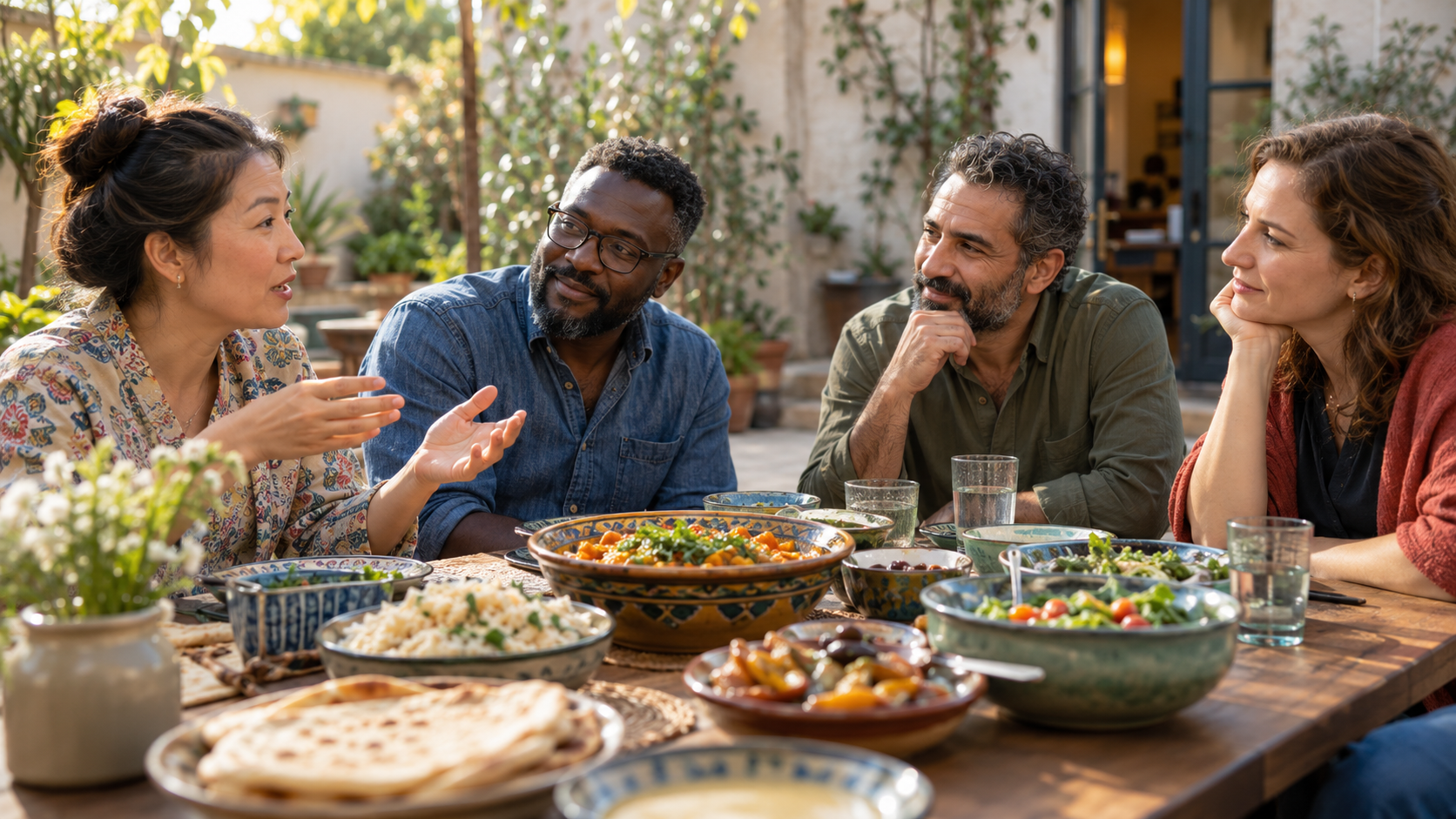
Today, food offers an accessible introduction to an unfamiliar tradition. But tasting a dish and understanding its place in someone’s life are different experiences.
At a community event, a visitor might ask what a dish contains. A more revealing question could be: “When does your family make this?”
The answer might lead to a particular holiday, a memory of a relative, or an explanation of how the recipe changed after a move. These are possibilities to ask about, rather than details to assume.
It also matters who is answering. One person’s family recipe cannot stand for an entire country. Someone else from the same place may prepare it differently—or never eat it at all.
The useful exchange begins when there is room for that difference.
Understanding Does Not Require Agreement
An unfamiliar custom can prompt an immediate judgment. Asking about its context gives that judgment more information.
That does not require approving of every practice or accepting every explanation. People can understand why a tradition matters to someone and still question it.
Nor should a person have to defend everything associated with their background. Asking “What does this mean in your family?” leaves more room for an individual answer than “Why do people from your country do this?”
The first question invites a conversation. The second asks someone to speak for millions of people.
A Short Video Cannot Supply Every Answer
A video of a wedding, meal, or religious celebration can introduce viewers to something unfamiliar. The problem comes when the viewer treats that glimpse as a complete explanation.
Before drawing a conclusion, ask what the clip actually shows. Is this one family’s practice? A regional custom? A performance arranged for visitors? Does the person posting it explain where and when it was recorded?
Those questions do not diminish the experience. They help distinguish what is visible from what is being assumed.
The same care applies when sharing cultural content. A precise caption—identifying a place, event, and source—gives readers more to work with than a sweeping statement about what an entire population believes.
Exchange Begins With a Better Question
You do not need an international trip to have this kind of conversation. A local exhibition, a neighbourhood event, or a discussion with someone you know can provide an opening.
Ask about a detail that caught your attention. Listen to the answer without expecting it to represent everyone.
At your next cultural event, try asking: “Which part of this tradition do visitors tend to misunderstand?”
The answer may be more interesting than the explanation you arrived with.