Bob W reports 69% lower CO2 emissions per guest night than the European hotel average | News
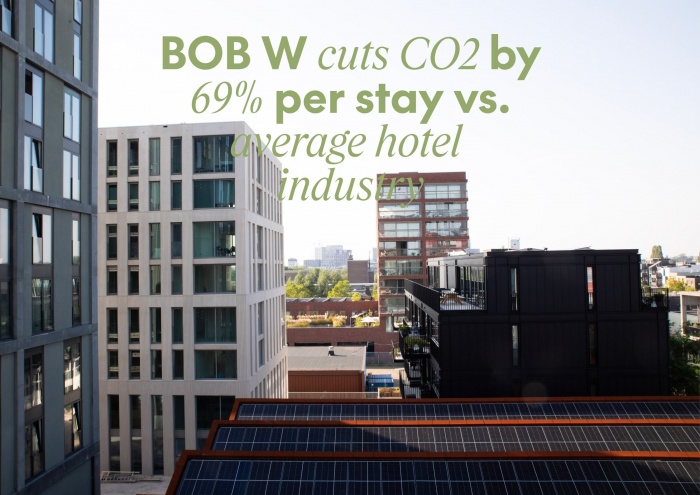
Bob W, Europe’s fastest growing technology-driven hotel operator, has reported that a typical guest stay in its aparthotel portfolio generates 69% less carbon emissions than the average European hotel stay, according to the company’s latest impact results.
During the 2025 measurement year, Bob W expanded its footprint by opening ten new locations throughout Europe. Despite this growth, the company has reduced the environmental impact of each residence through smarter operations, circular design principles, adaptive reuse of existing buildings and clean energy initiatives.
Compared to the previous year, total emissions fell by more than 9%, supported by improved accuracy in data collection and reporting, while emissions per guest night at Bob W’s aparthotels fell by 31%.
A typical Bob W stay now produces 3.78 kg CO₂e, or carbon dioxide equivalent, per night, compared to an average European hotel benchmark of around 12 kg CO₂e per night1. The company has offset 100% of stay-related CO2 emissions through verified CO2 credits since 2021, with 1,979 tCO₂e offset to date.
The results will be published on Bob W’s new impact site and build on the company’s LEGIT methodology, the Lodging Emissions & Guest-night Impact Tracker, developed in collaboration with environmental consultancy Furthr. LEGIT records a wider range of emission sources than standard hotel carbon measurements, including building materials, cleaning products, toiletries, consumables, waste, water and furnishings, giving guests and stakeholders a more complete picture of the impact of each stay.
Niko Karstikko, co-founder and CEO of Bob W, said: “The hospitality sector has a transparency problem. Most operators talk about 2050, but we show our numbers for today. Our latest results show that it is possible to scale across markets while reducing the emissions intensity of each stay.
“Our live impact site brings together data on energy consumption, emissions, local partnerships, corporate events and the footprint of individual stays. Through our LEGIT standard and our broader reporting, we make the impact of every stay easier to compare and take action. We’re publishing the numbers because the sector needs more transparency, not vaguer commitments.”
Bob W’s lower-impact business model is built around smarter stays, circular design and local partnerships. Digital check-ins reduce paper consumption, while real-time monitoring helps optimize energy consumption across the company’s portfolio.
Many Bob W properties are being repurposed from former hotels, offices and commercial buildings, reducing the need for new construction and bringing underutilized urban assets back into productive hospitality use. The company also uses recycled and upcycled furniture where possible, specifies sustainable, lower-impact materials, runs on 100% renewable electricity and works with local makers, designers and community businesses in its markets.
Bob W’s key impact highlights include:
A typical Bob W aparthotel stay produces 3.78 kg CO₂e per guest night, 69% lower than the European hotel average of approximately 12 kg CO₂e per night.
Emissions per guest night at the Bob W aparthotels fell by 31% year-on-year.
Total emissions have fallen by more than 9% compared to 2024, supported by improved accuracy in data collection and reporting.
Each residence is powered by 100% renewable electricity.
Since 2021, 100% of accommodation-related CO2 emissions have been compensated.
To date, 1,979 tCO₂e has been offset through verified carbon credits.
Bob W provides detailed environmental information about the footprint of each residence.
The average length of stay is 2.68 nights and the average guest rating is 4.5 out of 5.
The latest impact results come as Bob W continues to expand across Europe and Britain, with a portfolio of more than 100 assets and more than 7,000 apartments and hotel rooms.
Learn more about Bob W’s impact work at impact.bobw.co.