Remembering the bottom of 9th, Game 7 of the 2001 World Series

This is the next in a series of stories from Cronkite News looking back at the Diamondbacks’ 2001 World Series win.
PHOENIX – After Alfonso Soriano’s eight-inning home run broke a 1-1 tie in the top of the eighth inning of Game 7 of the 2001 World Series, Bank One Ballpark fell into a hush. The juggernaut New York Yankees were six outs away from their fourth consecutive championship thanks to the second baseman’s effort, with the best closer in playoff history on the way.
As right-handed pitcher Mariano Rivera emerged from the visiting bullpen, the faint tune of Metallica’s “Enter Sandman” seemed to drift over the 2,400-plus miles between Yankee Stadium in the Bronx to downtown Phoenix, creating a feeling of impending doom for the partisan crowd.
That effect seemingly carried over into the Diamondbacks dugout, as Rivera struck out the side in the bottom of the eighth to maintain the one-run lead. After left-hander Randy Johnson compiled a 1-2-3 top of the ninth, Arizona had three outs left to keep its magical season alive.
While fans sporting the purple and teal had fallen silent, their team had been in this situation before, advancing to the National League Championship Series with a walk-off win in Game 5 of the Division Series against the St. Louis Cardinals.
“We knew they still had to get three outs,” Diamondbacks shortstop Tony Womack said. “We just needed somebody to get on base and Gracie did that, led off with a single so we just needed to keep playing.
“We had been down that road before. I mean, Mariano was great, but we also faced some other good closers during the year in the playoffs.”
First baseman Mark Grace began the bottom of the ninth with a bloop single up the middle of the field, breathing life back into Arizona. When catcher Damian Miller’s bunt attempt came straight at Rivera, he instantly turned around and fired the ball to shortstop Derek Jeter, a sure out with pinch runner David Dellucci only halfway to second base.
But he missed the throw.
As Dellucci slid into second, the throw to Jeter was wide right and the ball bounced into center field. Arizona had runners on first and second with nobody out. A scenario that would leave any team confident, except for the fact that Rivera was on the mound.
Fox’s play-by-play announcer Joe Buck put it best before the inning: “So many teams have tried, and so many teams have failed.”
This time felt different. Rivera made a mistake. It was the first postseason error he had ever committed in his seven-year career, making him look almost human for once.
He immediately rebounded from the blunder. Pinch hitter Jay Bell’s sacrifice bunt was quickly fielded by Rivera, who quickly pounced on the ball and threw out Delucci at third for the first out of the inning.
Maybe this was what he needed. Like a basketball player in a shooting slump seeing the ball go through the net one time to re-ignite his play, the first out of the inning could be just that for Rivera.
Nonetheless, the bottom of Arizona’s order had gone 2 for 3 against the most intimidating closer in baseball history, putting two baserunners on for the top of the lineup. Leadoff hitter Womack stepped into the box against Rivera for the second time in three games. His first plate appearance against Rivera was a groundout in a 3-2 Game 5 Yankees win that required 12 innings, only seeing one pitch before he was thrown out.
Womack was much more patient in his second at-bat, watching two balls and a strike before fouling off a pitch to even the count, 2-2. Womack may have been just late on the fourth pitch, but he wasn’t on the fifth. He pulled a 92-mile-an-hour fastball down the right field line, scoring pinch runner Midre Cummings from second and advancing Bell to third with a game-tying RBI double.
It was only the third run Rivera had given up in the 2001 postseason, tying his career-high set the season before.
“He threw me, I think it was a two-one pitch and I fouled it straight back and the only thing I said was, ‘Usually with Moe, when he makes a mistake, you usually can’t miss it,’” Womack said. “So I just told myself, ‘Hey, just see the ball up and drive.’
“That’s all I did. I didn’t change the game plan. I can’t remember which game it was in New York, but I saw enough of him to understand, ‘Just stay in the moment.’”
The Diamondbacks had completely flipped the script on Rivera with runners on second and third and only one out. All second baseman Craig Counsell had to do was put the ball deep enough into the outfield to score Bell from third. He wouldn’t get the chance though, as the second pitch he saw inside nailed him on the knuckles.
Rivera could have walked Counsell intentionally to put a runner at first for a potential double play, but the batter waiting on deck was foaming at the mouth for a plate appearance. Although Rivera had sent right fielder Luis Gonzalez down on strikes in the eighth, the 34-year-old was in the midst of an all-time season with 57 home runs and 142 RBI. Now, he had the moment of a lifetime.
“This is a scenario that you kind of dream about as a little kid,” Gonzalez said. “You play those scenarios in your mind in the backyard with your buddies.
“I’m a sports fan. I always sit on the couch and wonder what it’s like to throw a touchdown or make a big putt or a big jump shot or whatever it might be in sports. You always see those guys celebrate and you wonder, ‘Man, what does that feel like?’“
The first pitch Gonzalez saw he fouled off for strike one. Right before the second pitch of the at-bat, color commentator Tim McCarver mentioned that Rivera threw inside to left-handed batters, resulting in broken-bat bloop singles. With the bases loaded, New York decided to bring in its infielders in the case of a sacrifice bunt.
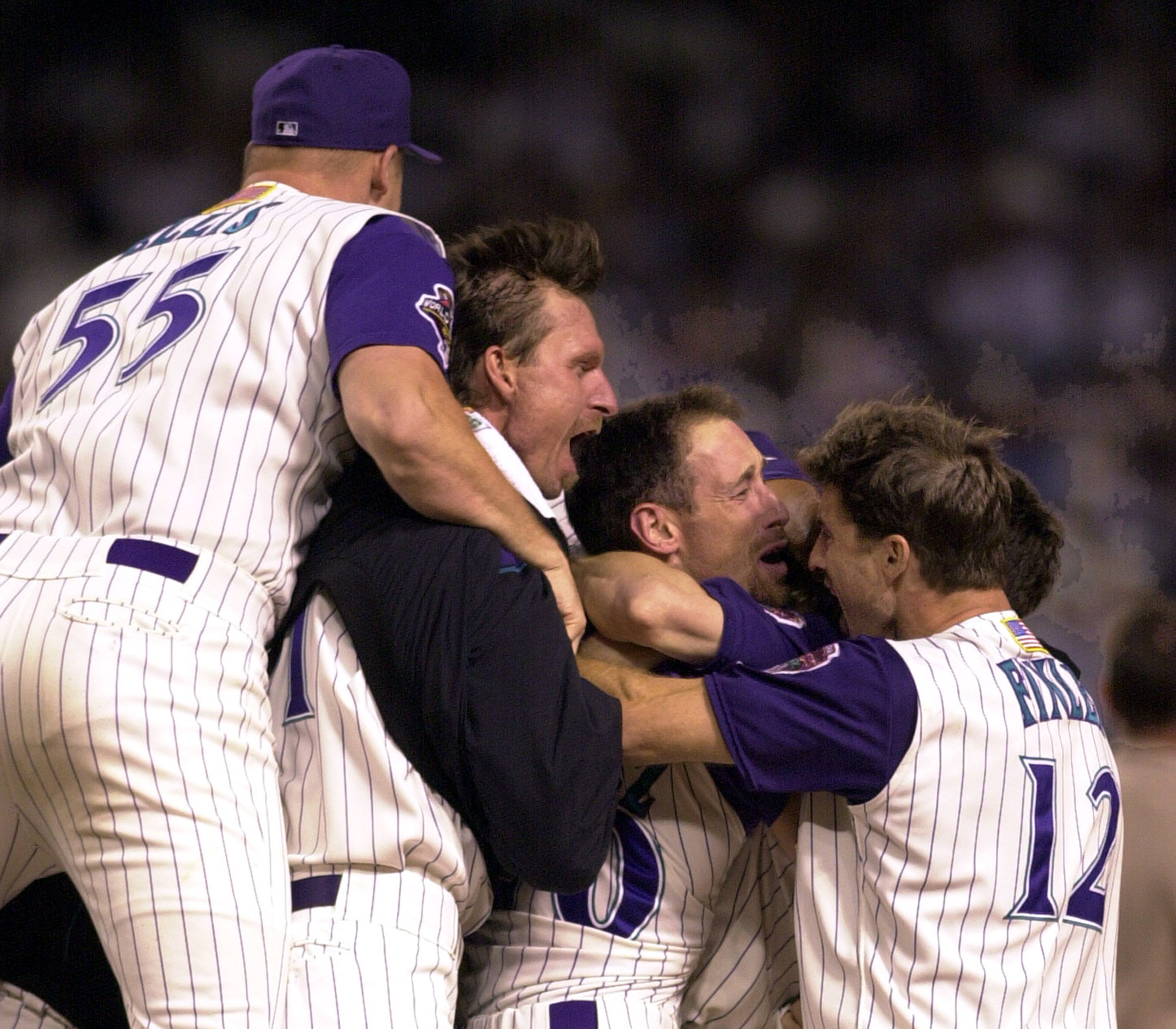
It was almost as if McCarver spoke his comment into existence. With an 0-1 count, Gonzalez made just enough contact for the ball to float over Jeter’s head and into the outfield. Bell triumphantly touched home plate as the winning run before third baseman Matt Williams wrapped him in a bear hug, lifting him off his feet.
“To be honest, I just had to make sure that I touched third base,” Bell said. “Once I did that, the helmet went off and, man, it was wild. There’s 30 teams, and you’re the last one standing up. You got the big hit. We weren’t supposed to beat them and we beat them. So now you’re jumping around with your teammates and it’s all justified.”
Diamondbacks manager Bob Brenly leaped from the dugout with his arms reaching for the Phoenix night sky as fireworks battled against the deafening roar inside Bank One Ballpark. They had done it. Since the Diamondbacks became an organization in 1998, they had watched the Yankees lift the World Series trophy every year until they became the team to dethrone one of the best dynasties in baseball history.
“I turned into a 10-year-old kid. Honest to God,” Brenly said. “I remember my son running by me to go out on the field and celebrate. And then I just started jumping, just bouncing up and down, up and down, up and down.
“When I see the videos, I look like an idiot, but there’s no way to prepare for that. And when it happened, it was just, it was all natural. It all just came out, like winning the Little League Championship, and we’re going to Chuck E. Cheese.”
After mobbing Bell at home plate, players began floating toward Gonzalez between first and second base to swarm the hero of the night. The storybook ending to the season was waiting for Gonzalez, and he picked up the pen to finish it. Despite his 0-for-4 statline heading into his fifth at-bat, he was the player the Diamondbacks wanted at the plate. And he delivered.
“It was super special and I don’t take things for granted,” Gonzalez said. “Every time somebody mentions it or whatever, I always take the time to listen to their stories, where they were, what they were doing and things like that.
“I’m truly blessed that I was in that situation, but you don’t get there without good teammates and good people around you. Sometimes I get embarrassed because people say, ‘You won the World Series.’ I’m like, ‘No, it’s not me. It’s our whole team.’ We had a good bunch of guys and we rallied together. The city and the state rally behind us and we felt like we were part of the community.”
In the stands behind Arizona’s dugout, team owner Jerry Colangelo could only utter two words: “We won.” As the general manager of the NBA’s Phoenix Suns from 1968 to 2004 and owner from 1987 to 2004, Colangelo witnessed his team fall just short of a championship multiple times, but 2001 felt as if it made up for all of the previous shortcomings. No one could take it away – what remains the only major men’s professional sports championship for the Phoenix area.
“I always wanted an NBA championship,” Colangelo said. “We had great success with the Phoenix Suns. Our record during my tenure (of) 40 years, we have the fourth best record in basketball, and we knocked on the door. We should have won two or three times. The championship didn’t happen. It wasn’t meant to be.
“And here we are in year four of the baseball experience, and I’m sitting to the right of the dugout while all this is unfolding. And I said, ‘Lord, you really do have a funny sense of humor. We’re going to win. We’re going to win this thing.’”
Related

Source link