Redefining how young Americans engage with TV news

A growing share of U.S. audiences turn to social media for their news — a shift that’s been evident for years and shows no sign of slowing down. Newsrooms tend to respond by posting their original product online. In local television newsrooms, this has meant publishing a reporter’s package from the 6 p.m. newscast on the station website.
But that strategy isn’t viable for the future. It overlooks the fact that social media platforms operate as distinct media environments with their own norms, logics and modes of engagement. In these environments, audiences have redefined what counts as news.
Instead of going to news sources, younger audiences want news sources to come to them. These audiences expect the stories they encounter to feel visually alive and socially connected, and they value journalism that reflects their communities in meaningful, contemporary ways.
Younger audiences aren’t turning away from local TV news
To help newsrooms find a path forward, the Reinventing Local TV News Project at Northeastern University partnered with SmithGeiger Group to conduct online interviews with 1,012 news consumers aged 18 to 34 across the U.S. The study was fielded from June 3 to June 8, 2025.
The final weighted sample included:
- 50% men, 49% women, and 1% nonbinary respondents.
- 42% were age 18 to 24, 28% were 25 to 29, and 30% were 30 to 34.
- 68% were white; 16% Black; 14% Latino; 8% Asian; 3% Native American or Aleutian; 1% Pacific Islander, Native Hawaiian, or Samoan; 1% another ethnic background.
To maintain data quality, we reviewed responses for clarity, accuracy and completeness, and removed respondents who failed to pay attention or give quality responses to the survey questions.
All respondents were weekly news consumers on at least one platform, and half reported turning to at least one local news source on a daily basis.
As part of the survey, respondents watched videos produced by our research fellows, who were embedded at three local television stations.
Respondents gave feedback on the videos, including on story length, tone, and their overall reaction.
4 takeaways from the survey
1. Audiences have redefined what counts as news, and younger audiences want the news to come to them.
2. Instead of turning away from local news, younger people are engaging with it in ways that are distinct from older generations — frequently via social media and on their own schedule.
3. Social media posts aren’t dead ends. They’re the start of a consumer’s experience with a news story or news organization.
4. “Local” needs to be considered a method of producing news, not just a geographic description.
We were pleasantly surprised by the results. While popular opinion may be that young audiences have abandoned news, especially from local television, our survey found otherwise.
An overwhelming percentage — 91% of all 18- to 34-year-olds — are getting news and information from at least one news platform on a weekly basis. News usage is frequent and habitual, with over half of weekly users turning to their primary platforms every day.
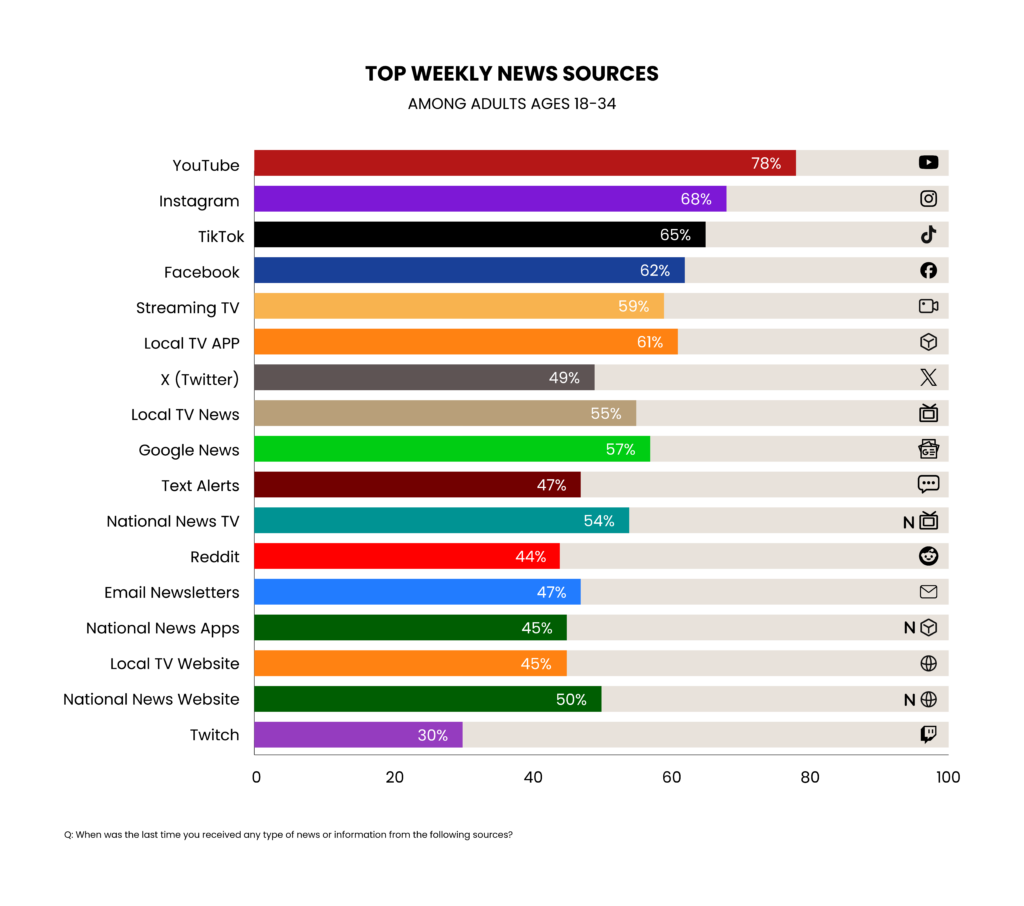
Among 18- to 34-year-olds, local news maintains significant visibility: 55% still watch local news programs on TV each week, while 61% actively use local stations’ apps or weather apps. This places local outlets firmly in the middle tier of weekly news sources overall, ahead of Reddit, newsletters and even national news websites and apps.
Instead of turning away from local news, younger people are engaging with it in ways that are distinct from older generations — frequently via social media and on their own schedule.
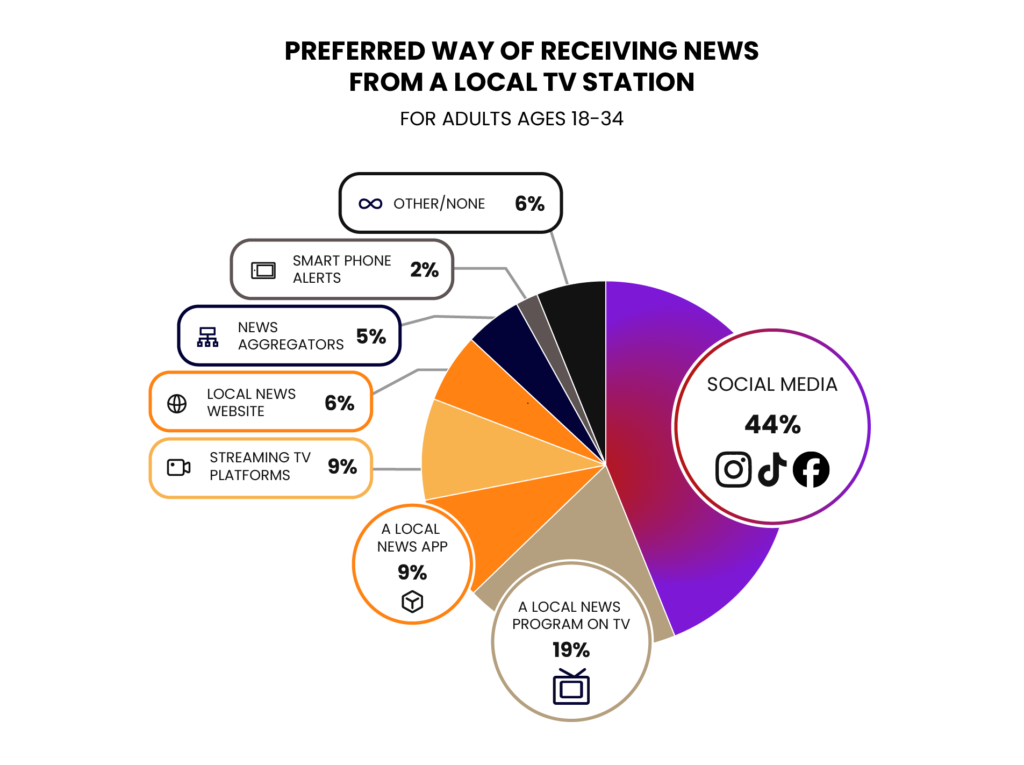
For station managers, the opportunity is not to win them back to linear programming from TikTok or YouTube. Rather, newsrooms should recognize that this demographic cares about local news and that there is an opportunity to reach them if stations make their reporting part of their audience’s daily, multi-source news routine.
Cultivating connection: What successful journalism looks like on social platforms
The Reinventing Local TV News Project has spent the last decade researching how local newsrooms can reach younger people.
In this latest phase of our research, we embedded innovation fellows to serve as digital content creators in three top newsrooms in New York, Chicago and Boston. They worked in collaboration with an animation fellow who served all three stations. The group produced stories specifically for the television stations’ digital platforms, including social media, websites and streaming apps. From their work, and the responses to that work in our survey, we’ve developed a sense of key factors for successful journalism on social platforms.
One is cultivating connection, especially on social media platforms.
“I want to see more community outreach and help, I want truly local stories, I want to see how individuals are making the place better.”
Younger audiences turn to local news for a sense of place and belonging, but they expect interactivity. For newsrooms, this can mean soliciting audience involvement through comments, polls, or live Q&As. One survey respondent, when explaining why social media is their preferred way to get news, said, “…I like to read comments to see what others think about the news.”
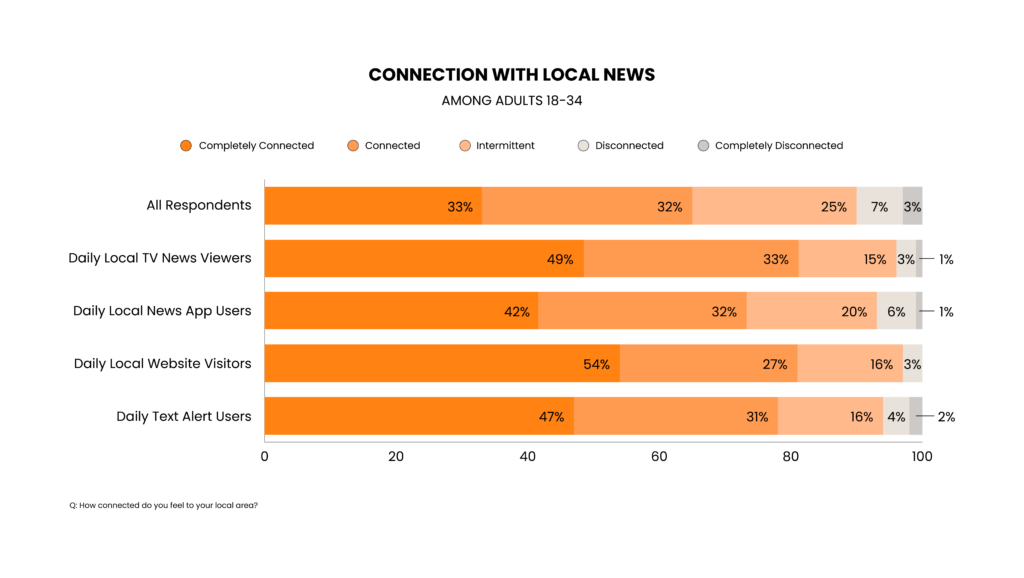
Daily local news consumers report having a deep connection to where they live. Nearly two-thirds — 65% — of younger news consumers report feeling connected to their local communities, with this connection strengthening significantly with age, especially among Black and Hispanic audiences.
One survey respondent, when asked what local news stations could do to improve their digital offerings, said, “I want to see more community outreach and help, I want truly local stories, I want to see how individuals are making the place better.”
For younger audiences, interacting with social media content they consume is a default. For newsrooms, that means every short-form video offers an opportunity to connect with them.
Social media news videos aren’t dead ends. Our survey showed that those stories were the start of a consumer’s experience with a news story or news organization — 94% of viewers say they search for more information after they watch a local news video on social media.
Substantial audience segments also like or share videos — 87% — watch longer versions on station apps or websites — 81% — or even make a point of tuning into the full local newscast on television — 78%.
For younger audiences, this undercuts the stereotype of social media news as fleeting or shallow. Instead, it demonstrates that local news clips can function as entry points that channel audiences toward deeper, cross-platform engagement.
Newsrooms can encourage their audiences to engage further by linking to additional stories, creating follow-up content or prompting viewers to leave comments. This opens a door for newsrooms to cultivate the connection that this audience wants in their social media content.
Local news is no longer solely about proximity
Our research leads us to believe that connection has become an essential factor in how younger audiences define local news. Younger audiences attribute value to local stations both because they are nearby and because they perform functions that extend beyond geography.
They provide urgent and actionable information, sustain a sense of connection to community, and embody trustworthiness and relevance in ways that other information sources often do not.
For this audience, local news is no longer simply defined by geography.
That means “local” needs to be considered a method of producing news, not just a geographic description. A station may be geographically situated within a community and still fail to meet the expectations of what it means to be local if it does not deliver on urgency, connection or trust.
Our data suggest daily local news consumers report stronger community connection than even heavy social media users, and nearly three-quarters of respondents say they trust local news more. Ultimately, credibility at a local level will now have to be earned through a newsroom’s journalism, rather than simply inherited through location.
Learn more in our report published by The Shorenstein Center and our Survival Guide for newsrooms.