Colombia’s fuzzy guardians of the water : NPR
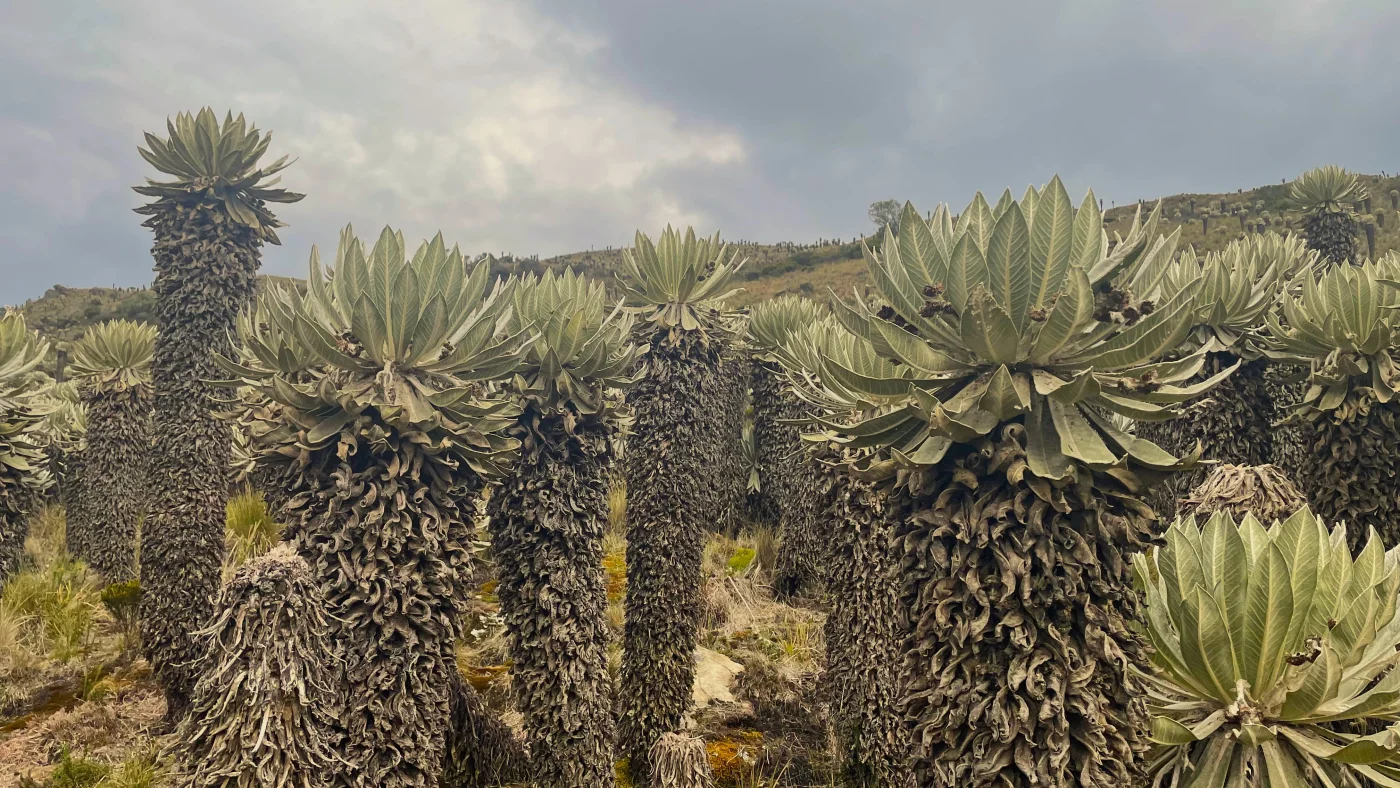

Frailejons, Colombia’s iconic high-altitude plants, help protect the páramos that supply much of the country’s water.
John Otis for NPR
hide caption
John Otis for NPR
MONGUÍ, Colombia — Moisés Moreno greets visitors at his greenhouse 10,000 feet high in the Andes Mountains. Underneath the plastic roof, he nurtures tiny seedlings that can grow to be 30-feet tall.
“Do you know anything about frailejons?” Moreno asks his visitors, who are mostly clueless.
Related to the sunflower, frailejons are the iconic flora of Colombia’s high mountain wetlands, which are known as páramos, and are vital for the country’s water supply.
The wooly fuzz on their leaves protect frailejons from the cold and absorb water from the cloud cover. This helps maintain moisture in the páramos, which are the source of major rivers, and much of Colombia’s water.
But frailejons and the páramos where they grow face a growing array of threats, including farmers, cattle ranchers and coal miners who are gradually pushing higher into the Andes. In addition, climate change is warming the mountains, allowing invasive species to survive at higher altitudes and disrupt their fragile ecosystems.

A cow sits among frailejón plants in Colombia’s Andean páramo, a fragile high-altitude ecosystem that supplies water to much of the country. Ranching and farming threaten the plants’ survival.
John Otis for NPR
hide caption
John Otis for NPR
Of the nearly 150 species of frailejons, two-thirds are at risk and 17 are endangered, says Mauricio Diazgranados, a Colombian expert on the plant who is chief science officer at the New York Botanical Garden.
“They are a keystone species for maintaining the páramos and play a key role in water production,” he says. “But most frailejons are in trouble,”
When explorers first spotted the shrubs mysteriously protruding from the mountain fog centuries ago, they reminded them of hooded monks. Hence the name frailejon, which is Spanish for “big friar.”
The long, thin leaves of some species bend toward the sky and resemble palm fronds. Many are stout in the middle because, rather than falling to the ground, their dying leaves slump down to form a brownish outer shell to their trunks.
The Muisca Indians, who once populated the area, considered frailejons to be sacred guardians of the water. When he first came across the plants as a teenager in Colombia, Diazgranados says: “I became completely captivated.”
By contrast, Moreno, 53, who runs the frailejon greenhouse, used to be one of the plant’s predators. Growing up on a mountainside farm near the central Colombian town of Monguí, Moreno and neighboring farmers knew little about them and chopped them down to make way for potato fields and cow pastures.
“We viewed them as a nuisance,” Moreno says.
Later, while employed by a coal mine, he was injured during a cave-in and vowed to work above ground in the fresh mountain air.
On his own he began studying páramo ecosystem that he’d grown up in, started his greenhouse and began leading tourists and volunteers on expeditions to replace the frailejons that had been wiped out.
“I felt inspired to do something to protect the páramos,” he says.
Elsewhere, Colombia’s National Parks agency and even its armed forces have gotten involved in reforestation campaigns after wildfires scorched thousands of acres of frailejons.
Yet many average Colombians have learned about the plant’s importance through an enormously popular cartoon character called Ernesto Pérez. Shaped like a frailejon, he exhorts people to conserve the flora and fauna of the Andes, similar to the way Smokey Bear promotes forest fire prevention in the U.S.
In fact, several of the volunteers Moreno is guiding up the mountain say the cartoon and its earworm theme song introduced them to the frailejon.
“The song is very contagious,” says Nicolás Coronado, 25, who works for a Bogotá-based plastics company, and is carrying a 6-inch frailejon that he will plant in the páramo.
The hike takes the group up to an altitude of 11,000 feet, past streams, waterfalls and lagoons. Underfoot, the ground is damp and spongy. The area is a state park and frailejons dot the landscape. But there are also barbed-wire fences erected by farmers and a half dozen cows grazing on the mountainside.

A frailejón flower blooms in the páramo wetlands of Colombia’s Andes Mountains, set against the rugged high-altitude landscape.
John Otis for NPR
hide caption
John Otis for NPR
Moreno and his assistants show the volunteers how to dig shallow holes, then add a bit of shredded tobacco as fertilizer, before nestling the tiny frailejons into the soil.
Their survival is no sure thing. Many die in the cold, harsh climate and those that take hold grow just a few inches per year.
To help them along, the volunteers hold an impromptu ceremony, with one member reciting a prayer to connect with the mountain spirits and another blowing on a conch shell.
By now, some volunteers have grown attached to the frailejons that they’ve carried up the mountain and have bestowed names on them. Among them is biologist Julieta Barba has baptized hers “Gerry,” in honor of her mother.
After patting some dirt around the plant’s roots, she says: “I’m very excited for her future here in the páramo.”
Source link