Bosnian fans’ war memories carry into World Cup match with USMNT
PHOENIX – When Ismet Murtic realized the Bosnian national team had qualified for the World Cup and would play Switzerland in Los Angeles, he already knew he wanted to go.
There was one major problem.
It wasn’t ticket prices, transportation or even accommodation. It was the fact that he needed surgery after recently testing positive for lung cancer.
Given the approaching date of the game, he had to make a choice: get the surgery now or miss the match.
The decision was a no-brainer.
“No matter what happens I want to see the game,” Murtic said, recalling what he told his doctor. “He told me, ‘You still have time to recover and go to the game,’ and I said ‘OK then, schedule that surgery.’”
Bosnia and Herzegovina faces the U.S. Men’s National Team in the round of 32 of the World Cup at 5 p.m. MST on Wednesday at Levi’s Stadium in Santa Clara, California. For many Bosnian-Americans, it’s a match over 30 years in the making. Decades after arriving in the United States in the aftermath of a brutal regional war, the World Cup offers a unique chance for two deeply connected nations to compete on the world’s biggest stage.

Memories of war
Wars in Slovenia and Croatia broke out during the early 1990s as Yugoslavia began to break apart. By 1992, it trickled down into Bosnia, whose population was split between three main ethnic groups: Bosnian Serbs, Bosnian Muslims (Bosniaks) and Bosnian Croats.
Over three years of war ensued, causing over 100,000 casualties, according to the United States Holocaust Memorial Museum.
“What went down stemmed from a collapse in the political institutions of part of the Yugoslav state, which Bosnia was a part of,” said Arizona State University Barrett Honors Faculty Fellow Robert Niebuhr, whose scholarship has focused on the political and military history of the former Yugoslavia.
“People had a lot of things to fear in the 1980s. A lot of nationalist rhetoric began to re-emerge. There were what we would call hate crimes. There were a lot of memories of atrocities from World War II, finger pointing and all sorts of things were emerging that made it uncomfortable for folks.”
One of the darkest chapters of the war happened in the town of Srebrenica in July 1995, an enclave in eastern Bosnia where many Bosniaks fled for safety. Despite the area being declared a United Nations safe zone, Bosnian Serb commander Ratko Mladić led his army past UN peacekeepers and into the town of the stranded Bosnian Muslims.
“When the Serbian forces decided to take (Srebrenica), they surrounded and the UN didn’t have the means to do anything about it,” Niebuhr said. “They were intimidated by the Serbian forces, and the Dutch peacekeepers were the ones (who) famously stood down.”
The UN’s efforts weren’t enough as women and girls were separated from their families while Muslim men and boys were taken by Serb forces. Eight thousand of them were executed in what is now considered the worst atrocity in Europe since the Second World War.
Fighting ended in late 1995 with the signing of the US-backed Dayton Accords, but scars still remained. And accountability wasn’t immediate.
Mladić evaded authorities for 16 years until being arrested in Serbia in 2011. Six years later, he was sentenced to life in prison by the International Criminal Tribunal for the former Yugoslavia after being found guilty of genocide, crimes against humanity and violations of the laws or customs of war.
The former president of the Republika Srpska between 1992 and 1995, Radovan Karadžić, also evaded arrest until 2008. He was later found guilty of genocide, crimes against humanity and violations of the laws or customs of war.
“There are definitely still folks who have committed war crimes who are still loose,” Niebuhr said. “A lot of them found refuge in either neighboring Croatia or neighboring Serbia, or Montenegro.”

A new home and dual allegiance
The United States took over 100,000 Yugoslav refugees in the aftermath of the conflict. Almost 7,000 Bosnian refugees settled in Phoenix between 1993 and 2004, according to the Arizona Department of Economic Security. Now 30 years later, the memory of war still lives on, but soccer is affording an opportunity to bring people together.
This especially rings true for the younger generation who were born during or after the war, like Edita Cermelj, who settled in Phoenix after leaving her home town of Banja Luka at age 5.
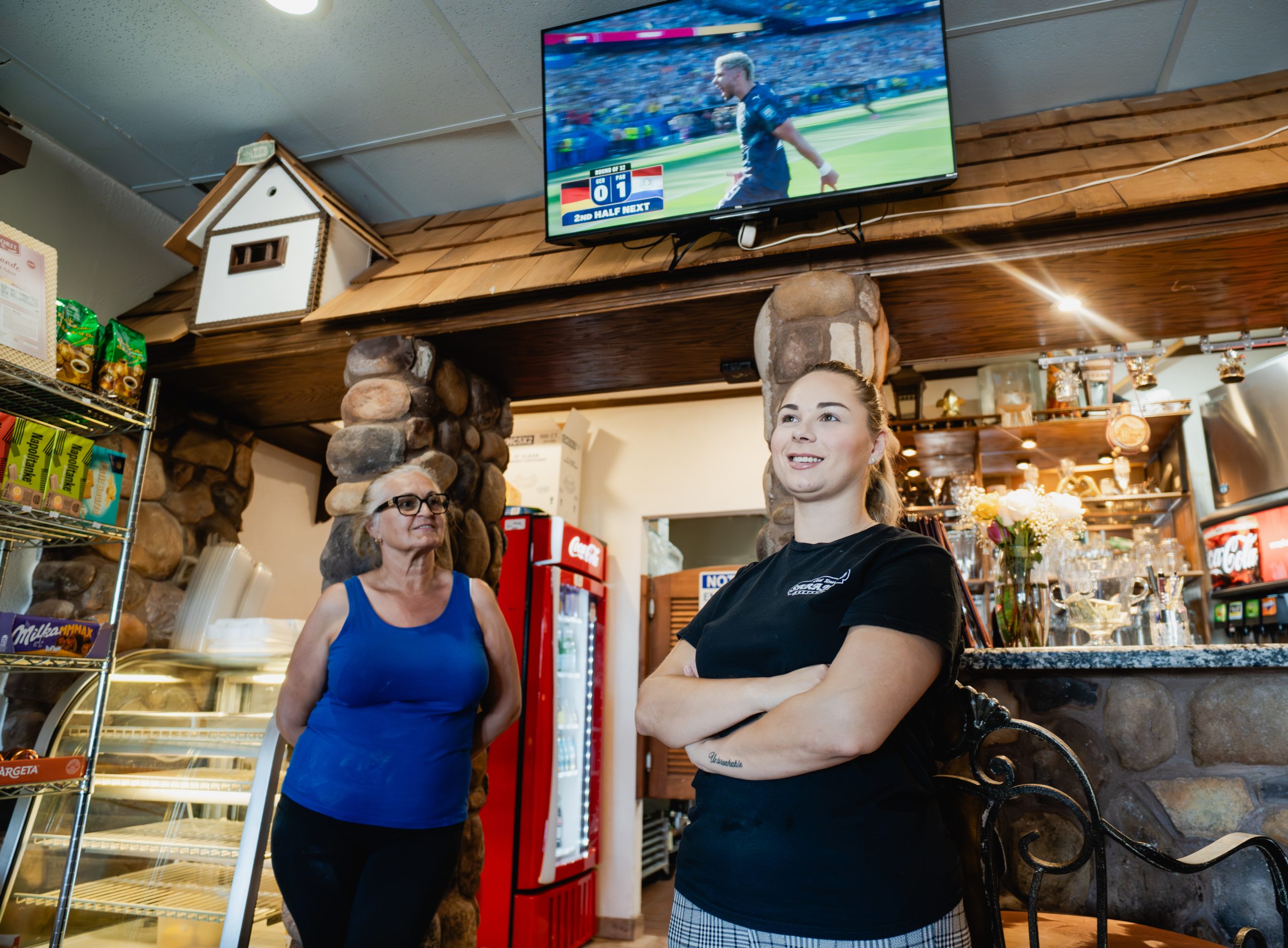
“Our generation doesn’t want a repeat of history, we don’t want war to continue,” said Cermelj, who is now a waitress at the Old Town Sarajevo restaurant in Phoenix. “Our country was very united at one point in time.”
Bosnia and Herzegovina’s team competing in this World Cup is made of 26 players; a mix of Bosniaks, Croats and Serbs.
“It goes to show you that sometimes things in history can be a lesson,” Cermelj said. “We learned through the immigration process through many of us coming here at 3 to 6 years old. In that toddler prime time when you’re supposed to be starting kindergarten and start your roots, we weren’t starting our roots. We were cutting every single root we knew and to start new roots.”
The team qualified for its second World Cup after shocking Italy in the UEFA playoffs in March. For Bosnians in the Valley, it was a core memory and a reminder of what sport offers to a community.
“It’s very big for us, it’s one of the main vocal ways to get out of that poverty and farming lifestyle,” said Manojlo Ilić, a 32-year-old Bosnian who settled in Phoenix in 1999. “We’re very passionate about teams we support, local small teams back home. People are very passionate, they get tattoos on them.”
This summer, the Dragons finished third in Group B which sealed one of the best-third place finishes in the tournament, advancing to the knockout stage for the first time.
Their opponent? The United States – a country which has given so much to a community following a bloody conflict.
Murtic, now 60, grew up in northwestern Bosnia and lived his life like any other young adult in the region. He worked in a bar, completed his mandatory army service and never thought he’d live anywhere else but his homeland.
But when he decided to visit his brother in Germany, his life changed forever. War broke out in the Balkans, meaning he couldn’t return to his country. So in 1996, one year after fighting ended, he moved to Phoenix as one of the nearly 7,000 Bosnian refugees arriving in the Valley.
He only spoke two words of English: “hello” and “bye.” He had difficulties integrating with American society, which is why 30 years later, Wednesday’s game feels like something out of a movie.
“I was never thinking that this was coming,” he said of the idea of a USA vs. Bosnia game. “It’s going to be a win-win, I’m just excited for the game.”
Murtic planned on making the six-hour car journey to Southern California for Bosnia’s second match at SoFi Stadium, but something happened in early 2026 that changed everything.
While at a doctor’s appointment, the medics revealed that his son needed a kidney transplant. Murtic described it as “the hardest day” of his life. Even for a man who lost family members and lost friends in war, this was one of the biggest shocks he faced.
But that moment led to something even more shocking. Murtic tested positive for lung cancer soon after, which required immediate surgery. This development jeopardized the World Cup trip, but Murtic was determined to make it to Los Angeles, which meant having to do the surgery weeks before the match.
The plan worked out. Murtic and his two sons drove through the Southern California traffic and arrived in LA. His youngest son, who needed the kidney transplant, brought a dialysis machine and used it while staying in their hotel room.
All the uncertainty lifted when they arrived at SoFi Stadium in a sea of blue shirts and Bosnian flags, while music by the late Halid Bešlić blasted through the arena.

“Around 8 a.m. we were ready to leave the hotel,” Murtic said. “We were ready to go out and we heard a lot of noise. We got to the street and there was a line of Bosnian people marching through the neighborhood. It was at least 10,000 people, probably. And we just joined that group.
“To be in that, you cannot explain to someone that feeling. You have to be there to feel that.”
Murtic planned on going to Wednesday’s game in Santa Clara, but had to pull out at the last minute. He will be watching the game on the TV like many Bosnians in Phoenix, across the United States and even in Bosnia, despite the 2 a.m. local time kickoff.
By the end of the night, one nation will advance to the round of 16 while the other’s World Cup dream will be crushed.
For Bosnians in Phoenix, however, they’ve already realized their American dream. No matter the outcome, they will always be grateful for the country they now call one of theirs.
“Bosnia is my motherland, but I left 30 years ago. I’m staying here in this country and I’m going to die in this country,” Murtic said. “My kids, we will all die in this country. This is our country and we are Americans too.”
Related

Source link