Voter roll purges banned 90 days before federal elections : NPR
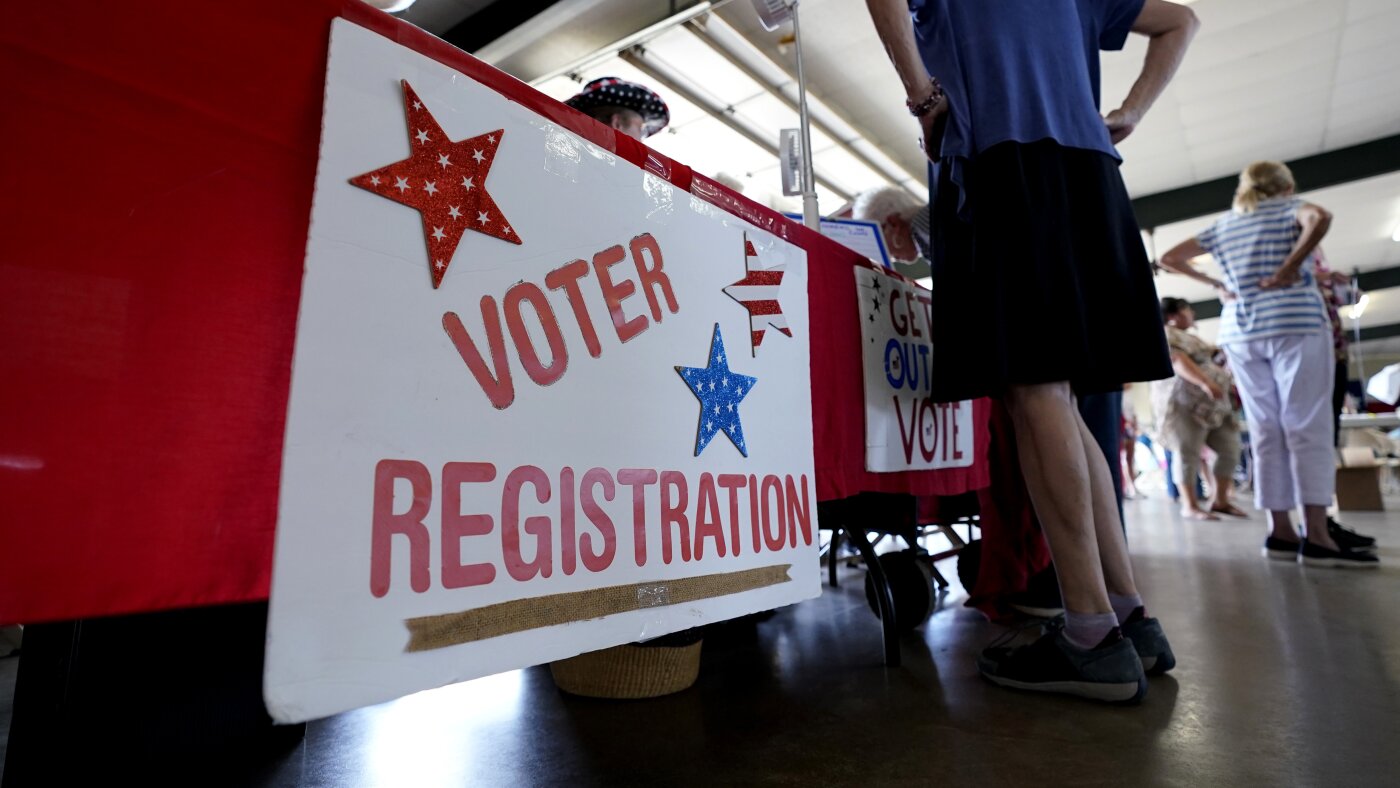

People stand near a voter registration table at a 2022 event in Fredericksburg, Texas.
Eric Gay/AP
hide caption
toggle caption
Eric Gay/AP
Republicans are mounting a push for courts to reinterpret a longstanding ban on mass purges of voter rolls just before a federal election.
That legal protection for eligible voters is now set to be reviewed by the Supreme Court during its upcoming term, beginning in October, through a case out of Arizona, as President Trump and GOP leaders continue to spread false claims of widespread voter fraud by non-U.S. citizens, even as state reviews have found illegal voting by noncitizens to be incredibly rare.
Under the National Voter Registration Act of 1993, election officials are supposed to finish any program for systematically removing ineligible voters 90 days before Election Day in federal races. That deadline applies to the 44 states covered by the NVRA, plus Washington, D.C.
Congress passed this ban on late mass purges to make sure any eligible voters who mistakenly get caught up in a purge have enough time to resolve issues and cast their ballots.
But as this fall’s midterm election draws closer, some legal experts are questioning how courts will enforce what’s known as the 90-day “quiet period” that’s set to begin Aug. 5.
Much of that uncertainty is the result of a brief, unexplained ruling the Supreme Court’s conservative majority made before the 2024 election, allowing a Virginia program for removing suspected noncitizens to continue during that year’s quiet period.
“It’s absolutely playing a huge role,” says Maureen Edobor, an assistant law professor at Washington and Lee University. “There’s no doubt in my mind that litigators and voting rights advocates and state officials are really testing the limits of the NVRA’s quiet period protection.”


In several ongoing cases, the Trump administration and Republican state officials have lined up legal arguments that call for allowing more aggressive reviews of state lists for ineligible voters.
On Monday, the Supreme Court agreed to the Republican National Committee’s request to take up an Arizona-based case that could narrow the quiet period’s scope. A decision in the case known as RNC v. Mi Familia Vota, which also touches on an Arizona requirement for U.S. citizenship documents when registering to vote, is not expected until next year.
All of these legal fights dovetail with the Trump administration’s push to amass sensitive voter-roll data from states and check it against a database for verifying voter eligibility that has been found to erroneously flag U.S. citizens who are eligible to vote.
What happened in Virginia during the “quiet period” before the 2024 election
During a quiet period before a federal election, states can continue removing from their voter rolls a person who has asked to be taken off, died or, in many places, lost their right to vote because of a felony conviction or what the state considers to be their “mental incapacity.”
But in 2024, multiple federal judges, who were nominees of either former Presidents Barack Obama or Joe Biden, found that Virginia likely violated the NVRA by setting up a systematic voter removal program targeting “non-citizen registration” too close to Election Day.
On the first day of that quiet period, the state’s Republican governor at the time, Glenn Youngkin, put out an executive order that called for “daily updates” to voter rolls in order to remove people who were not able to verify they are U.S. citizens to the state’s Department of Motor Vehicles.
Virginia’s program ended up kicking eligible voters off of the state’s list.
Still, the Supreme Court’s conservative majority allowed the purge to continue — with no explanation.

“This is part of what has come to be known as the ‘shadow docket,’ ” explains Dan Tokaji, dean of the University of Wisconsin Law School, referring to the short emergency orders the Supreme Court often issues to pause lower court rulings. “It’s worrisome because it suggests there may not be a remedy, at least in federal court, if a state unlawfully purges voters from its rolls during the period that it’s not supposed to be doing that under the National Voter Registration Act.”
Republicans argue the “quiet period” doesn’t apply to purging non-U.S. citizens
This year, the legal fight over Virginia’s voter purge reached a settlement, and the state’s current Democratic governor, Abigail Spanberger, issued an executive order that echoed the NVRA’s requirement for any removal program to be completed 90 days before a federal election.
Still, Tokaji says the Supreme Court’s 2024 ruling that sided with that program leaves open questions about what the high court would allow states to do during this year’s quiet period.
In making the case to reinterpret the quiet period, Republican state officials in Arizona and Ohio are using the two main arguments put forth by Virginia Republicans in 2024.
GOP officials argue that the quiet period does not apply to noncitizens. Under their reading of the NVRA’s words, the federal law’s 90-day ban of “any program the purpose of which is to systematically remove the names of ineligible voters from the official lists of eligible voters” does not prohibit a program for removing noncitizens.
Their other claim focuses on the NVRA’s use of the word “systematically.” The Republican officials in Arizona and Ohio say they consider their states’ efforts to be individualized, not systematic, removals.
A 9th U.S. Circuit Court of Appeals panel, however, did not buy these arguments from Arizona Republicans. In a 2025 ruling now under review by the Supreme Court, the panel’s majority — both nominees of former President Bill Clinton — found that Arizona’s program for canceling registrations based on U.S. citizenship violates the NVRA because it “authorizes systematic cancellation of registrations within 90 days before a federal election.”
“This periodic cancellation of registrations does not rely on ‘individualized information or investigation’ but rather comparisons to databases,” wrote U.S. Circuit Judge Ronald Gould, citing a 2014 ruling by a panel of the 11th U.S. Circuit Court of Appeals that found individualized removal programs would not be banned during the quiet period.

Edobor, the Washington and Lee University professor, says how federal courts end up resolving this legal fight may come down to how they define technical terms.
“If a state runs a database search that identifies thousands of voters using the same criteria, is that really individualized?” says Edobor, who co-wrote a University of Richmond Law Review article about Virginia’s voter removal program. “It seems that in many ways we’re sort of playing this very dangerous textualist, semantic game that is going to give states broad authority that Congress never intended under the statutory framework of the NVRA.”
A push for a similar reinterpretation of the law is coming from the Trump administration.
So far, the administration has sued multiple states unsuccessfully in attempts to obtain sensitive voter-roll data to run through a federal database known as the Systematic Alien Verification for Entitlements, or SAVE, program. In a June court filing for a lawsuit seeking access to Georgia’s voter information, Justice Department attorneys argued that the quiet period “would not prevent a state like Georgia from investigating and removing ineligible people in an individualized fashion if the United States alerted the State of the possibility that people on their rolls were ineligible to vote.”
“A voter’s responsibility is really increasing”
Supporters of conducting removal programs during the quiet period have emphasized that eligible voters who are wrongly kicked off of a list have, in some states, until Election Day to re-register and could cast provisional ballots.
Same-day voter registration, however, is not available in more than half of the country, and provisional voting comes with a risk of not getting counted because of clerical errors.
With an active legal fight over the quiet period’s scope still playing out in the courts, eligible voters should be vigilant about checking their registration status before their states’ deadlines, says Edobor.
“In many ways, a voter’s responsibility is really increasing in the months leading up to a federal election,” Edobor says. “Voters really have to take great responsibility to ensure their information is up to date.”
Edited by Benjamin Swasey
Source link