Due to the earthquakes in Venezuela, 680,000 children need help: UNICEF
Damage to hospitals, schools and water systems worsens the situation for affected families, many of whom remain displaced.
The two earthquakes, which measured 7.2 and 7.5 on the Richter scale, killed at least 1,430 and injured 3,238, according to the latest official count. More than 3,100 families have been affected as authorities continue to assess damage and aftershocks maintain uncertainty in affected areas.
The search continues
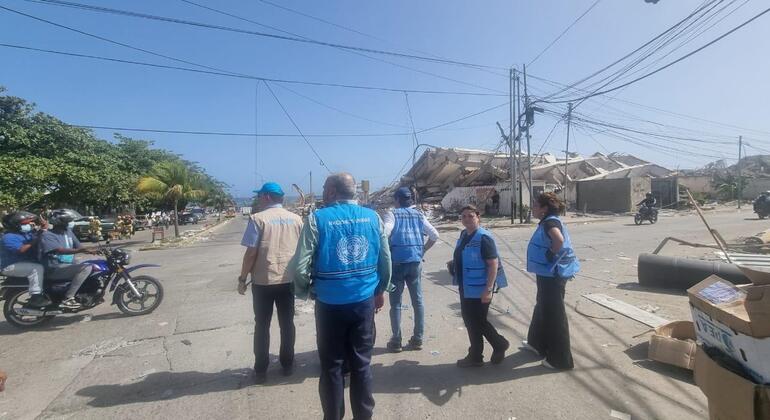
On Saturday, the UN’s humanitarian coordinator in Venezuela, Gianluca Rampolla, carried out an action his first mission to La Guairathe state most affected by the earthquake, accompanied by several UN agencies. The visit included a tour of some of the worst affected areas and the coordination center for search and rescue teams.
Together with authorities, the Mission has also made progress in identifying locations where services can be installed for families who have lost or cannot return to their homes.
Mr Rampolla stressed that, in addition to the destruction and suffering of the families, he noted that neighbours, volunteers and rescue teams from around the world had mobilized in support of the victims.
“At a time when we are always focused on the bad things happening in the world, here is a gesture of solidarity from all over the world to support Venezuelans,” he said.
“The first priority is to get those who are still alive from the rubble, which is why supporting and coordinating the teams arriving from all over the world is so important. At the same time, we must support the survivors.”
Teams from 27 countries, with more than 2,200 rescuers and 140 sniffer dogs, are working to locate people trapped under the rubble, with UN support in coordination.
Tom Fletcher, UN emergency response coordinator and head of the humanitarian organization, writes on social media OCHAemphasized that “every minute, every hour counts.”
A representative of the International Federation of Red Cross and Red Crescent Societies described the emotional impact of the search efforts, mixing hope, pain and fear of aftershocks.
“People have not lost hope. Hours pass, but all efforts are focused on saving lives and helping people,” he said. “The sense of community is enormous. There is a strength that comes from the desire to find friends and loved ones, and that comes with pain, with fear because the earthquake is still shaking, and with enormous vulnerability.”
Relief supplies are delivered to people affected by the earthquake in Venezuela.
A child emergency
UNICEF‘s new estimate reflects a crisis that extends far beyond collapsed structures. For hundreds of thousands of children, the earthquake has jeopardized access to healthcare, safe water, protection and education.
“Hospitals are operating beyond capacity, thousands of children do not have reliable access to clean water and many schools have been damaged,” said Manuel Rodríguez Pumarol, UNICEF representative in Venezuela.
“UNICEF is working with the Venezuelan government and its partners to scale up support for children and families, but sustainable financing will be essential to sustain the response in the coming weeks.”
The agency indicated that the damage to hospitals in La Guaira, Caracas, Carabobo, Aragua and Falcón is affecting the care of children and pregnant women.
In the Capital District, preliminary information indicates damage to 432 schools, more than a third of the total. Some schools that remain secure are being used as temporary shelters for displaced families.
UNICEF has mobilized additional staff and supplies to reach some 650,000 people, including 234,000 children, with support in health, nutrition, water and sanitation, child protection and education.
The agency’s first flight, carrying 20 tons of medical supplies and water and sanitation supplies, arrived in the country on Friday. A second shipment, from UNICEF’s global supply center in Copenhagen, is expected in the coming days.
The inside of a building in Caracas is exposed due to earthquake damage.
Hospitals are at their limit
The earthquake has increased pressure on the healthcare system. Preliminary assessments compiled by the Pan American Health Organization (PAHO) indicate that of the 21 reported facilities, three are in critical condition and another six have structural damage or are only partially operational.
Several hospitals continue to treat patients, but there is a high demand for trauma, orthopedic and neurosurgery. Identified needs include medicines, intensive care facilities, water, electricity and improved mechanisms for transferring and distributing patients between healthcare facilities.
In La Guaira, the UN has set up three field hospitals with intensive care units, treatment rooms and trauma rooms to extend care closer to affected communities.
PAHO – the regional office of the UN World Health Organization (WHO) – also supports Venezuelan authorities in assessing hospitals, coordinating emergency medical teams, and shipping medicines, trauma supplies, water and sanitation, and other essentials.
The assessments also indicate an urgent need for mental health and psychosocial support for those affected, families searching for missing persons, healthcare workers and first responders.
From rescue to supporting families
During the visit to La Guaira, the United Nations and the authorities agreed to establish multi-service areas in two strategic points of the state to support those who have lost their homes or cannot return to them.
These spaces will provide food, medical care, water, sanitation and hygiene, as well as protection services for children and adolescents, as well as prevention and response to gender violence.
As the days pass, needs multiply. For the affected families, the emergency does not end with the rescue operations: it also means securing safe water, medical care, a place to sleep and conditions in which children can recover and resume their learning.