How ‘camp’ went from Roman military lodgings to summer cabins : NPR
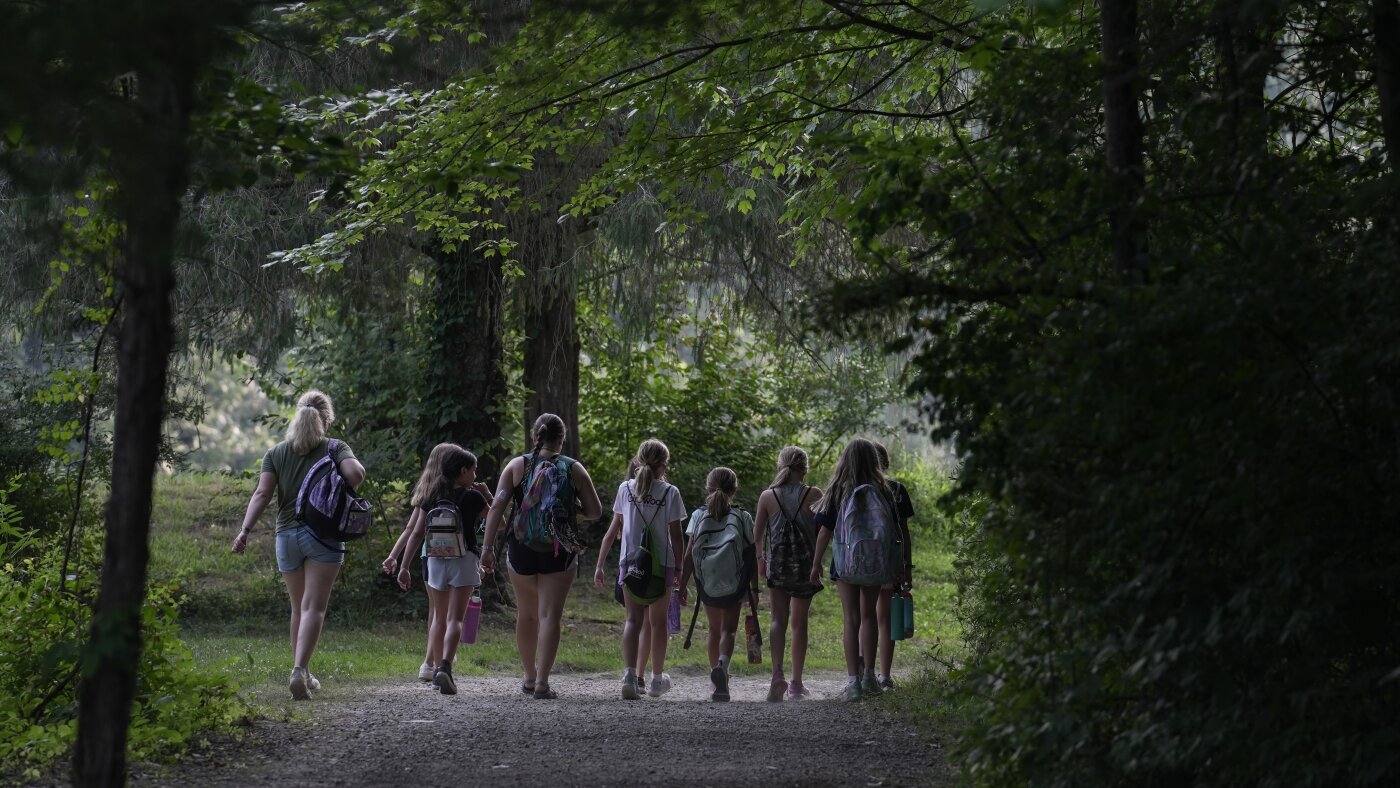

Counselors and campers pictured at YMCA Camp Kern in Oregonia, Ohio, in 2024.
Joshua Bickel/AP
hide caption
toggle caption
Joshua Bickel/AP
Classrooms have emptied out, the solstice sun has reached its zenith, and parents are coating their children in sunscreen and bug spray to participate in that annual tradition: summer camp.
“Camp”: It’s a word that’s become a large part of American children’s lives, encompassing everything from sleepaway camps in the woods to day programs at community centers. But the earliest roots of the word in the early 1500s have very little to do with summer recreation, according to Jennifer Hurd, an editor and lexicographer from the Oxford English Dictionary. In fact, it had everything to do with the Roman military.
“If you talk about a summer camp now, I’m pretty sure that nobody would think about the Romans,” she says.
In this installment of NPR’s Word of the Week, we’re going to camp — all the way back to the 16th century military quarters —and how it became entrenched in American childhood thanks to societal fears about modernity and masculinity.
From the military to the mountains
Like many other words in the English language, Hurd says, the word comes from the French word camp, which means temporary military lodgings. The French word was derived from the Latin campus, or a field where troops would marshal for drills, according to David Wilton, a lecturer in Texas A&M University’s English department and the publisher of WordOrigins.org.
It was in that military context that the first use of “camp” was recorded in the early 1500s, Hurd says. The story itself was a less-than-flattering tale of retreat.
“The first [documented use], in fact, is about an army that had refused battle, or is said to have refused battle, and conveyed themselves out of their camp in the middle of the night,” she says. “In other words, they had been encamped somewhere and they had packed up in the middle of night and disappeared.”
Over the years, “camp” started showing up in the civilian world, Wilton says. First, there were mentions in the 1560 Geneva Bible, an early English translation, referring to the camps set up in Sinai by the Jews leaving Egypt, he says. Later, it was used to describe the sites created by nomadic groups like the Romani people. By definition, Wilton says, “Camp could not be a permanent dwelling.”
In the centuries that followed, the use of the word “camp” expanded even further, Hurd says, showing up in documents from the 1700s about surveyors and lumbermen encamped together. The 1800s saw references to a sugar boiler “busy in his camp” and sport hunters setting up temporary shelter. The meaning was more utilitarian than recreational, she says.
It wasn’t until the late 1800s that “camp” began to become more about fun than function. One of the earliest references to summer camps for children came in 1876, Hurd says: “It’s actually from a Rhode Island newspaper that’s talking about someone wanting to establish a camp for boys among the mountains.”
Funnily enough, though, the first-ever reference to “summer camp” in the written record goes back, once again, to the Romans, Hurd says. A Latin translation of a 1606 document, she says, “recounts the story of how a particular Roman general, unfortunately, fell sick and died in his ‘summer camp.’ ” (Much less fun than retiring to a tent after stargazing and ghost stories.)
A place to become ‘manly men’ and learn ‘American values’
By the 20th century, going to summer camp was a bona fide movement in the United States, according to Leslie Paris, a history professor at the University of British Columbia in Vancouver, Canada.
That was no accident of history. The very first summer camps arose from the anxieties of “middle-class white men,” in the late 19th century as many areas of the U.S. became more urban and industrial, Paris says. They were concerned about “the boys who they assumed would grow up to be national leaders,” she says — but worried that, as cities expanded and children spent less time in nature, they wouldn’t be up to snuff.
“They were worried that without access to wilderness and testing adventures, that these boys would not have the skills that they needed to grow into the kinds of manly men that they were imagining,” she says.
Meanwhile, there was the growing sense in the U.S. that childhood should be a “special time,” Paris says. The school year was longer than ever before — why shouldn’t summer be a time reserved for play, instead of work?
So, by the turn of the 20th century, summer camp expanded from the realm of boys in the woods to enrichment programs that included girls and working-class immigrant children, too. That was particularly true near major urban areas, where parents were eager to get their kids out of the city during the summer to avoid the polio epidemic, she says.
From the outset, these camps were not designed to be wild rumpuses in nature; rather, they were “carefully controlled adventures,” that were managed by adults, Paris says. And as children of all backgrounds, particularly immigrant children, began to attend summer camp, they became “perceived to be spaces where children could be Americanized, could be taught American values.”
It wasn’t all about ideology, though. By design, Paris says, camp became a place where children could spend an extended period of time — often for the very first time — away from their parents, away from the responsibilities of factory and farm jobs, to finally experience childhood.
Source link