Arizona’s Tommy Lloyd leads coaches’ pushback as Big 12 weighs 20‑game conference basketball schedule
Overview:
The Big 12 is weighing a move from 18 to 20 conference games as coaches push to keep scheduling flexibility. Arizona’s Tommy Lloyd and league officials outlined competing priorities during the conference’s spring business meetings in Texas.
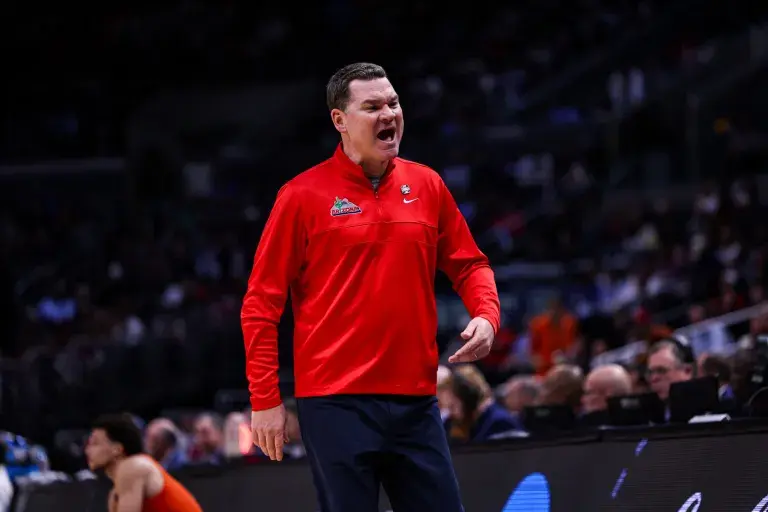
PHOENIX – Tommy Lloyd didn’t wait long to make his position clear.
The Arizona men’s basketball coach opened the Big 12’s spring business meetings by drawing a sharp line between where coaches stand and where the league appears to be headed on conference schedule expansion. The divide centers on whether the Big 12 should keep its current 18-game conference schedule or expand to 20.
“You know us coaches,” Lloyd said. “I think there’s kind of a general consensus. We’re really happy with the 18. We think that gives us the best flexibility for us to schedule accordingly with our nonconference schedules based on the needs of our program.
“There’s going to be a push from the conference level to get 20 games because they want more content, more content. When we do become media free agents in 2030, obviously, they think more content equals more value.”
The Big 12’s annual spring business meetings, held this week in Frisco, Texas, brought together men’s and women’s basketball coaches with league officials to discuss a wide range of issues shaping the conference’s future.
Topics included NIL, international competition, NCAA Tournament expansion, and the aforementioned conference expansion.
“For me, I’m a strong proponent for the 18-game schedule,” Lloyd reiterated, “but unfortunately, I don’t know if I get a vote on the issue.”
While Lloyd made his stance clear on one end, West Virginia coach Ross Hodge seemingly liked the possibility of a 20-game campaign.
“I think any time you get a chance to schedule more aggressively without feeling like it’s hurting you is good for your brand individually and collectively, the strength of the league,” Hodge said.
“So with the additional games, with an expansion, you know, it just allows for more big swings. And if you take big swings, you are going to miss some, but you don’t feel like you’re getting punished for swinging and missing.”
The Big 12’s chief basketball officer, Brian Thornton, acknowledged internal discussion of conference schedule expansion.
“I think it’s on the table,” Thornton said. “No decisions have been made. This week was the first time we really dove into that conversation. We understand that people have to plan accordingly, and if we decide to move in that direction, it needs to happen fairly judiciously and quickly.”
Even if conversations have only occurred recently, it’s clear that the idea has been brewing for some time.
“I think the conversations around why we’re even talking about it are around the fact that, one, we have media free agency coming up in 2030, and the more quality games, the better,” Thornton said. “It’s been proven, based on the ratings and whatnot, that our conference games have a significant rating, whether they’re on any of our media partners.”
Taking coaching concerns into account, Thornton concluded by encapsulating the dichotomy of the schedule expansion discussion.
“We certainly understand the flexibility that takes place with our coaches’ desire to build out their schedules,’ he said. “Also understanding that the world is changing around us and that there is a desire of our institutions to play more.”
While the men’s side engages in a tug-of-war, the women’s schedule is not expected to change. Big 12 vice president of women’s basketball Dayna Scherf said “right now, there is no expanding beyond 18” for women’s basketball, noting that the men’s schedule often affects the women’s cadence and TV windows.
Beyond the looming possibility of a 20-game season, NCAA Tournament expansion was seen as a net positive for both the men’s and women’s game.
“It’s the greatest experience that we have in college athletics,” West Virginia women’s coach Mark Kellogg said. “To give – whether it’s players, coaches, fans – opportunities to experience and whatever that looks like in your situation is fantastic.”
Oklahoma State coach Jacie Hoyt built on that sentiment.
“Great opportunities for so many,” Hoyt said. “I think with our conference in particular being as competitive as it is and kind of all beating up on each other and feeling like there were arguably a couple teams in our conference who very well could have been in the tournament this year, it’s going to open up those opportunities for teams like that.”
Among other topics discussed at the meetings, roster construction in the revenue‑sharing and loosened transfer portal era was a shared concern. Hoyt said coaches are “learning on the fly” as programs evolve to include GM‑style roles and adapt to new recruiting responsibilities with NIL.
Kellogg described the landscape as “changing by the minute,” adding that coaches must remain adaptable because “it hasn’t necessarily gone the way we thought.”
While the NIL era hasn’t gone as smoothly as many thought, Thornton noted that implementing a true hard cap to provide some stability is difficult because “as long as there’s outside money, the cap is never going to be hard.”
International games also surfaced as a growth opportunity. Lloyd noted how Arizona’s upcoming three-game series against European teams in Lithuania in August reflects the Big 12’s push to expand its global footprint.
“These guys do think big,” he said of league leadership. “They want big things, and they take big swings.”
On the women’s side, Kellogg praised neutral‑site and overseas games for helping elevate programs and the league.
“It’s all about exposure and growing the brand,” he said. “You want as many opportunities in front of as many eyes as you can.”
Coaches also weighed in on the proposed 5‑and‑5 roster rule, which would limit annual player movement.
“Just tell me what the rules are and let’s go,” Lloyd said.
Exposure and media reach were also recurring themes, especially for women’s basketball. Scherf said the league made “great strides” last season, with eight games on ESPN’s main network and record attendance at the Big 12 tournament. Hoyt furthered that sentiment, saying coaches are aligned on continuing to push visibility: “We all understand that the rising tide lifts all ships.”
While the topics varied, the emerging theme of this year’s meeting can be summed up in one word: expansion. The college basketball landscape is ever-evolving. Big 12 Conference officials and coaches understand they must balance the stability coaches want against the dizzying desire to innovate, increase revenue and keep up with the times.
Related

Source link