Why Rome is still the best city in the world to explore on foot | News
The result is compelling because the rankings are based on verified traveler activity, combining volume and satisfaction, rather than soft travel sentiment.
The center of Rome is accessible on foot because the main distances are short and the street pattern still retains the logic of an older city. Piazza Venezia, the Imperial Forums, the Pantheon, Piazza Navona, the Trevi Fountain and the Spanish Steps can be connected by routes where movement is as important as the stop.
This article explains where to start, which pedestrian areas deserve time, when public transport becomes the smarter choice, and why Naples serves as a practical complement to rail after Rome. Start in the middle. Walk with a purpose. Take advantage of public transportation when the distance starts to wear on the day.
Start at Piazza Venezia and let the city unfold
Piazza Venezia is one of the most convenient starting points for a first walk in Rome. The Via del Corso runs north, the Capitol is nearby and the Via dei Fori Imperiali leads to the Colosseum.
That route gives visitors a direct introduction to ancient Rome. Trajan’s Column appears first. The Imperial Forums, the Roman Forum, the Capitol and the Colosseum follow within a compact area. Turismo Roma describes Via dei Fori Imperiali through the forums of Caesar, Augustus, Nerva and Trajan, which explains why the street has more value than a connecting piece.
The best pedestrian zones for a first walk through Rome
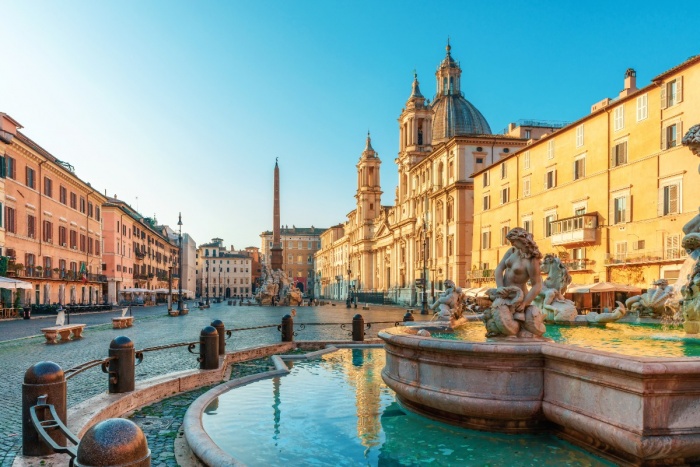
Via dei Fori Imperiali is the strongest route for ancient Rome, a long, linear experience with sweeping vistas, traffic light systems and entry and exit points around the Colosseum. The Centro Storico is an obelisk of a different kind: this walk can connect the Pantheon, Piazza Navona, Campo de’ Fiori, the Trevi Fountain and the Spanish Steps in one easy stroll.
Trastevere is good in the afternoon or evening, especially in and around Santa Maria in Trastevere and the small streets that lead from there to the river. The Jewish Ghetto and Tiber Island combine nicely for a short daytime walk that also brings in food, history and an up-close waterside experience. Villa Borghese and Pincian Hill are like a trip out of the city and a nice break from the well-visited historic center.
Choose one central starting point and then build the day around nearby clusters.
Why Rome’s metro in the center does less than visitors expect
Visitors who know Paris, London or Madrid can expect the metro to transport more of the central journey. In Rome, the network plays a smaller role in the historic core, because underground construction extends into archaeological layers beneath the modern city.
Metro C has made that tension visible. Work around the Colosseum and Porta Metronia stations uncovered material from Roman times, including ceramic objects, springs, remains of thermal baths, frescoes and mosaics. Some station designs are now integrating discovery into the passenger experience.
Short trips through the center are often more useful above ground. Walking avoids unnecessary travel and keeps visitors close to the squares, side streets, churches and ruins that give central Rome its value.
If you can no longer walk, use public transport in Rome appropriately
Rome is too big for a walking route. The center is suitable for pedestrians; the wider city requires better judgment.
Use public transport to the Vatican Museums and St. Peter’s Basilica if your accommodation is far from Prati. Do the same for EUR, the Via Appia, Ostia Antica, the Catacombs, the Olympic Stadium and Foro Italico. These places belong on a serious itinerary through Rome, but they’re far enough apart to punish poor planning.
Walk where distance adds context. Take buses, taxis, trams, metro lines or trains where the distance only takes time.
Naples is the smart add-on after Rome
Rome also serves as a base for broader trips. For visitors who want a second city without planning a complicated route, the high-speed line is the clear option: from Rome, in less than an hour you can reach Naplesmaking the city a realistic day trip or an easy next stop.
Naples offers a sharper change of pace: a denser historic center, vigorous street life, a serious food scene, and access to Pompeii and Herculaneum.
Rome rewards travelers who refuse to hurry
Rome’s place at the top of GuruWalk’s rankings is compelling because the central experience still belongs to pedestrians. Start from a central point, walk through the historic core, use public transportation for the suburbs, and take the train as the route expands.
Routes are more important than checklists. Rome’s best travel value often appears among the sights: an exit after a square, an open church door, a ruin next to a crossroads, a fountain at the end of a narrow street. Those moments require time on foot, plus the discipline to stop walking when the next place is on the bus, subway or train.