5 Best Time Clocks for Small Business in 2026
Small businesses need more than a basic punch clock. I reviewed top time clock systems and picked the best options for preventing time theft and tracking employee hours more accurately.
A good time clock does more than log when employees start and end their shifts. For small businesses, the right system can reduce payroll errors, control labor costs, flag missed breaks or overtime risks, and give managers better visibility into when and where work happens.
To find the best time clock for small business owners, I evaluated online time clocks and time tracking systems based on pricing, clock-in flexibility, security controls, reporting, ease of use, and overall fit for different types of small businesses. These are the five that stood out most.
Honorable Mention: When I Work
When I Work didn’t make my list because its time tracking tool is a paid add-on to its scheduling module. However, its affordable plans make it a good choice for budget-constrained companies. With monthly starter fees of $2.50 per employee for both its time tracking and scheduling modules, it’s priced much lower than busybusy and Buddy Punch whose scheduling tools are included in higher tiers.
To learn more about its features, visit When I Work or check out my When I Work review.
I have over eight years of experience reviewing, testing, and writing about HR and payroll software. I’ve evaluated dozens of systems designed to handle simple to complex HR processes for small to midsize businesses (SMBs) in different industries.
I also have 10 years of expertise handling various facets of human resources, including managing HRIS, time tracking, and pay processing software. These allowed me to provide insights to help business owners determine which HR platform best fits their needs.
To evaluate the best time clock for small business owners, I compared 23 solutions across 27 data points, prioritizing functionality, ease of use, and value for money. See my full methodology below.

Payroll & HR Software Expert at Fit Small Business
Best time clocks for employees compared
Homebase: Best overall time clock for small business

Pros
- Feature-rich platform; offers time tracking, scheduling, payroll, and hiring tools
- Basic time tracking and scheduling are included in the free plan
- User-friendly interface
- Can handle unlimited employees (on paid plans)
Cons
- Free plan limited to one location and only up to 10 employees
- Geolocation tracking, geofencing, paid time off (PTO) accruals, and overtime alerts are only included in paid plans
- Limited clock-in/out options; only via unique PIN codes
Overview
Who should use it:
Homebase is a strong choice for small businesses that want more than a basic time clock. It works best for hourly teams that need to manage scheduling, time tracking, and team communication in one system.
If you’re running a single-location business and want a free tool that can handle both time tracking and day-to-day workforce management, Homebase is one of the most practical options on the market.
Why I like it:
Homebase offers a free plan for one-location companies, which includes access to staff scheduling, communication tools, and employee time clock apps for multiple devices. Although it has a 10-employee limit, the free tier has the basic tools you need to manage employees.
I like how easy it is to use. Employees can clock in from shared devices, POS systems, or their phones, while managers can review hours, approve timesheets, and monitor attendance without much setup. Homebase even helps you stay on top of break rules and overtime by sending alerts and tracking hours automatically. This is especially helpful if you’re trying to control labor costs or avoid payroll mistakes.
Homebase also stands out because it combines time tracking with scheduling, onboarding, hiring, and payroll tools in a single platform. Instead of stitching together multiple systems, you can manage employee hours, shifts, and pay in one place.
These functionalities contributed to Homebase earning an overall rating of 4.45 out of 5. However, it’s not the most flexible option for clock-ins. It only supports PIN-based entries, so if you need facial recognition or biometric clock-ins, tools like Buddy Punch offer more control. You’ll also need to upgrade to a paid plan to unlock advanced features and live support.
- Free trial: 14 days of the All-in-One plan
- Plans
- Basic: $0 for one location and up to 10 employees
- Essentials: $30 per location monthly for unlimited employees
- Plus: $70 per location monthly for unlimited employees
- All-in-one: $120 per location monthly for unlimited employees
- Plan requirements: None
- Add ons
- Payroll: $6 per paid employee monthly + $39 base fee per month
- Tip manager: $25 per location monthly
- Background checks: $30 per background check
- Job post boosts: Starts at $79 per job post
- Task manager: $13 per location monthly
- Hiring assistant: Starts at $30 per post
- Compliance tools: Homebase tracks PTOs and sends overtime alerts so you know if employees are close to working overtime, making it easy for you to manage labor costs. You can set up break and overtime rules to follow federal, state, and local laws. This is a bit like 7shifts, which also has state-specific compliance features. However, Homebase takes it a step further by alerting you of changes in federal and state laws and offering live HR assistance if you have questions.
- Multiple job rates: If your employee works different jobs at different rates, Homebase can allocate hours by job and track employee time with multiple roles and wage rates. This simplifies payroll calculations and reporting.
- Feature-rich free option: This tier includes time clock apps that work on multiple devices. You can create weekly schedules, capture and monitor employee attendance, store timesheets for 90 days, integrate with POS software, and message team members in real time. It’s one of the few options in this guide that lets you run basic operations without paying upfront.

With Homebase’s time clock apps, you can clock in/out from desktop computers, laptops, tablets, and smartphones. (Source: Homebase)
Deputy: Best for seasonal businesses

Pros
- Easy to set up, learn, and use
- Available in 100+ countries
- Flexi Weekly plan with reduced pricing for those with only a few people on schedules
- Sandbox environment for training and testing features
Cons
- Facial recognition clock-in verifications, auto-scheduling, and demand forecasting included in higher tiers
- All plans, except for the Flexi Weekly option, require a monthly minimum spend of $30
- Starter tier only comes with email support
Overview
Who should use it:
Deputy ranks second on my list of the best time clock for small business owners because of its Flexi Weekly plan for seasonal companies. While the plan includes complete access to Deputy’s time tracking and scheduling tools, you only pay the full rate for active employees and a minimal fee for inactive workers. If your workforce size changes frequently, it’s one of the few tools that lets you control costs without constantly adding and removing employees from the system.
Why I like it:
Deputy stands out for its flexible pricing model, particularly its Flexi Weekly plan, which lets you pay full rates only for active employees while keeping inactive workers on standby at a lower cost.
Its time clock tools support multiple clock-in methods, including facial recognition and PIN codes, giving it more flexibility than options like Homebase. Deputy sends break reminders and allows employees to confirm whether they’ve taken required breaks, which can help reduce compliance risks. It also works in over 100 countries and supports multiple languages, making it a good option for businesses with diverse or distributed teams.
In my evaluation, Deputy earned an overall score of 4.23 out of 5. Its general ease of use and efficient time tracking tools contributed to its high scores. However, the required monthly minimum spend may not suit very small teams, and some features, like geofencing and multi-device tracking, require higher-tier plans.
- Free trial: 31 days
- Plans
- Lite: $5.50 per user monthly
- Core: $7.25 per employee monthly
- Pro: $10 per employee monthly
- Flexi Weekly: Call for a quote
- Plan requirements: Minimum monthly spend of $30 for all plans (except the Flexi Weekly option)
- Add ons
- Deputy Payroll (enabled by Paycor): $8 per user monthly + $49 base fee
- Messaging+: $1.95 per user monthly
- Analytics+: $1.50 per user monthly
- HR: $2 per employee monthly; available for clients in the US, UK, and Australia; includes onboarding, document management, staff surveys, applicant tracking, job advertising tools, and a personalized career hub
- Special plan for seasonal or rotating workforce: If you have big seasonal fluxes or a rotating schedule of week(s)-on/week(s)-off, Deputy might be a more cost-effective option. Rather than paying for all employees all the time, you pay only for active members, with the others in archive for easy reactivation. The Flexi plan includes both scheduling and time clock machine features. It’s unique to any plan I’ve researched.
- Calculate wages: If you’re already using a payroll software, Deputy integrates with multiple popular pay processing systems. Plus, its online timesheets allow you to calculate wages, including overtime and penalties. Most software on my list will require you to input or transfer the information into payroll systems.
- Voice-command clock-ins: Deputy allows employees to clock in with voice commands, a feature I did not find in other employee time clocks on my list.
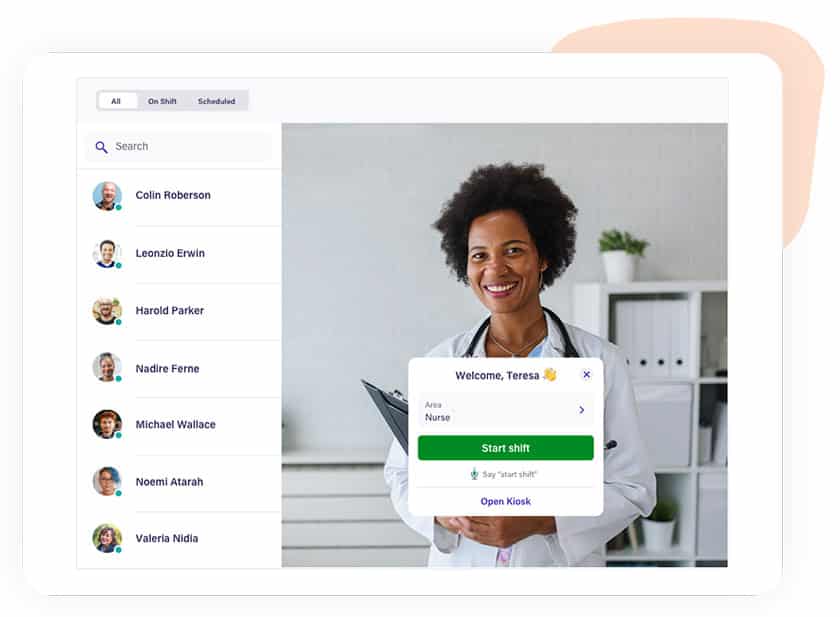
With the Deputy Kiosk app for iOS and Android tablets, employees can clock in/out via voice commands and facial recognition. (Source: Deputy)
Buddy Punch: Best for preventing time theft

Pros
- User-friendly platform
- Multiple clock-in/out options; supports PIN code, facial recognition, QR code, and username with password time entries
- Offers a payroll add-on
Cons
- GPS tracking and scheduling tools are available in higher tiers
- Lacks phone support
- Expensive for only a few users
Overview
Who should use it:
Buddy Punch is a strong fit for businesses that need tighter control over employee time tracking, especially those with field workers or teams spread across multiple locations. If time theft, buddy punching, or inaccurate clock-ins are a concern, it offers more verification options than most tools in this guide.
Why I like it:
It lets employees clock in via QR code and has facial recognition, passwords, and PINs to avoid buddy punching. It even allows field workers to clock in by sending a text message in case their mobile devices have intermittent internet connection.
I also like that it adds an extra layer of accountability by capturing photos during clock-ins, which you can review directly from the dashboard. This is especially useful for businesses managing remote or field teams. If overtime is a concern, the system sends email or mobile notifications so that if an employee is nearing overtime for the week, you can adjust your planned schedule.
Buddy Punch earned an overall rating of 4.20 out of 5 in my evaluation, with perfect scores in reporting, security, and user reviews. Meanwhile, the lack of live phone support and a free tier, including its expensive plans pulled its overall rating down.
- Free trial: 14 days
- Plans
- Starter: $5.49 per employee monthly + $19 base fee per month
- Pro: $6.99 per employee monthly + $19 base fee per month
- Enterprise: $11.99 per employee monthly + $19 base fee per month
- Plan requirements: None
- Add ons
- Payroll: $6 per employee monthly + $39 base fee per month
- Data retention: $2 per employee monthly
- Custom reporting: $2 per employee monthly
- Scheduling: $1 per employee monthly; included free in the Pro and Enterprise plans
- Real-time GPS: $2 per employee monthly; included free in the Enterprise plan
- Job codes: Like Homebase, you can assign job codes so that employees can clock in and out by job. It even lets employees designate or assign time to customers, making it easier to track billable hours and labor costs across projects or clients.
- SMS clock-in: For employees who travel or work remotely, you can set up SMS clock-in via Zapier. This allows field workers with bad data connections to clock in by sending a text message to a specific number. The other time clocks for employees on my list don’t have this feature.
- QR Code punch-in: Buddy Punch is the only time clock on the list to provide QR-code punch-in capabilities. Employees are given a unique QR code so that you can track them in real-time or let them scan it for self-reporting. If your employees are using a device with a webcam, Deputy will automatically take their picture so you can check who actually clocked in/out.
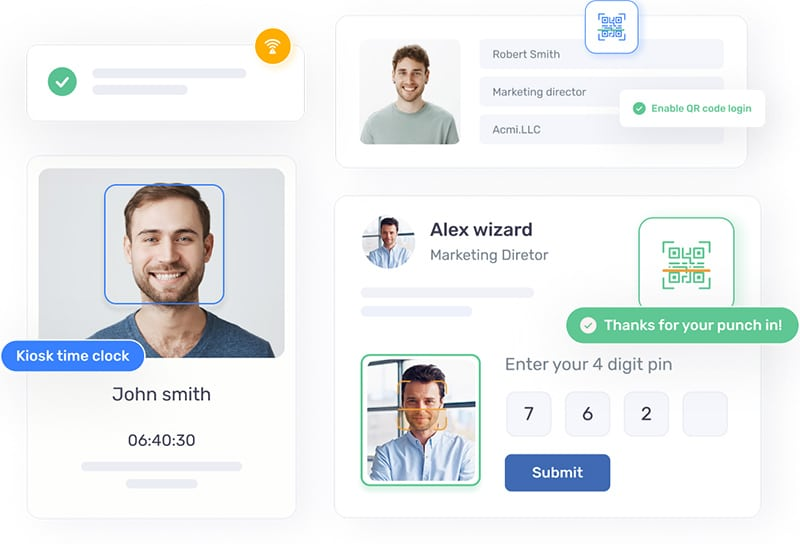
With Buddy Punch, your employees can clock in/out using a PIN, SMS message, QR code, facial recognition, or username and password. (Source: Buddy Punch)
busybusy: Best for field employees

Pros
- Job costing codes include instructions and color-coding
- Safety and project reports
- Offers a 90-day money-back guarantee for new clients
Cons
- No phone support
- No overtime alerts
- Standard reports only
Overview
Who should use it:
For workers on the move who may go from project to project—like plumbers, landscapers, or construction workers—busybusy offers a time clock and scheduling tools to make tracking time on site and on the job easier.
Why I like it:
busybusy is built for field operations, not just general time tracking. Its geofenced clock-ins with facial recognition help ensure employees are clocking in at the correct job site, which reduces time theft and improves accountability for off-site teams.
I like how it goes beyond basic time tracking by tying hours directly to jobs, equipment, and daily reports. You can track which employees are working on specific tasks, where they are located, and what equipment they’re using—all in one system. This is especially useful for businesses that need detailed job costing or want better visibility into field operations.
It also offers team messaging tools, client billing capabilities, in-app timecard signatures, and shift reports to capture workplace injuries and illnesses, which is great for complying with Occupational Safety and Health Administration (OSHA) reporting requirements.
busybusy earned an overall rating of 4.10 out of 5, with high marks for security, user reviews, and time tracking capabilities. However, it lacks overtime alerts, has limited report customization, and does not provide phone support.
- Free trial: 14 days
- Plans
- Free: $0; includes unlimited users, GPS time tracking, job costing, and equipment tracking tools
- Pro: $11.99 per employee monthly + $40 admin license (first user included)
- Premium: $17.99 per employee monthly + $40 admin license (first user included)
- Plan requirements: None
- Add ons
- Payroll: Call for a quote
- Daily reports: busybusy allows for full daily construction reports. It automatically adds weather reports, lets you upload photos of progress or trouble areas, tracks hours and cost codes, lists equipment, and records digital signatures.
- Cost codes: While some of the software on my list, like Deputy, lets you create job codes, busybusy goes beyond that by attaching special instructions for the codes and adding colors for specific jobs to help keep your workers organized. Employees can switch between projects and cost codes.
- Equipment tracking: This is the only time clock software that also tracks equipment and operator time, a vital component of job costing.
- Safety reports: busybusy is the only time clock for small business owners on my list that lets you file safety reports, record incidents, and collect daily sign-offs. This supports OSHA compliance and helps reduce administrative work for field supervisors who need to track and report injuries that happened on the job.
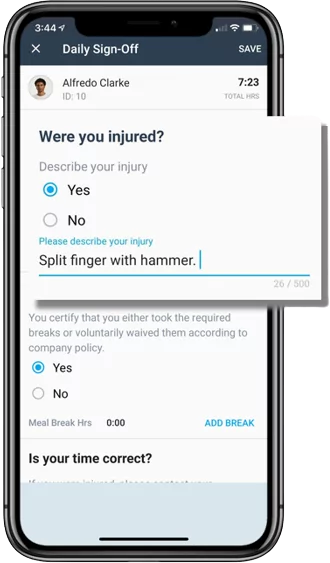
With busybusy, you can add injury reporting in employee clock-outs to capture workplace injuries. (Source: busybusy)
7shifts: Best for restaurants
Pros
- Intuitive interface
- Robust reports and POS integration options
- Strong compliance tools for employees who are minors
Cons
- Plans are by location; can be expensive for small staff sizes
- Many of the features are in the higher plans
- Lacks phone support; has live chat and email support but available only in paid plans
Overview
Who should use it:
7shifts is the best time clock for restaurants and food-service businesses because of its shift-swapping capabilities, employee health checks, forecasting, and tip tracking tools. It also offers time clock apps that work on computers, tablets, smartphones, and POS devices.
Why I like it:
With a platform designed specifically for restaurants, 7shifts makes it easy for you to manage employees and process staff payments by automating tasks. For example, it automatically calculates actual hours worked, wages, tips, and deductions by gathering the required attendance and pay data from its various modules.
Its compliance tools make it a good option for industries hiring minors, who have more rules concerning breaks and work hours. It also has a wide range of add-on products to help you track tips, tasks, checklists, new hire onboarding, and labor performance.
In my evaluation, 7shifts earned an overall rating of 4.08 out of 5. I would have given it higher scores if live phone support and GPS tracking tools were available in all plans. Plus, many of its advanced features, which the other time clocks on my list provide in lower tiers (like task notes and compliance tools), are with the higher plans.
- Free trial: 14 days
- Plans
- Comp: $0 for one location and up to 15 employees
- Essentials: $44.99 per location monthly for up to 30 employees
- Pro: $89.99 per location monthly for up to 60 employees
- Premium: $149.99 per location monthly for unlimited employees
- Plan requirements: None
- Add ons
- Tip management: $49.99 per location monthly
- Task management: $12.99 per location monthly
- Employee onboarding: $2.99 per onboarding package sent; for US clients only
- Manager logbook: $14.99 per location monthly; includes a customizable digital logbook to keep managers in sync across shifts
- Restaurant-specific tools: Integrations with over 25 POS systems, tip pooling and calculations, and specialized employee health checks make this a top choice for the restaurant industry. 7shifts also offers discounts to franchises.
- Labor compliances: While most of the software on my list lets you schedule break reminders and offer overtime alerts, 7shifts goes further by including state compliance rules. This saves you from manually inputting the federal, state, and local laws that apply to you. Minors are also flagged so managers can keep this in mind when scheduling.
- Clock-in limits: One unique feature of 7shifts is that it only allows people who are scheduled to clock in, which can save you unbudgeted labor hours. It also has facial recognition, geofencing, and early clock-in prevention.
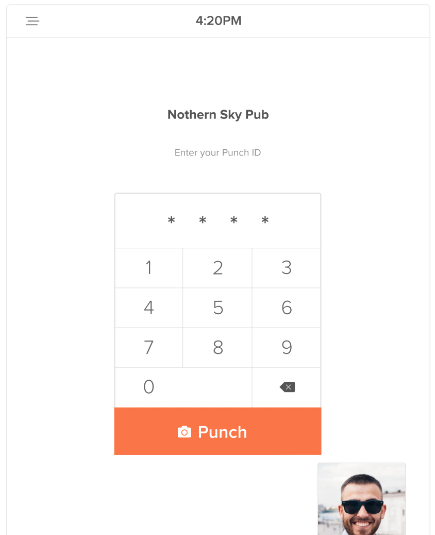
7shifts has a facial recognition tool that verifies if the snapshot of the employee clocking in matches the image saved in its system. (Source: 7shifts)
Benefits of Using Time Clock Software
Relying on pen and paper to track employee time can be a cause for errors. However, using a time clock or time clock software that allows employees to clock in and out on a device can ensure accuracy when processing payroll. Below are additional benefits of using time clock software:
- Accountability: If you require a central place for workers to clock in and out, an employee time clock helps them stay accountable. However, this can only work for businesses in the manufacturing, retail, restaurant, and healthcare industries. Construction and transportation businesses with field workers may need flexible time clock options, such as clocking in/out via smartphones.
- Labor law compliance: Time clock software can help your business stay compliant by remaining updated on all applicable state and federal laws.
- Accuracy: By having employees clock in and out through software, managers can instantly check and approve time, thus increasing accuracy in time records and pay processing.
- Improved management: Because managers have the ability to review and approve timesheets within the software it increases overall management.
- Reduced time theft: Time clock software ensures individual employees only clock in for themselves by mandating PIN codes, facial recognition, and biotechnology.
How to Choose an Employee Time Clock
Choosing the best time clock for your small business doesn’t have to be difficult. Start by understanding what you want from the time clock software. Consider your business situation and ask these questions:
- Do you require multiple clock-in options? Most employee time clocks allow your staff to clock in via PIN code, QR code, and facial recognition scans. A few others only come with a simple clock in/out button.
- Do you have a problem with early clock-ins? Most time clocks for employees can prevent this.
- Do you want to enforce manager approval of overtime? Some time clocks notify managers when an employee is late clocking out or nearing overtime hours, while others ping the employee with a reminder to clock out after shift.
- Does your state enforce breaks and lunches? Some time clocks let you set these rules.
- Do your people work outside of the office? Some time clocks have mobile apps with geofencing that lets employees punch in when they are on location.
- How important is it to integrate with your payroll software? The top cloud-based time clocks for small business owners usually include integrations with popular software, while others create CSV files you can upload. Meanwhile, the best time card machine providers let you download a file to upload into your payroll software.
- Do your employees need to track time to specific projects? While time tracking systems capture when employees clocked in/out for work, some allow you to track the time workers spend on projects, including the applicable labor costs.
- What kind of time clock device do you need? Most time clocks for small businesses operate from tablets—usually iPads. However, some have their own employee time card machine. These cost $200 to $500, depending on features, which is less than an iPad. However, they usually have less robust software.
- How much are you willing to spend? Naturally, price is a consideration. Most come with monthly fees, especially if they have cloud-based software or mobile apps. Keep in mind, however, that you are paying for convenience—time clock software is usually more accurate, includes rules and reports that help you with compliance to state break laws, and makes it easier to create timesheets or integrate straight to payroll software.
Methodology: How I Evaluated the Best Time Clock for Small Business
To create this list of the best time clock for small business owners, I used a rubric that compared 23 time card machines and time tracking software across 24 data points. I compared each option based on pricing, time and attendance features, ease of use, security controls, reporting, and user reviews. I also added my expert rating to each criterion, where I considered the effectiveness of that area or feature.
I prioritized those that make it easier for small businesses to track time accurately, control labor costs, reduce time theft, and sync hours with payroll. I also considered real-world usability, such as clock-in flexibility, mobile access, compliance tools, and integrations with payroll, POS, and scheduling systems.
While I wasn’t able to test all of these tools, I checked video tutorials if available and user reviews for feedback about the system’s overall ease of use and functionality. Of the 23 solutions on my list, I narrowed it down to the five best time clocks for employees.
Below is my full evaluation criteria:
- Pricing 20%: I checked if the provider has a free plan and transparent pricing for its paid tiers. I also considered the cost of subscriptions and gave those priced at $10 or less per employee monthly extra points. I did not include hardware price because even the software-based time clocks would require a tablet or computer if you want an on-location kiosk.
- Time & attendance tools 20%: The best time clock should include basic time tracking tools, such as exportable time data, multiple time clock types, break and PTO tracking, and administrator alerts. Plus, having access to mobile apps and a self-service portal is also ideal.
- Ease of use 20%: Having a time clock and time tracking software that are intuitive and easy to learn is a necessity. I also looked at whether the provider offers live phone support, training, quick system implementations, and integration options with payroll, POS, and scheduling systems.
- Security features 20%: Geofencing, geolocation tracking, and multiple clock-in/out options (such as fingerprint, badge, and pin code) are just some of the essential functionalities that I looked at. I also checked whether or not the software can set up approvals and limit early time-ins.
- Reporting 10%: Aside from having access to standard and pre-built reports, the time clock tool should have report customization options.
- User reviews 10%: I checked the reviews that actual users left on third-party sites (like G2 and Capterra) and looked at complaints and overall user scores.
Frequently Asked Questions (FAQs) About Employee Time Clocks
The best time clock app is Homebase. It does more than just allow your employees to clock in and out from their mobile devices—it will allow you to send and approve PTO requests, create schedules, track locations, and send attendance-related alerts. It even helps you hire, onboard, and pay workers.
While several time clocks have their own devices, many will work using a tablet or even your employee’s mobile phone. These are usually cloud-based and come with additional software features.
Each time card machine or software has a unique way for your employees to clock in and out. The oldest models used time cards that literally punch in times. These still exist, but none made my list. The most convenient allow facial recognition, thumbprints, and/or a PIN code to clock in. In those cases, the employee simply follows the directions on the pad. Some have geofencing procedures that let the employee clock in on their mobile device provided they are in a certain area of the workplace, which is great for out-of-office workers like construction or catering.
Source link