Don’t worry about the Eiffel Tower view: these are the hotels in Paris worth booking for their design alone | News
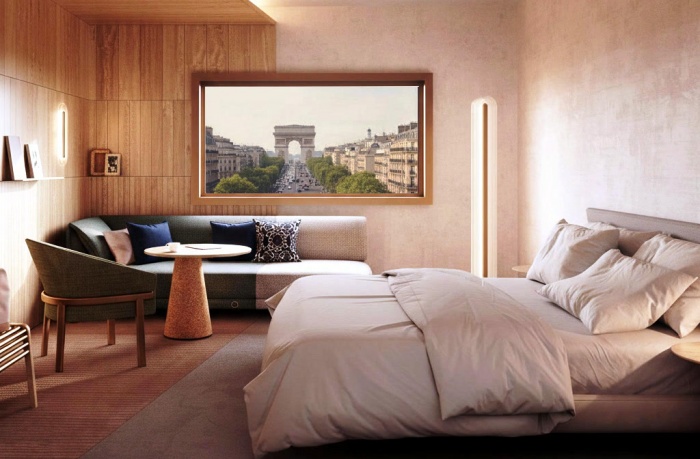
Paris has quietly become one of Europe’s most interesting testing grounds for design-led hospitality. It is not unusual to enter a hotel in France and be immersed in iconic furnishings Line RosetDe Sede or Fermob. The properties that are now attracting interior design-conscious guests in Paris are those where the choices go deeper, where furnishings are selected or commissioned with the same precision as applied to the architecture. The following hotels make a compelling case for staying somewhere where interiors are taken as seriously as service.
1) Hotel Novotel: France finally has a warm minimalism experience worth booking
When Novotel launched a global design pitch to redefine its room concept for the 21st century, Belgian designer Ramy Fischler, working through his studio RF Studio, was among the four international teams selected. The result, produced by Ligne Roset Contract, is now visible in two buildings in Paris: Novotel Paris Les Halles, a stone’s throw from the Louvre and the Center Pompidou, and Novotel Paris Orly Rungis, near the southern gateway to the city.
What makes the Fischler concept worth paying attention to is its restraint. The palette consists of warm neutrals and soft pastels, and the sofa bed and headboard, produced by Ligne Roset Contract, are the anchoring pieces. The headboard integrates a reading lamp and a socket directly into the structure; the kind of details that go unnoticed when it’s working correctly, and that’s exactly the point. In addition to the rooms, the Atelier H event space was redesigned by Scottish designer Jim Hamilton, drawing on the material history of Les Halles (mosaic, wrought iron, steel) to create a setting that feels rooted rather than generic.
2) Hotel Dandy: the eclectic interior of Paris that no one saw coming
A few minutes’ walk from Les Halles, Hotel Dandy occupies a completely different position. A four-star hotel developed by the Elegancia group in collaboration with architect-decorator Michael Malapert. It engaged Roche Bobois Contract to design custom furniture for each of the 36 rooms; no two configurations are identical. The brief was eclectic Paris: teal and petrol blue, chessboard tiles, dark furniture against light marble and wood, the kind of interior that references a Parisian café without imitating one.
Roche Bobois Contract developed wardrobes, headboards and bathroom furniture, combining marble, metal, mirror and wood: each piece was designed to fit the specific geometry of the room. For a small hotel building a distinct identity, this level of artisanal investment communicates something to guests that no amount of lobby art direction can replace.
3) Hotel Lutetia: why this 100-year-old hotel in Paris feels more relevant than ever
On the Left Bank, the only major hotel on that side of the Seine, Lutetia’s architecture moves between Art Nouveau and Art Deco, with history interwoven into the cultural fabric of Saint-Germain-des-Prés. During the recent renovation, led by Jean-Michel Wilmotte, the Italian furniture brand Poliform Contract was called upon to furnish the common areas: the concierge, the atrium, the salons, Bar Joséphine, the Orangerie, the library and the Brasserie.
Wilmotte’s approach was to honor the hotel’s layered past without freezing it in amber. Swivel leather armchairs in anthracite, light-colored stools with wooden legs, round side tables, custom-made counters: the material language is precise, refined and deliberately unhurried. The Lutetia does not have to announce itself. It’s just that way.
4) Hotel Bvlgari: Italian luxury just landed on Avenue George V
On Avenue George V, in the heart of the Golden Triangle, the Bvlgari Hotel Paris, designed by Antonio Citterio and Patricia Viel with the French firm Valode & Pistre, offers a study in the dark register of contemporary luxury. The lounge areas are furnished with the Feel Good sofas and armchairs from Flexform, Guscio and Happy chairs and Dida tables with marble tops. Deep tones, leather surfaces, polished wood, gray marble: the atmosphere is completely considered.
In a more secluded wing of the lounge, Happy armchairs with hand-woven leather backs and the skinny Happy Hour chairs at the bar complete a space that feels both lush and lived-in. The Italian hospitality ethos, meticulous without being formal, finds an unlikely but coherent home in one of Paris’s most emblematic neighborhoods.
5) Hotel Tsuba: This understated hotel in Paris is quietly winning the design game
Located a short walk from the Arc de Triomphe, the four-star Tsuba Hotel takes a warmer approach. Porada furnished the bedrooms with pieces from the most recognizable collection (the Andy chair, Ziggy consoles and bedside tables, the Webby sofa), working in warm wood tones and cushions with geometric patterns. The palette reads more inviting than imposing.
Walnut desks, beige leather armchairs with matching ottomans, blue upholstered sofas with buttoned cushions: the choices are specific enough to feel personal, and understated enough to let you relax rather than sit back and admire. It is a room that functions as a refuge, without pretending to be something that it is not, which is more difficult to achieve than it seems.
This is the real reason these Paris hotels are worth the price
The trend is not limited to Paris, but the city is accelerating it. As more hospitality groups commission work from serious design houses instead of contract furniture suppliers, the gap between a well-designed hotel room and a well-designed home is closing, and guests are starting to notice. Booking patterns change. Reviews mention sofas and headboards in addition to the location and breakfast.
What this means in practice is that the research worth doing before a trip to Paris has expanded. Maps and star ratings only tell part of the story. Knowing who designed the room and who made the furniture is increasingly the kind of information that turns a good stay into one you’ll remember.