Why women in groups face a ‘collaboration penalty’ that solo female stars like Taylor Swift and Coco Gauff escape
When Taylor Swift’s Eras Tour became the highest-grossing concert tour of all time in 2024, taking in more than $2 billion, it was hailed as a breakthrough for women in music.
But Swift’s success, it turns out, didn’t translate into broader gains for female artists. Taking a closer look at the list of top-grossing tours, we see a clear pattern: in the top 27 highest-grossing tours of all time, there are no all-female ensembles, while 14 are all-male.
The same discrepancy occurs in album sales: no all-female groups make the top 100 best-selling artists of all time, while 41 all-male groups do.
Does Swift’s success stem from her status as a solo artist? As management scholars who have studied organizational behavior and workplace bias, we argue that this is the case. And it points to a broader conclusion: women who work in same-sex groups face a “collaboration penalty” that solo women escape. Our research found that this pattern holds true for venture capital, professional sports, healthcare and entertainment.
Why? Our research shows that this is because all-women groups are seen as more threatening, as they are more likely to challenge power structures through collective action. Surprisingly, this perception was shared by both male and female study participants – that is, women applied these biases to all-female groups, just as men did.

Stephen Mease on Unsplash, CC BY
The law of disappearance of venture capital
The clearest evidence comes from startup financing.
Despite years of diversity initiatives, all-female founding teams receive just 2.4% of venture capital dollars – a figure that has barely increased in three decades.
What explains this dramatic gap? We designed an experiment in which participants evaluated venture capital pitches that were identical in content but varied by gender and solo versus team status. The study participants described that all-female investor groups are much more likely to engage in “social competition” – that is, challenging existing power structures through collective action. All-male groups had no such perception, even when they made identical investment decisions that prioritized diversity.
This prejudice was important. Our research found that those perceived as ‘socially competitive’ were less entitled to funding and resources. The punishment was not about competency or performance because the fields were the same. It was about how group composition raises assumptions about motivation. All-female teams were seen to be pursuing an agenda; All-male teams simply did business.
Why women on teams pay a fine
The music industry tells the same story.
Solo women can reach the climax. Taylor Swift, Beyoncé, Madonna and Pink are all among the top music earners in the world. But their success makes the absence of all-female groups even more glaring. If individual women can succeed at the highest levels, why can’t groups of women work together?
Our research into top sport provides insight. We analyzed prize money from 1,145 major international competitions in 44 sports from 2014-2021. Solo men and solo women earned similar amounts. But in team sports, a huge gap emerged, with all-female teams earning less than half of their male counterparts.
This wasn’t about performance. The all-female teams in our dataset had won their competitions – they were literally champions. The gap also wasn’t related to popularity or monetization, because we controlled for sport type and governing body. Something in the group composition itself resulted in a lower reward.
To test this mechanism, we conducted another experiment. Study participants viewed identical athlete profiles, differing only by gender and whether the athlete competed solo or in a same-sex group. Once again, all-female groups were perceived as more socially competitive than all-male groups, and this perception predicted lower expected reward – even when performance metrics were identical.
As a result, female team athletes pay an expensive fine. For example, no women at all appear in Forbes’ top 50 highest-paid athletes in 2025. Notably, the highest-paid female athlete, tennis player Coco Gauff, plays an individual sport – but even her earnings of $33 million in 2025 would rank 150th compared to men. And only one of the 15 highest-paid female athletes plays a team sport: basketball star Caitlin Clark, who earned just $119,000 in WNBA salary in her rookie year, compared to $16 million in individual endorsements. Even Clark’s success comes from being recognized as an individual brand, not from her team play.
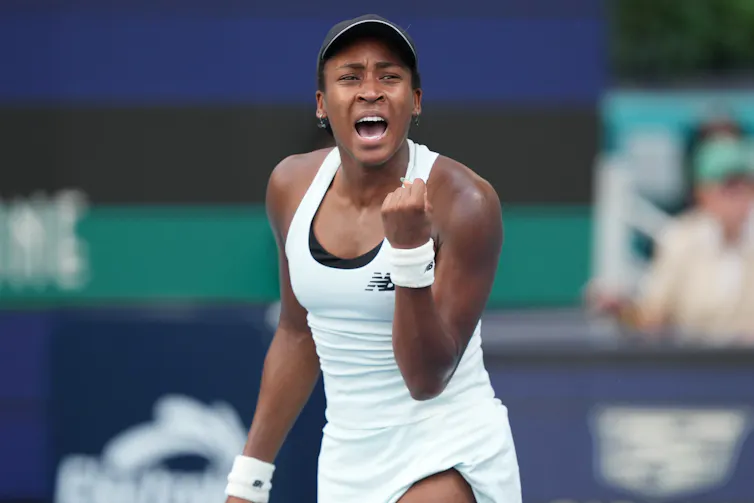
AP Photo/Jim Rassol
It’s not just top athletes
These patterns don’t just apply to high-profile industries. We found the same effect in a conventional workplace: a large healthcare organization in the northwestern United States.
We analyzed salary data for 682 medical providers across 18 clinic locations. Among solo practitioners, men and women earned similar salaries. But providers who work in same-sex groups showed dramatic wage differences. Men in all-male groups earned the most ($111,004 on average), while women in all-female groups earned the least ($52,497) – less than half. This remained even after controlling for age, experience, credentials, specialty, patient satisfaction scores and clinic location.
These were not selected cases, but licensed medical professionals with quantifiable performance data, working for an organization with formal human resources policies and pay scales. Yet somehow the gender composition of their immediate work group predicted a difference in annual salary of $58,000 – despite women’s higher average patient satisfaction scores.
Perhaps the most striking illustration comes from cheerleading in professional sports. NFL cheerleaders earn approximately $150-$500 for their Super Bowl appearance, while the minimum NFL player salary is $885,000.
Even players on the losing Super Bowl team who never leave the bench earn $103,000 each – about 687 times what cheerleaders earn for playing the entire game. Both groups are at high risk for injuries. Both are performing at the same event. The difference? One is an all-men’s team, the other an all-women’s team.
What can be done?
To counter this deep-seated bias, organizations could look at their compensation data not only to spot individual differences between men and women, but also to see whether all-female teams systematically receive smaller bonuses and pay increases than all-male teams. Similarly, investors and funders could explore whether a team’s gender composition affects proposal evaluation, regardless of actual team qualifications and business potential. Manager training could also explicitly label this misconception as inaccurate, unconscious, and costly.
Most importantly, we understand that employees rarely have control over the gender composition of their team. Women are economically penalized for something determined by organizational demographics, project needs, and scheduling – factors completely beyond their control.
Women can succeed alone. Taylor Swift, Beyoncé and Coco Gauff prove this. But until all women’s groups receive the same legitimacy, funding, and compensation as all-male groups, enormous talent and economic potential will remain on the table. As our research shows, the penalty for cooperation is not only unfair, but also economically irrational.