Utah senator warns he’ll block $354M in water aid if Arizona sues over Colorado River
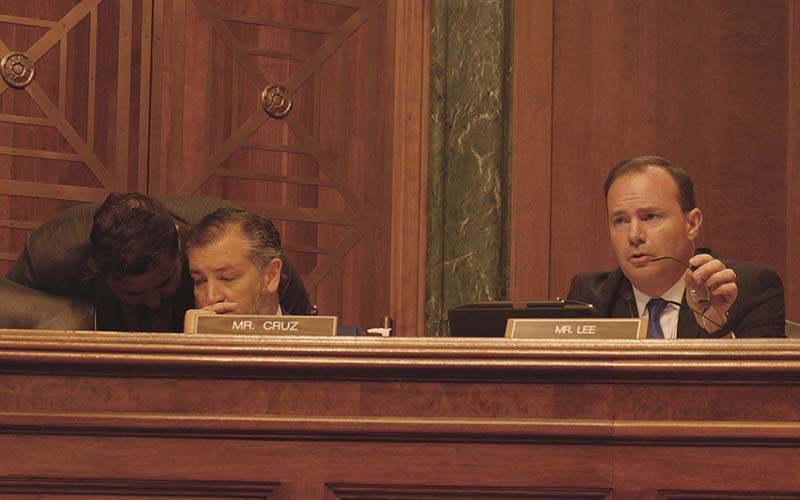
WASHINGTON – The chair of the Senate Energy and Natural Resources Committee warned Arizona and two other states that rely on the Colorado River on Wednesday that they will lose access to hundreds of millions in conservation aid if they pursue litigation over water rights.
Roughly $354 million is still available under a pandemic-era stimulus law. But the funds expire at the end of September.
“States that choose to sue their fellow basin states over Colorado River operations should not expect Congress to reward that decision with additional federal funding,” Sen. Mike Lee, a Republican from Utah – one of the four Upper Basin states, said at the outset of a hearing on the stalemate among the seven states that share the river. “Federal taxpayers should not be asked to subsidize litigation among the states.”
Arizona, California and Nevada have been at odds with Colorado, Utah, New Mexico and Wyoming over how to divide the dwindling water supply when the most recent 19-year deal expires at the end of 2026.
The funds Lee threatened to block are a key element of the Lower Basin’s most recent proposal from May 1, which relies on the funding to incentivize voluntary water conservation as an alternative to mandatory cuts.
The $354 million comes from the Inflation Reduction Act signed in 2022 by President Joe Biden, which set aside $4 billion for drought mitigation and compensation for voluntary conservation. Funds that remain unused when the current fiscal year ends Sept. 30 will revert to the Treasury.
By then, the Bureau of Reclamation, part of the Department of the Interior, plans to finalize a federally imposed plan to allocate water to the seven states over the next decade. One alternative in the draft the bureau issued in January would impose cuts up to 77% for Arizona, with a 7% cut for Nevada. The other states could continue taking water at current rates.
The states missed a deadline last November to submit a consensus plan to federal regulators.
The White House tried to facilitate progress by convening Arizona Gov. Katie Hobbs and her counterparts in January. With the stalemate continuing, Lee used Wednesday’s hearing to add more pressure on the states to find a solution.
He chastised officials in the Lower Basin states for, among other things, taking out newspaper ads attacking Upper Basin states.
Negotiators appeared to be “preparing actively for litigation,” he said – and in fact, key officials in both camps have told Cronkite News in recent days they are preparing for that possibility.
Congress “will not be a bystander in this process,” Lee said, noting that under the Constitution, Congress holds approval authority over any long-term interstate compact.
He also expressed sympathy with the Upper Basin’s stance, warning that any proposal asking those states to absorb greater operational burdens without regard to the river’s existing legal framework “will face a difficult path forward” in Congress.
The chairman framed the moment as a failure of collective will, cataloguing a string of missed deadlines. “The basin can no longer afford to wait,” he said.
After Lee delivered his rebuke, Arizona Sen. Ruben Gallego, a Democrat, pressed the Trump administration from the opposite direction.
Gallego asked Andrea Travnicek, assistant secretary for water and science at the Department of the Interior, how the department plans to weigh Arizona’s economic stakes as it finalizes its decision.
“The Colorado River is a lifeline for Arizona,” Gallego said, noting the state is home to the most advanced semiconductor manufacturing hub in the Western Hemisphere and that the success of its industries are essential to the nation.
“The technological industries, the domestic food supply, and energy security are all top priorities for the United States, including the president’s agenda,” he said.
Travnicek said the department cannot accept either the May 1 proposal from the Lower Basin nor the latest Upper Basin proposal as they currently stand.
“We have some concerns and areas where we think that there should be adjustments,” she said.
She confirmed that the Interior Department is coordinating with the Energy Department and U.S. Department of Agriculture, among other agencies. She said an interagency water subcabinet meeting will be held Thursday.
The hearing laid bare the tension that has made a seven-state deal so elusive, with senators from both basins on hand.
Travnicek fielded pressure from both directions without committing to either.
The stakes are straightforward and very high.
Decades of drought have pushed water levels to dangerously low levels even as demand and population grow. The river now provides barely half the amount of water each basin has been legally entitled to draw.
“Delay carries its own consequences,” Lee said, “and the basin can no longer afford to wait.”
Related

Source link