Trump threatens further action as US and Iran exchange fire in new flare-up | US-Israel war on Iran
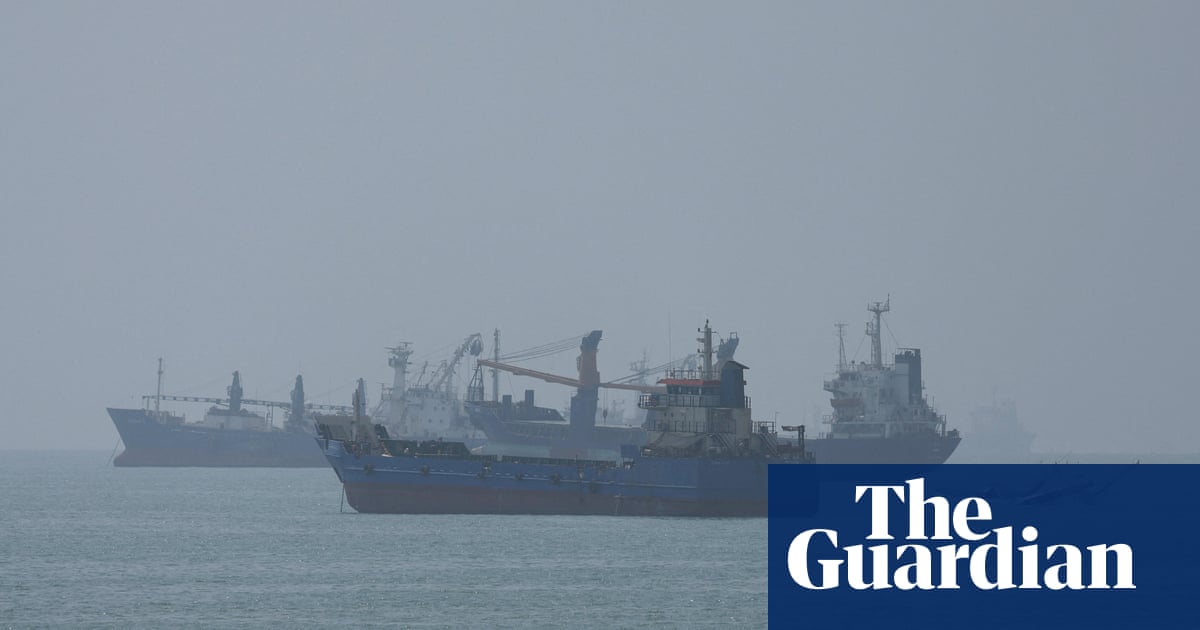
The US and Iran have exchanged fire for the first time in a month, with missiles and drones fired at Iranian rocket launchers on an island in the strait of Hormuz, and Iran targeting US military bases in Jordan and the United Arab Emirates in response.
The US president, Donald Trump, on Monday threatened further action. The US is to trying to prise open Tehran’s grip on shipping going through the strait, which before the war accounted for a fifth of the world’s seaborne energy supply. Washington claimed that Iranian control over the waterway had been loosened by repeated US attacks on Iranian missile launchers and radars.
US Central Command said it acted late on Sunday, launching the first strikes on Iran since July, after it detected the Iranians were planning to deploy fresh mines in the strait. Last week Trump claimed the US navy had cleared the strait of mines for the first time since the conflict started on 28 February, a claim the Iranians rejected as lies.
In response to the US attack, the Islamic Revolutionary Guard Corps (IRGC) said it “targeted technical infrastructure, maintenance facilities and enemy fighter jet positions at the US-operated King Hussein and al-Azraq airbases in Jordan” with ballistic missiles, causing “heavy damage”. The UAE defence ministry said it intercepted a drone over its territorial waters.
Trump responded to the Iranian reprisals by telling Fox News: “We’re going to hit them hard. There will be a response.” The US president called Iran “officially a failed nation without an airforce, a navy or a currency”, adding that inflation was at 300% and its leaders were incapable of representing their country.
The White House last week signalled that Trump was shelving military measures in favour of a campaign to destroy the Iranian economy by enforcing sanctions.
Iranian state TV claimed the military exchanges escalated on Sunday after a tanker caught fire when hitting two Iranian naval mines while attempting to pass through the southern side of the strait close to Oman. Officials later said Iran had targeted three ships trying to navigate the southern route that Tehran says is unauthorised.
The IRGC warned that other ships violating its rules would face the same fate and said compliance with its regulations for passage through the strait was mandatory.
However, the Iranian president, Masoud Pezeshkian, told Pakistan’s prime minister, Shehbaz Sharif, in a bilateral meeting on the margins of the Shanghai Cooperation Organisation summit in Kyrgyzstan on Monday that continuing the war was not in Iran’s interest, adding he was still ready to implement the memorandum of understanding with the US that Pakistan had mediated in June.
The Iranian currency was under renewed pressure on Monday and the inflationary impact of its rapid depreciation is causing growing concern to MPs.
Iran and Oman last week reached a verbal agreement on a new single temporary route for shipping through the strait in which Oman retains controls on shipping in Omani waters.
One western diplomat familiar with the talks said the message had got through to Washington that this bilateral agreement would not be enough for Iran to open the strait and that to do so would at least require the US to end its blockade of Iranian oil exports, something Trump is not currently prepared to do. “There are many in Iran determined to torment Trump right up to the end of his presidency,” the western diplomat said. “We are stuck.” He said some oil was getting through but not very much.
The latest fighting broke out late on Sunday with the US claiming it attacked Larak Island in the strait. A US official said: “I can confirm that earlier today US forces struck two Iranian launchers on Larak Island. Islamic Revolutionary Guard Corps forces were observed preparing to launch rockets with sea mines into the strait of Hormuz.”
The IRGC said the US attack had killed three soldiers and wounded two citizens. Iran’s Mehr news agency quoted the IRGC as saying its air defences shot down a US MQ-9 drone over the strait, causing it to crash into Gulf waters.
The US said all missiles fired towards US forces in Jordan had been intercepted with no significant impact.
The White House claim that the US now controls the strait and ships are free to navigate its waters is heavily contested. Tanker Trackers, an independent tracking agency, said on Sunday: “Past seven days daily average of crude oil exports via the strait of Hormuz was 3.8m barrels per day. During the formal ceasefire period (which in effect only lasted for 25 days), it was 9.8m.” The agency said Iranian crude exports had been at zero for some time.
A meeting of G20 finance ministers in the US is likely to lead to a clash over American demands that more countries impose sanctions on Iran or face punitive action by Washington. The German finance minister, Lars Klingbeil, who is facing difficult regional elections, is to urge the US to bring the conflict to a diplomatic end, pointing to the war’s inflationary impact.
The US treasury secretary, Scott Bessent, echoing Trump, claimed on Monday the resumed exchanges of fire showed Iran was “lashing out” because the fresh sanctions were taking a heavy toll on its already battered economy.
“They’re taking it very seriously … they’re in shock at the state of their economy,” Bessent told reporters at the G20 finance ministers meeting in North Carolina. “I would think that they are lashing out kinetically because they are losing economically.”
China, a key Iranian customer for its oil, has said it opposes the new US sanctions campaign. In Kyrgyzstan, Pezeshkian will be looking for concrete assurances from the Chinese president, Xi Jinping, that he will not allow the US to spread economic chaos through Iran.
Source link