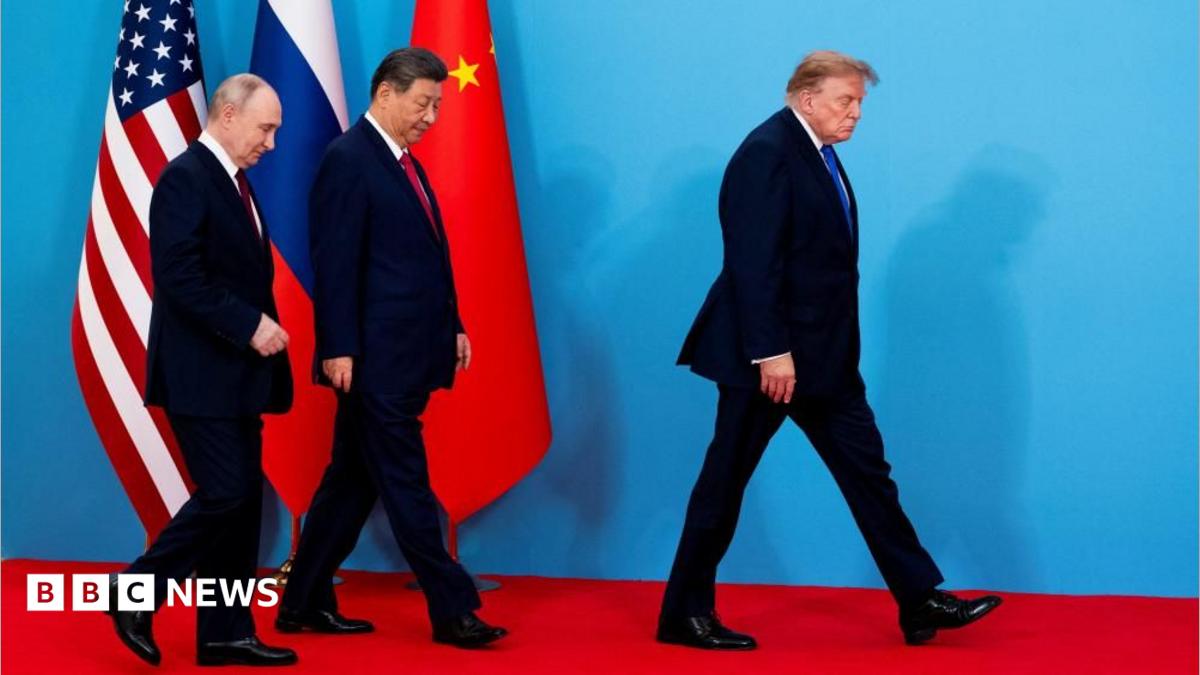
Trump China summit with Putin and Xi high on spectacle
A line about boosting “the production and supply of refined petroleum products” seems directed at Putin, given that nation’s role as a major source of fossil fuels on the international market. And it was hard to miss the condemnation of the International Criminal Court – a recent target of American ire.
If there’s one thing the leaders of the three major world powers can agree on, it’s that multilateral global organisations that attempt to enforce international law shouldn’t have the teeth to back up those efforts.
While in China, Trump called Putin his “friend”, and praised his “outstanding personal relationship” with Xi after sharing a handshake and hug with the Chinese leader.
But once Trump returns to Washington, he is likely to face a political environment where views of his Asia trip range from measured concern to outright criticism.
“I am concerned by how we are characterising our relationships with geopolitical adversaries. Vladimir Putin and Xi Jinping are not our friends,” Republican Senator John Curtis of Utah said in a statement to the BBC on Thursday.
“Diplomacy is important, but it should never come at the expense of clarity about who our adversaries are.”
Illinois Republican Congressman Darin LaHood, who was re-elected with Trump’s endorsement earlier this month, says the US should have discussions with both allies and adversaries abroad. But he adds that Putin is a “dictator” and “an international criminal”.
“I worry a little bit about the images of giving him a platform on a world stage as somehow equal to the United States,” he tells BBC News.
“We have to remember what Putin has done in Ukraine,” LaHood says. “He invaded a sovereign, independent, democratically-elected country, and continues to engage in aggression there.”
Democrats, for their part, did not mince words.
“American security cannot be traded away for photo opportunities or personal aggrandisement,” nine senators on the foreign relations committee wrote in a letter to the White House.
Trump is hardly the first American president to seek an international diplomatic breakthrough as a salve following domestic political setbacks. Democrats Bill Clinton and Barack Obama took overseas trips as presidents shortly after their party’s own midterm electoral defeats.
In those cases, any boosts to their standing proved short-lived. And while Trump may have gotten the images he wanted from his Asian summit, the lack of substantive progress accompanying them likely means this trip also will be quickly forgotten.
Brandon Drenon contributed to this report.
Source link