Tourism in the southern Mediterranean shows a summer dependency of 59% | News
A new report from Data Appeal Mabrian (Almawave/Almaviva Group) highlights how European destinations can strategically boost off-season demand by expanding and diversifying their offerings beyond traditional peak periods. This highlights the need for a coordinated shift in the way destinations design and promote year-round travel experiences.
The study, presented by Emilio Inés, Tourism Global Director at The Data Appeal Company at the Seasonality Summit 2026 in Rimini, analyzes low-season inbound demand trends in Italy, Spain, Greece, Croatia and Portugal within the context of the Southern Mediterranean. It examines seasonal patterns, traveler profiles, air connectivity, price trends and demand factors in key southern European destinations, providing strategic insights to support the development of more balanced year-round tourism models.
Key findings show that destinations are making progress in tackling seasonality at different speeds. According to the Summer Dependence Rate*, Spain records the lowest peak season dependency (52.8%), well below the Southern Mediterranean average of 59.1%, followed by Portugal (54.5%) and Italy (58.7%). In contrast, Greece (72.9%) and Croatia (79.1%) remain significantly more dependent on summer demand, although Greece is showing the first signs of expanding tourist activity into the shoulder seasons.
The report identifies different traveler profiles in the low season. From January to March, demand is largely driven by couples from nearby markets for mid-range accommodations; whereas between October and December there is a shift towards established European markets, with travelers more likely to extend the summer and opt for luxury hotels.
According to the analysis, on-site events also play a key role in driving demand in the off-season. As Emilio Inés noted at the Seasonality Summit: “Organically speaking, off-season, between 53% and 72% of events already take place outside the peak months, while 58% to 73% of total attendance is concentrated in the low season, effectively turning events into a demand center for the off-season periods.”
Connectivity, climate, prices and experiences: important levers for limiting seasonality
The report highlights that improving off-season performance requires a deeper understanding of traveler motivations, better alignment between event calendars and tourism products, and stronger targeting of high-connectivity source markets. Climate perception, price benefits and composite experiences are identified as important levers to distribute demand more evenly over the year.
Air connectivity to the five studied destinations will increase further by the end of 2026. Between October and December 2026, a total of 96.64 million seats will connect Italy, Spain, Greece, Croatia and Portugal, representing an increase of +4.6% compared to the same period in 2025. All destinations are expected to show growth in the fourth quarter of 2026, except Portugal (-2.5%). Greece leads the growth with +10.7%, followed by Spain (+5.4%) and Italy (+4.2%).
According to the Data Appeal expert, “leveraging inbound markets with increasing connectivity in low season is essential, in addition to strengthening airline networks beyond peak months.” This includes both low-cost airlines – especially relevant in Italy and Spain – and traditional airlines, which expand seat capacity in Italy, Spain and Greece in the low season. In Croatia and Portugal, low season connectivity accounts for an average of 58.5% of total capacity.
The report identifies climate perception as a growing competitive advantage for off-season travel, especially among short- and medium-haul repeat visitors, as well as among flexible segments such as young adults, digital nomads and seniors. Based on the Perception of Climate Index (PCI), the study reveals ‘windows of climate opportunity’ when actual weather conditions exceed travellers’ expectations. Italy, Spain and Greece typically have two such windows – late winter/early spring and autumn – while Croatia and Portugal benefit from an additional spring window.
“Combined with the incoming holiday calendars, these periods provide significant opportunities to stimulate low-season demand,” emphasizes Data Appeal’s Tourism Global Director. Data shows that Britain, Germany and France provide a structural base for low season travel, with 63%, 60% and 53% of holidays respectively taking place outside peak periods.
Prices also play a key role in shaping demand. In winter 2026, hotel prices in the analyzed destinations will be significantly lower than in summer 2025, with average reductions of 24.6% for three-star hotels, 22.4% for four-star hotels and almost a third for five-star hotels.
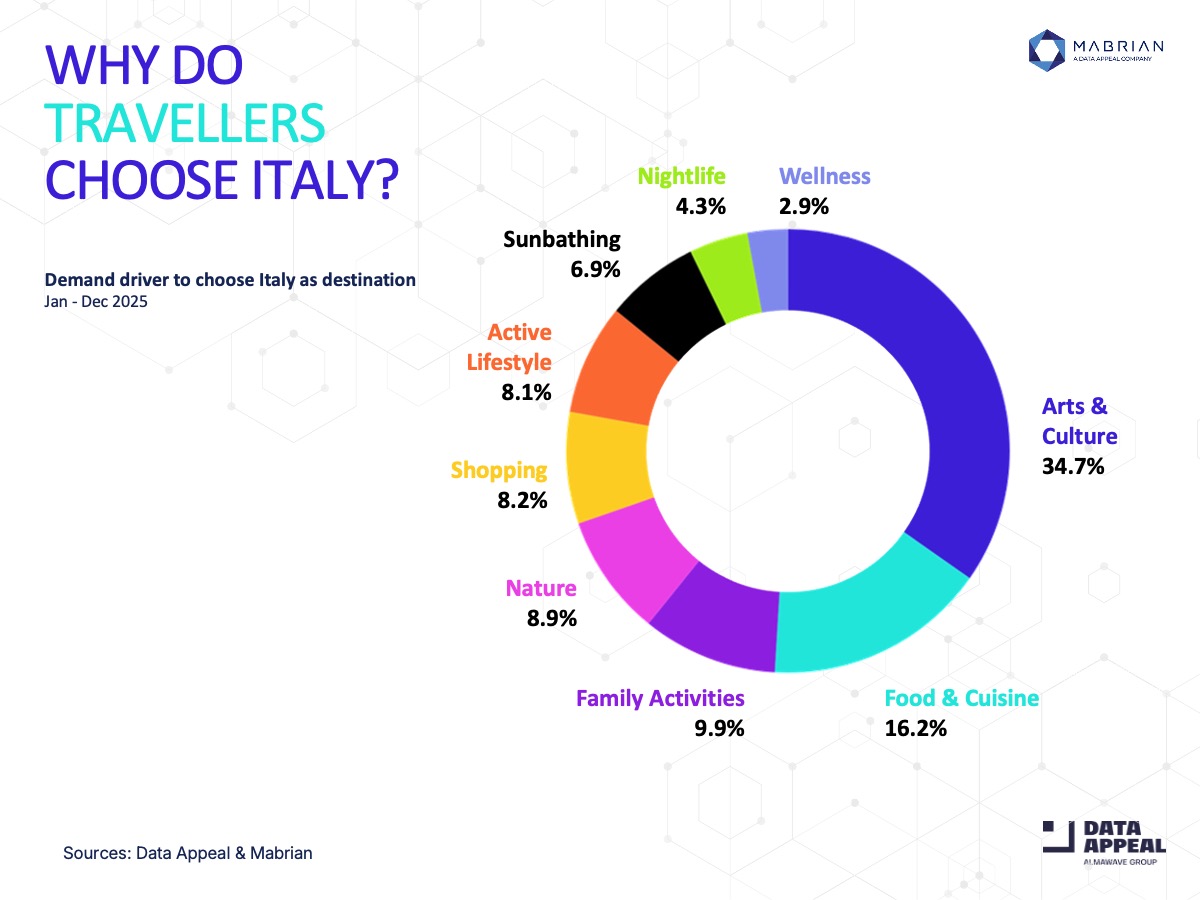
Finally, the report highlights that many of the most attractive tourism activities for travelers visiting the European destinations studied – including cultural, nature, gastronomy and active experiences – are inherently less seasonal and highly customizable throughout the year, offering great potential to further redistribute demand away from peak periods.
* Summer dependency rate: proprietary indicator measuring the concentration of tourism activities during the summer period. It represents the percentage of total annual tourism activity – based on assessments of verified and completed accommodation stays – that takes place between May and September (inclusive), relative to total year-round activity.