The US says ASML’s top chip tool may be in China. ASML says it isn’t
According to Bloomberg, US Commerce Secretary Howard Lutnick has told senior ASML executives in a series of recent meetings that he is concerned that one of the Dutch chipmaker’s extreme-ultraviolet lithography machines – the EUV systems that are the only instruments on Earth capable of printing the most advanced semiconductor patterns – It may have ended up in China. That would be a major breach of the export controls that have prevented ASML from selling EUV to China since the first Trump administration.
It’s a serious claim. Senior government officials told Bloomberg that they have evidence that ASML has shipped EUV-related components and transportation equipment to China, although they have repeatedly refused to show it – to Bloomberg or, apparently, to ASML itself. The company says such a machine does not exist in China and has never existed there. The Commerce Department did not respond to Bloomberg’s questions about whether it has evidence of an actual EUV system on Chinese soil.
You might think this isn’t worth paying attention to if you’re outside the chip industry, but it is. ASML is a Dutch company that most people have never heard of, but it is by a wide margin the most important company in global AI development that isn’t called Nvidia or one of the hyperscalers. It makes the only machines in the world capable of EUV lithography – the process of printing the microscopic circuit patterns that define the most advanced chips.
Every advanced processor made by TSMC, the foundry behind Nvidia and Apple chips, relies on ASML tools that cost the company about twenty and untold billions to develop. There is currently no second supplier. That monopoly has made ASML Europe’s most valuable listed company, with a market capitalization trading near $700 billion as of this week, up sharply in the past year thanks to insatiable AI-driven demand for chips.
That scale is exactly why the China issue is so important. If even a single EUV machine were to end up in Chinese hands, it would be one of the most consequential violations of the export control regime the US has built in recent years to keep advanced AI capabilities out of Beijing’s military and industrial base.
Six weeks ago, well before this story broke, I spoke with ASML CEO Christophe Fouquet and asked him directly about the China issue.
Fouquet told me that ASML tracks every machine it has ever shipped; they are either in active use by audited customers, or have been dismantled and returned to the company. He said the company built an internal firewall years ago: employees who have access to EUV technology, documentation and training are shielded from those who cannot, and ASML’s Chinese staff are deliberately on the wrong side of that wall. He argued that the only reason ASML could build an EUV machine at all was that 80% of it already existed based on decades of prior knowledge, and that solving the only truly new problem – generating EUV light itself – took twenty years. His broader point seemed to be that you can’t reverse engineer a machine you’ve never had, and no one in China has had one.
There is also a simpler commercial logic that runs counter to the idea that ASML would risk its export license to quietly arm a Chinese customer. ASML is selling older-generation deep ultraviolet instruments to China – equipment that was first shipped a decade ago – but Fouquet explicitly described that as a protective calculation and not a loophole. The idea, he suggested, is to create enough of a generational gap so that customers can still do business, but without producing their own future competitor. ASML expects that approximately 20% of its turnover in 2026 will come from already authorized sales to China. Completely jeopardizing the EUV ban would put those revenues, and the company’s position as the most valuable monopoly in the European industry, at risk on a single illegal sale.
None of this proves that the allegations are false. The government has not yet made its evidence public, and it is worth delaying judgment until it does.
The Commerce Department, led by Lutnick, agreed late last year to put up to $150 million of taxpayer money into xLight, a startup developing a next-generation light source technology that is being written about as a long-term challenge to the core of ASML’s EUV monopoly. xLight’s own CEO told me last year that the company sees itself as a future partner of ASML, rather than a competitor, building hardware intended to plug into ASML’s machines rather than replace them. When I presented that framework to Fouquet in May, he was polite about it, but not convinced; ASML, he made clear, does not think it needs xLight’s technology to maintain its lead.
Does that have anything to do with why Lutnick is suddenly pressuring ASML on EUV? Nothing public connects the two. It could be completely unrelated. But a federal official scrutinizing a monopoly when his own agency has money for a start-up company looking to improve that monopoly’s core technology is worth investigating.
xLight isn’t the only outside bet on the future of lithography. Peter Thiel – who has his own longstanding ties to Trump’s political orbit – has done so supported substratea separate startup explicitly pursuing its own EUV-rival technology, with ambitions to compete more directly with ASML than xLight says it plans.
As Bloomberg notes, a bipartisan bill passed by Congress would go far beyond EUV. It calls for an effective ban on all ASML deep-ultraviolet (DUV) shipments to China, the less advanced lithography tools that account for about a fifth of the company’s expected 2026 sales. The bill cleared a key committee in April, and the Trump administration has not yet taken a formal position on it.
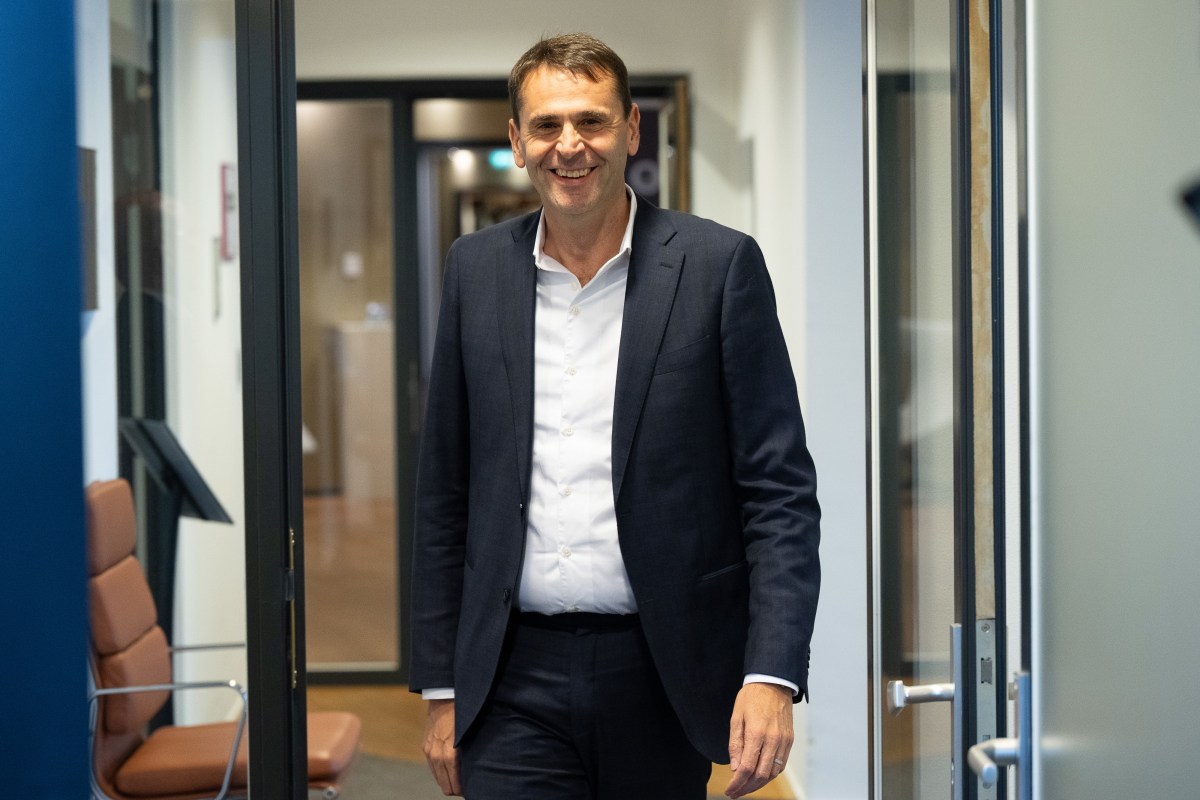
In the photo above: ASML CEO Christophe Fouquet
When you make a purchase through links in our articles, we may earn a small commission. This does not affect our editorial independence.