Off-grid desert ‘masterpiece’ built by Formula 1 driver’s daughter hits market in Joshua Tree for $15 million
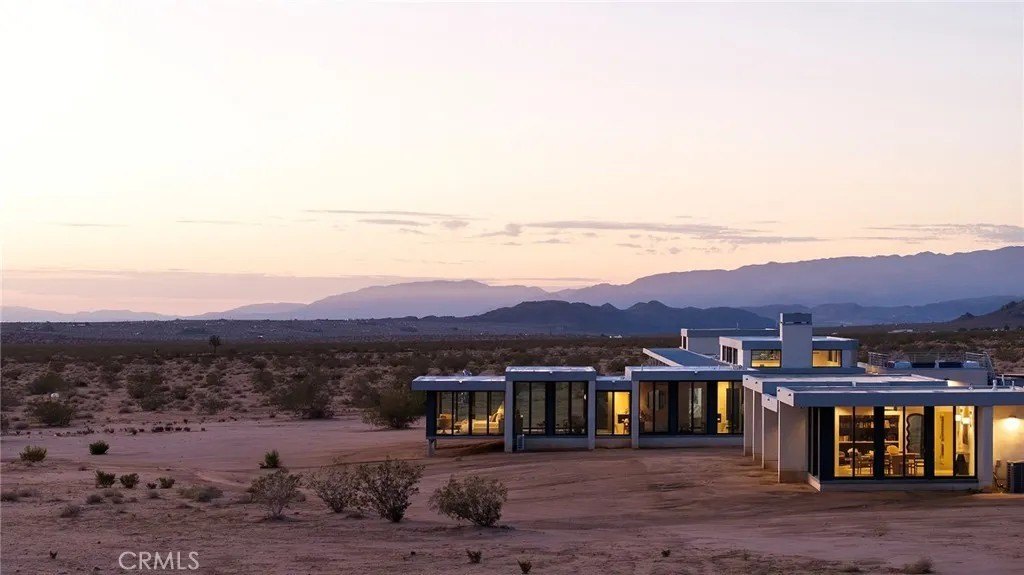
A gleaming glass sanctuary in the heart of the Californian desert has been brought to market for the first time since completion, offering a rare opportunity to enjoy the very best in off-grid living, with all the luxuries of a modern mega-mansion.
Known as ‘The Saturn Haus’, the self-contained complex makes a striking impression on the skyline between Joshua Tree National Park and the Mohave Desert, but also somehow seems to blend seamlessly into its surroundings, thanks to the enormous walls of glass that offer picturesque views from every room.
For those seeking privacy, the property, which is for sale for $14.99 million Charlie Pricefrom Coldwell Banker Realty-Newport Beach – is the perfect spot, nestled in the heart of a 160-acre parcel purchased by the seller Wendy Wakker in 2012.
Wacker then spent five years developing the incredible complex now known as The Saturn Haus, working with an acclaimed design collective called Northworks, known for its minimalist, context-driven architecture.
While some people may be baffled by the work that goes into creating such a “modern, minimalist masterpiece,” designing such a stunning abode could be seen as an act of fate for Wacker.


Although she chose to pursue a career as a writer, Wacker has a prominent family history that combines civic leadership, business acumen, and a deep appreciation for architecture and landscape, albeit not in California but in Chicago, where she grew up and where her family was involved in the city’s development.
Her great-grandfather, Charles Henry Wackerwas the first chairman of the Chicago Plan Commission and advocated widening streets, building park roads, expanding forest preserves and improving public infrastructure.
Wacker Drive, the multi-level street along the Chicago River in the Loop, is named in his honor.
Meanwhile, Wendy’s father, Frederick G. Wacker Jr. was an engineer, the president of two Chicago companies, a jazz musician, a Formula One driver and a prominent figure in Chicago’s architectural and social circles.
But Wendy had her own ideas. She decided to leave the Midwest behind and settle in Southern California, where she spent $7 million building her own unique vacation home/writer’s retreat, where she could find limitless inspiration in the rugged natural environment.
“The beauty here is so otherworldly,” she told the newspaper Wall Street Journal. “The way the sky looks, the clouds look so low it’s almost like you can reach them.”


She envisioned a home that would be in harmony with its park-like surroundings, rather than being a discordant burden on them. Her concept consists of minimalist, sculptural rooms connected by open-air corridors that maximize desert views.
Extensive indoor and outdoor spaces, including landscaped open-air courtyards, also ensure that the structures blend in with the desert environment.
Constructed largely of concrete, steel and glass, the complex consists of four distinct buildings, including a 2,110-square-foot main residence with a wide-open great room, high ceilings, glass walls and radiant floor heating for those cold desert nights.
The windows, walls and skylights are designed so that the sun changes the colors and moods of the interior as it moves through the sky.
“The residence unfolds as a composition of sculptural volumes – distinct in shape yet seamlessly connected by open-air corridors that capture sweeping desert vistas and follow the arc of the sun from sunrise to sunset,” according to the listing.
“As the desert transitions from day to dusk, cinematic shadows stretch across the minimalist lines of the house, transforming the architecture into a living canvas.”
In addition to the main residence, there is a 1,200-square-foot guest casita with bunk beds that comfortably accommodates four people; a music/listening room of 60 square meters; and a 230 square meter art studio or gallery.


Outdoor amenities include a lap pool bordered by a covered patio with expansive desert views, provocative sculptures, natural landscaping and a rooftop viewing platform. There is also an outdoor kitchen and a dining area with an architectural louvered roof.
However, the property’s collaboration with nature goes beyond its structural design and includes a range of eco-friendly features, functioning as its own self-sustaining microgrid, powered by photovoltaic solar panels and a wind turbine. Advanced thermal technology heats the pool.
Although Wacker was keen to implement these self-sufficient energy sources for environmental reasons, the remoteness of the house also meant that they were a necessity to ensure the home could function without interruption.
“The residence includes multiple pavilions that frame the desert horizon, capturing the arc of the sun while offering completely self-sufficient living,” according to a description shared with Realtor.com®.
“With expansive indoor and outdoor spaces, a wellness retreat, music studio and private guest accommodations, this is a statement in art, design and desert serenity.”
Speaking to the Wall Street Journal, Wacker confessed that she is reluctant to leave her beloved retreat behind, but has been forced to put it on the market due to health concerns.
“I’m going to miss nature most of all: the solitude and the absence of light pollution, being able to see the sky,” she said.