JAL and ANA release second joint report on sustainable aviation fuel | News
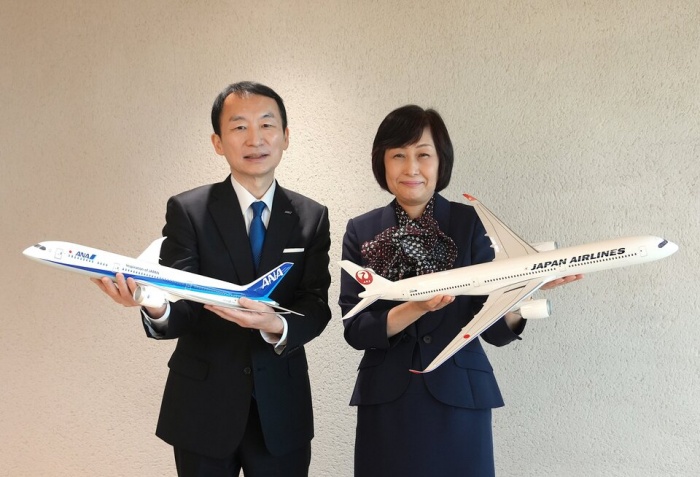
Japan Airlines (JAL) and All Nippon Airways (ANA) today released the second edition of their joint report, “Toward Net Zero CO2 Emissions from Air Transport in 2050,” which outlines the current state of sustainable aviation fuel (SAF) in Japan and the actions needed to support aviation decarbonization. The report calls for a societal effort to achieve net zero carbon dioxide emissions in air transport by 2050.
Report key findings
● The global SAF gap: SAF is critical to achieving net-zero aviation carbon dioxide emissions by 2050, but was responsible for just 0.6% of global aviation fuel consumption in 2025. The report warns that without increased SAF production and cost reductions within the next five years, the aviation industry will be unable to meet its emissions targets without significant social and economic impacts.
● Economic and social infrastructure: Japan’s aviation sector generates an estimated JPY 17 trillion in economic activity annually. Stable fuel supplies are critical to supporting the goal of attracting 60 million inbound visitors and maintaining air service to regional communities and remote islands that rely on aviation as essential infrastructure.
● The ‘Japan Model’ Approach: The report calls for a tailor-made Japanese model that balances the pace of SAF regulation with actual domestic SAF production capacity, limiting supply-demand imbalances and excessive costs while supporting the industry’s long-term growth.
● Scope 3 Co-Creation2: Through corporate programs3 that help reduce customers’ Scope 3 emissions, ANA and JAL promote a “Co-creation model” in which the high costs of SAF implementation are collectively borne by society as a whole.
● A unified approach to the industry: ANA and JAL act as the “two wings” of Japan’s aviation industry, taking on this challenge across competitive and industry boundaries to support the long-term sustainability of Japan’s air transport and drive the sustainable growth of Japan’s economy.
“In the aviation industry, our essential mission is to continually build the human connections and social good created by the movement of people. While scaling SAF poses formidable challenges, we will never waver in our commitment to pioneer a sustainable future for aviation. Together with All Nippon Airways and hand-in-hand with our customers and all stakeholders, we will overcome these difficulties to ensure that a vibrant future of movement is safely passed on to the next generation.” said Mitsuko Tottori, president and group CEO of JAL.
“Thanks to our stakeholders, we have laid a foundation for domestic SAF implementation. However, the global landscape surrounding SAF is extremely serious and any delay in securing fuel now represents an immediate crisis to Japan’s economic security,” said Juichi Hirasawa, president and CEO of ANA. “To meet this challenge, we are once again joining forces with JAL. We strongly call for an effective, society-wide framework to sustain Japan’s aviation infrastructure and transfer sustainable airspace to the next generation. We remain steadfast in our commitment to this decision as we seek the understanding of our valued customers.”
The report follows the first joint SAF report released in October 20211.
Press release October 1, 2021: [ANA and Japan Airlines Towards 2050 Carbon Neutral Joint Report on SAF]
2 JAL “JAL Corporate SAF Program” Details URL: https://www.jal.com/ja/sustainability/jcsp/
ANA “SAF Flight Initiative” Details URL: https://www.ana.co.jp/en/jp/brand/ana-future-promise/saf-flight-initiative/
3According to the GHG Protocol, an international standard jointly developed by the World Resources Institute (WRI) and the World Business Council for Sustainable Development (WBCSD), companies’ CO2 emissions are divided into three categories: Scope 1: Direct CO2 emissions from a company’s own business activities. Scope 2: CO2 emissions from energy sources supplied by other companies, such as electricity or heat consumption. Scope 3: Indirect CO2 emissions from a company’s business activities (e.g. product transportation, employee commuting and business travel).