How political leaders use combat spectacles to symbolize national power and purpose
Throughout history, rulers and political movements have used public spectacles of combat to evoke courage, sacrifice, collective strength and national purpose. From Roman gladiator contests to modern mixed martial arts, combat spectacles have served not merely as entertainment but as public rituals through which people experience belonging to something larger than themselves.
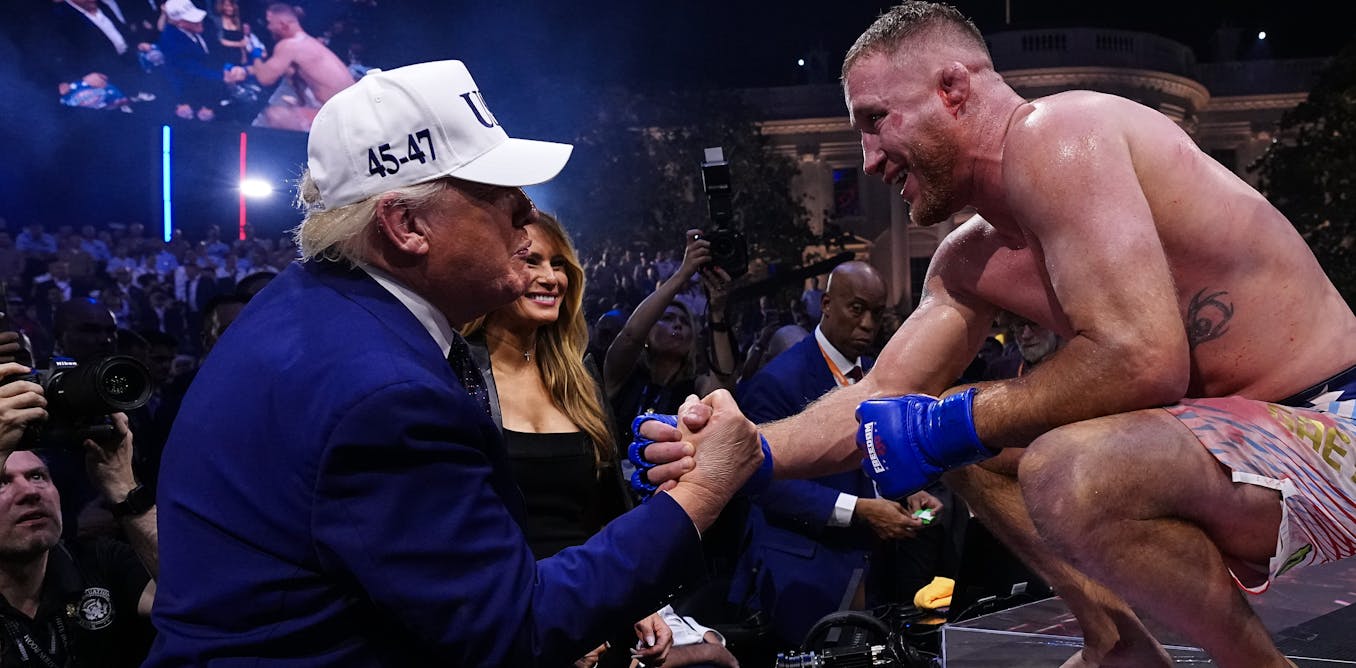
When President Donald Trump proposed staging a UFC championship event on the White House grounds as part of America’s 250th anniversary celebration, many observers treated it as another example of his affinity for spectacle and mixed martial arts, or MMA, a combat sport combining striking and grappling techniques from multiple martial arts disciplines. Yet the symbolism runs deeper than a president’s taste for theatricality and combat sports.
I’ve spent decades studying why people are willing to fight, sacrifice and even die for causes, and I see such spectacles illuminating an important psychological process known as identity fusion.
People belong to groups: families, nations, religions, professions, political movements, sports teams. Usually, these identities remain distinct from the personal self.
Identity fusion occurs when that boundary disappears. People do not just support a group – they experience it as an inseparable part of who they are. The group’s successes and failures become personal; threats to the group are experienced as threats to oneself.
The important question isn’t just what happens inside the cage – it’s what such spectacles can do for the audience. Public displays of courage, endurance and sacrifice can strengthen emotional bonds among spectators and deepen identification with the groups, causes or leaders they associate with those displays.
Research with soldiers and other front-line fighters in Iraq and Afghanistan, supporters of Ukraine, Palestinians in Gaza, Taiwanese concerned about a Chinese invasion, and participants in extremist movements shows that identity fusion predicts willingness to endure hardship, accept risk and make sacrifices for a collective cause.
This process does not necessarily produce violence. It can motivate volunteerism, mutual aid, military service and resistance to oppression.
It helps explain how public rituals that celebrate courage, sacrifice and collective strength can deepen commitment to groups, causes and leaders under conditions that appear irrational from a purely material perspective.

koyu/iStock Getty Images Plus
Why shared struggle matters
One of the strongest pathways to identity fusion is shared hardship. People who endure danger, suffering or intense challenges together often emerge with unusually strong bonds.
Combat sports play into this dynamic. Fighters publicly test themselves against pain, exhaustion, fear and possible defeat. Spectators witness not simply athletic competition but symbolic demonstrations of courage and endurance. The attraction lies partly in how character is being revealed under pressure.
For ancient Romans, gladiators embodied “virtus” – courage, discipline, endurance and willingness to confront death. Their appeal stemmed not merely from violence but from values they represented.
Modern mixed martial arts is often celebrated in similar terms: a proving ground for toughness, resilience and self-mastery.
In both cases, physical contests become moral dramas about sacrifice and human limits.
MMA has become politically important
The significance of combat sports extends beyond professional competition.
Across Europe and North America, mixed martial arts has become a focal point for segments of the contemporary far right. Organizations known as Active Clubs, now found in countries including the United States, Germany, Sweden, France and Britain, combine physical training with ethnonationalist activism, including recruitment, ideological indoctrination, public demonstrations and transnational networking among ethnic – particularly white – nationalist groups.
Gyms provide venues for recruitment and networking, but their deeper significance is psychological. Training and enduring hardship together and testing oneself before peers generates forms of trust and solidarity difficult to reproduce online. Political commitment becomes literal and embodied.
This helps explain why mixed martial arts has acquired unusual importance within transnational, ethnonationalist networks. Activists from different countries may possess distinct national identities, yet they recognize one another through a shared culture of physical discipline, masculine camaraderie and readiness for struggle. Combat sports provide a symbolic language that transcends borders, reinforcing a broader civilizational identity.
In this respect, mixed martial arts performs a role similar to military training camps, revolutionary youth movements and fraternal organizations in earlier eras. It creates bonds simultaneously local and international.
From Nero to the White House
The Roman emperor Nero was unusual not because he sponsored gladiatorial games – many emperors did – but because, as historian Thomas Wiedemann observed, he openly identified with the arena’s culture. Rather than maintaining aristocratic distance, Nero linked his public image to the virtues and popularity of spectacle.
Something similar occurs whenever political leaders align themselves with combat sports. The significance lies less in the sport itself than in what the spectacle symbolizes. A combat event staged as part of a national celebration transforms athletic competition into a ritual of collective identity and public values.
The White House UFC event was especially revealing because it linked a combat spectacle to the commemoration of the American republic’s 250th anniversary and to Trump’s own 80th birthday. Symbolically, it joined nationhood, leadership and martial virtue in a single public performance.
The symbolism also intersects with recent calls by administration officials, including the newly dubbed “secretary of war” Pete Hegseth, to restore a “warrior ethos” to U.S. military and civic life. The warrior becomes not merely a soldier but an ideal citizen: disciplined, courageous, physically formidable and prepared for sacrifice.

Illustration: Bettman/Getty Images
Why spectators experience awe
Mass rallies, military parades, religious pilgrimages, revolutionary festivals and combat spectacles can all produce moments in which individuals feel absorbed into something larger than themselves.
Such experiences do not automatically lead to political extremism. Most do not. But they help explain why people become deeply attached to groups and causes that provide meaning, belonging and a sense of shared destiny.
Spectacular public rituals – especially those involving violence and pain – often evoke what British political philosopher and politician Edmund Burke called “the sublime”: intense experiences of danger, terror and grandeur that transform fear into exaltation before overwhelming power.
The attraction of combat spectacles lies not merely in violence or entertainment. Their enduring power comes from transforming individual contests into collective stories of courage, sacrifice, identity and purpose. They reveal a fundamental human desire not only for security and comfort, but also for struggle, significance and belonging – as George Orwell observed in 1940 when reviewing the allure of Hitler’s autobiography, “Mein Kampf.”
In an age when established political institutions and movements command diminishing loyalty, combat spectacles provide more than excitement. They create communities of feeling and, under the right conditions, powerful engines of political commitment.
Source link