Here’s how Russia’s nuclear-powered ‘Skyfall’ missile works : NPR
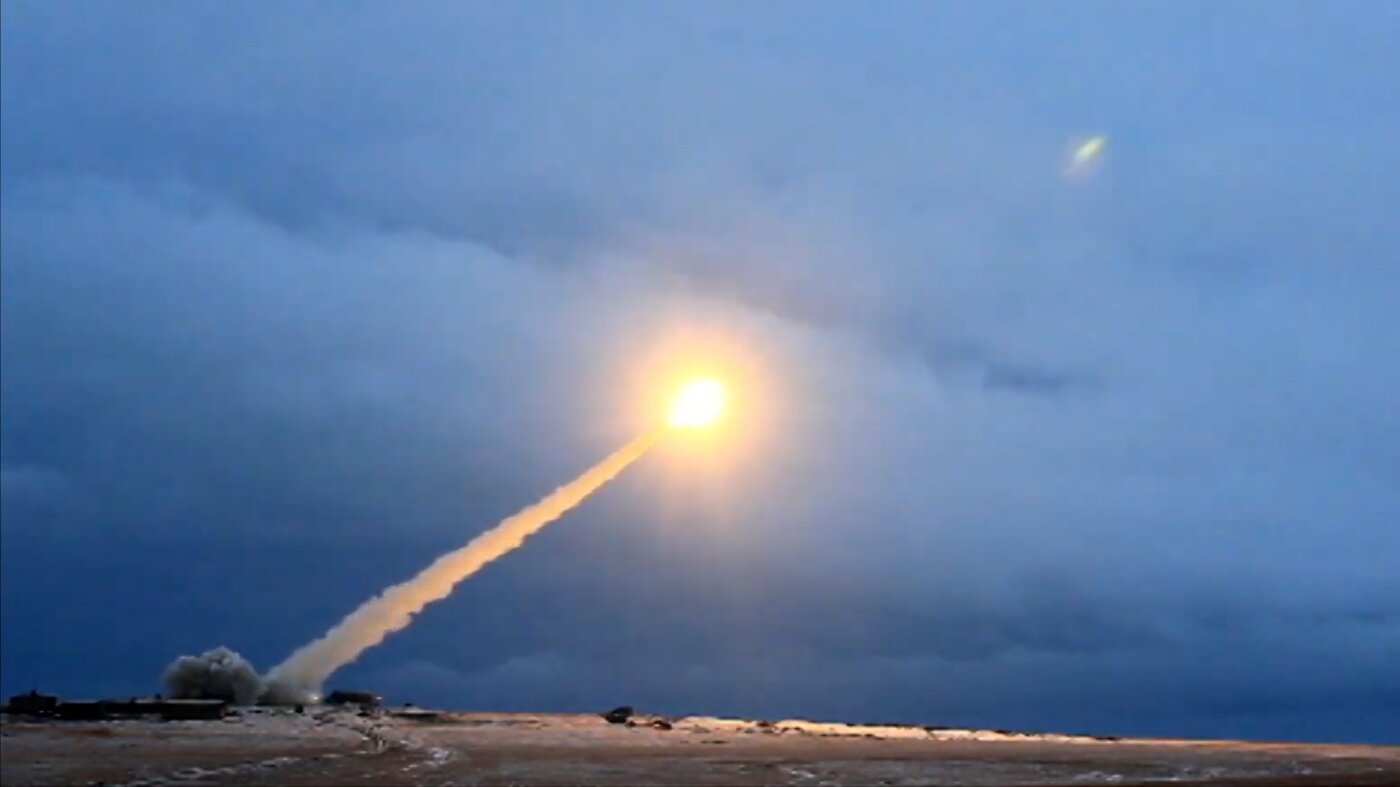
Sometime on Oct. 21 of last year, high above the Arctic Circle, a lone missile shot skyward from a Russian island.
The missile flew northeast and then banked and began flying in loops for hours over the barren, frozen landscape.
According to Russian and Western sources, the new weapon, known in Russian as Burevestnik and by NATO as Skyfall, was powered by a small nuclear reactor. Few other details were forthcoming.

Now, two MIT researchers have published an analysis that sheds fresh light on how the nuclear-powered missile actually worked. If they are correct, the October flight test marks the first time a nuclear-powered aircraft has ever flown. It would also suggest the opening of an extraordinarily dangerous new chapter in the 21st century’s simmering arms race.
“This is something that is possible, but wildly expensive and very dangerous,” said Jake Hecla, a professor at the Massachusetts Institute of Technology with a dual appointment in both aerospace and nuclear science and engineering, who led the new analysis along with co-author R. Scott Kemp.
Their modeling shows a reactor design that spews radiation as it flies, putting anyone living or working near the test site for the missile at “enormous risk, potentially.”
The dream of nuclear flight
Since the 1950s, both the U.S. and the then-Soviet Union contemplated building nuclear-powered aircraft. Such weapons had the potential to give both sides an advantage in the Cold War because they would have nearly unlimited range. That could allow them to loiter near a target awaiting an attack order almost indefinitely, or they could attack from an unpredictable direction, making it harder to defend against.

The U.S. and Russia both experimented with flying nuclear reactors during the Cold War. The U.S. placed a small nuclear reactor in a Convair B-36 Peacemaker, but the plane never ran off of nuclear power.
Chronicle/Alamy
hide caption
toggle caption
Chronicle/Alamy
In 1955, the U.S. Air Force put a small nuclear reactor inside a Convair B-36 strategic bomber to test whether it would expose the crew to excessive amounts of radiation in flight. The reactor was never hooked up to the plane’s engines, but it did show that a nuclear reactor could fly. In 1961, the Soviet Union conducted similar experiments aboard a modified Tupolev TU-95 bomber.
Safety concerns left those concepts grounded, but the U.S. also worked on a series of nuclear reactors to power missiles. Known collectively as Project Pluto, the idea was to build a supersonic low-altitude cruise missile that could deliver a nuclear weapon to any point on Earth. The tests culminated in 1964, with the ground test of a reactor mounted on a railroad car in Nevada that could run for five minutes, producing 513 megawatts — equivalent to more than 35,000 pounds of thrust.

During the 1950s and 1960s, the U.S. also looked into building a nuclear-powered cruise missile. American scientists built several test reactors, including Tory IIC (pictured), which was run at full power during ground tests.
Lawrence Livermore National Laboratory Archives
hide caption
toggle caption
Lawrence Livermore National Laboratory Archives
When news of the new Russian cruise missile first emerged, many onlookers assumed it would be a variant of the Project Pluto engine, but Hecla was skeptical. Project Pluto’s design, known as a ramjet, required air to move through it very quickly and could only operate at supersonic speeds.
“There are a number of reasons we have to suspect that a nuclear ramjet is infeasible for Burevestnik,” he said. In particular, the shape of the weapon looks much like a conventional subsonic cruise missile.
“You can see very obviously that it is a subsonic system, and ramjets are not very efficient at subsonic speeds,” he said.
A new kind of reactor
To try and figure out how the weapon was powered, Hecla first used a handful of videos posted by Russian media to determine its dimensions. He identified objects of known size in the factory where the videos were filmed — things like a utility desk or a fire extinguisher. Through many hours of repeated measurements, he was eventually able to build a three-dimensional model of the missile.
Based on the measurements, he concluded that Burevestnik is larger than even the largest Russian cruise missiles, but it is by no means enormous. Aerodynamic modeling showed it would need to travel around Mach .75 or about 575 miles per hour to stay airborne. That speed is similar to a commercial aircraft, like the Airbus A320.
Hecla now knew roughly how big the reactor could be and how much thrust it needed to produce to make Burevestnik fly. Based on that data, and his knowledge of nuclear engineering, he was then able to model the type of reactor that might be powering the missile.
His conclusion: “It’s almost certain that the system uses a direct-cycle air-breathing nuclear propulsion system, most likely driving a turbojet,” he told NPR.

A direct-cycle system means that the reactor runs by pushing air from the atmosphere directly through the nuclear fuel. A compressor forces the air through tiny straw-like channels in the reactor core, where nuclear reactions cause the air to heat and expand out the back of the engine. Such a system is radically different from most nuclear reactors, which use an “indirect” closed loop. Those sealed systems are filled with water or another coolant and transfer heat out of the reactor while limiting radiation exposure.
Hecla said he can’t completely rule out that some sort of indirect loop is used in the missile, but given the complexity and extra weight involved with building such an indirect system, he finds it far more likely that Burevestnik is heating air by sucking it right through the reactor core.
And that’s a big problem. “The direct cycle is very likely to result in a large quantity of radioactive material in the exhaust,” Hecla said. Air itself is irradiated as it passes through the engine, and fission decay products from the nuclear fuel also diffuse into the straw-like cavities and are shot out the back.
Hecla said his calculations show that a direct-cycle system would produce large quantities of radioactive isotopes of argon, krypton and carbon. He admits the reactor could release still more radioactivity if the core starts to corrode during hours of flight.
“Heated, compressed atmospheric air is very good at eroding engine components,” Hecla noted. There’s no reason to think this new nuclear reactor would be different.
“A terrible idea”
If Hecla is correct, then Burevestnik is the first aircraft ever built and flown using nuclear power. It’s also incredibly problematic, said Jeffrey Lewis, a scholar at Middlebury College who specializes in studying rockets and missiles and was not affiliated with the MIT study.
“This thing is an environmental nightmare,” Lewis said. In addition, the reactor poses a huge risk to members of the military who might be required to handle it. “Just the question of how you safely load one of these things is, I think, really pretty challenging,” he said.
In 2019, an accident off the Russian coast killed several Russian nuclear personnel. Shortly thereafter, a spike in radioactivity was detected nearby. It’s now widely believed the accident was the result of a Russian team attempting to recover a prototype Burevestnik reactor. Hecla said it’s possible that the reactor restarted as it was being hauled from the bottom of the sea, sparking an explosion.

Russian President Vladimir Putin speaks during his annual news conference in Moscow in 2018. During his address to the nation that year, Putin unveiled the existence of Burevestnik, calling it “invincible” against American missile defenses. Experts believe it would not be particularly hard to intercept.
Alexander Zemlianichenko/AP
hide caption
toggle caption
Alexander Zemlianichenko/AP
Given all the problems, both real and potential, associated with Burevestnik, Hecla questions why the Russians developed it at all. He notes that although its range is likely significantly longer than that of a conventional cruise missile, that doesn’t mean it’s particularly hard to intercept.
“It’s not a game-changing idea by any stretch of the imagination,” he said. “We are able to routinely shoot down cruise missiles today, and there is no reason to think this will be particularly more difficult to do.”

Moreover, Russia has said that Burevestnik will only be used with a nuclear weapon as its warhead. A conventional warhead would likely be heavier, Lewis noted, and the reactor would still end up spreading lethal radiation over a significant area where the missile strikes. Given all that, “I can’t see the Russians wasting one to deliver a few hundred pounds of explosives,” he said.
Put it all together, and the weapon appears to be “kind of useless,” Lewis said.
Hecla suspects that Burevestnik’s development may be advancing for one of two reasons. First, he said, it’s possible that somebody within Russia’s nuclear industry has simply caught President Vladimir Putin’s ear and convinced him to invest in the program. Second, he speculates, it might be possible that the reactor in Burevestnik is just a stepping stone to developing nuclear-powered surveillance drones or space-based nuclear systems that could be useful for other missions.
Lewis agrees that the nuclear-powered missile probably isn’t very useful as a weapon. But Hecla’s paper at least shows it is technically feasible that the Russians have developed it: “It might be a bad idea, it’s almost certainly a terrible idea,” he said. “But it’s not an impossible idea.”
Source link