Even if Australians won an extra week of leave, we’d need to make sure they could take it

Does your holiday always feel too short? Or do you, as a parent, have difficulty combining the demands of the school holidays with the leave you are allowed to take?
On Wednesday, the Australian Council of Trade Unions (ACTU) launched a major push to entitle working Australians to an extra week of annual leave.
The top trade union body says rising workloads and long hours of extra unpaid work are simply not factored into the current four-week minimum entitlement – which has not changed in around five decades.
In a statement, ACTU secretary Sally McManus said Australia’s system lags behind other countries and has fallen out of step with the times:
Most European countries are already more than four weeks away […] It’s time for Australia to catch up, our annual leave has been frozen at four weeks since the mid-1970s.
However, major business groups quickly voiced their opposition. Australian Industry Group CEO Innes Willox called the proposal “out of touch with reality” as the country is in a “productivity crisis driving up inflation”.
What are the unions asking?
The ACTU is calling on full-time employees to be entitled to a minimum of five weeks off, up from the current level of four (pro rata for part-time employees).
For shift workers, who are currently entitled to five weeks off, they want an increase to six weeks (pro rata for employees in part-time shifts).
There are some clear benefits to giving employees an extra week of leave. This includes people who have more time to rest and enjoy their free time – as well as to fulfill other important obligations outside of work.
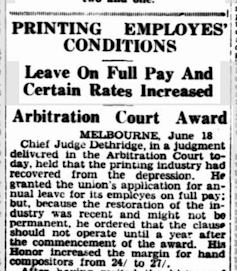
The right to paid annual leave has not existed in Australia for as long as you might think. The printing industry was the first to receive the right to a week of paid leave in the mid-1930s. In 1941 it became standard in other industries.
Trove
Leave entitlements increased slowly over the following decades, reaching four weeks in 1974. But they haven’t changed since then.
Why it is up for debate
It is not the first time that an extension to five weeks has been proposed. But this latest push comes amid a wider inquiry into whether Australia’s minimum standards for workers are adequate.
At the end of last year, the federal government launched an investigation into the National Employment Standards, which are part of the Fair Work Act.
In addition to leave rights, the inquiry could also examine related provisions, such as those defining “reasonable hours.”
Is this the best way to tackle unpaid overtime?
Central to the ACTU’s proposal is the need to tackle unpaid overtime in the workplace.
Here they have identified a real problem. But it’s important to make it clear what we’re talking about. Historical data from the Australian Bureau of Statistics shows that the average number of hours worked by full-time employees fluctuates, but has declined slightly since the 1990s.
Instead, we are talking about unpaid, extra work, which is not included in the official statistics.
Citing recent research from the Australia Institute’s Center for Future Work, the ACTU says employees work an average of 4.5 weeks of unpaid overtime every year.
The ACTU said the proposal would allow them to “return” for at least one of these weeks as furlough.
There are other issues that need to be addressed
It’s fair to ask why we have this problem in the first place.
Under the National Employment Standards in the Fair Work Act, your employer can ask you to work more hours if it is “reasonable”. And conversely, employees have the right to refuse unreasonable working hours.
However, this provision does not work very well in practice. First, it is a very difficult protection to enforce. While it may seem like it provides a hard cap for employees, the wide range of exceptions means it tends to be more porous in practice.
There have been very few cases that have tested its limits in court. Among the definitive statements we have are some egregious examples of extreme work expectations.
Problems that more leave may not solve
Giving employees the right to an extra week of leave may not address the broader cultural issue around overwork.
If the work asked of some employees is not reassessed, they may end up simply trying to do the same amount of work all year long – in 47 weeks instead of 48 weeks.
Even under the current four-week model, many employees struggle to find space in their working lives to make use of their existing leave entitlements. Employers must create space for employees to take leave without unnecessarily increasing the workload.
What are the costs?
Then there is the matter of cost. Adding an extra week will inevitably entail additional costs and administrative burdens for companies.
Writing for The Conversation in 2024, University of Melbourne economist Jeff Borland estimated that an extra week of furlough would increase labor costs by about 2% – which he said was less than the usual annual growth in full-time weekly wages.
Whether the union push for more paid annual leave succeeds or not, employers can help themselves and their employees by proactively managing their workforce’s access to leave. Employers should also ensure that work expectations are reasonable and achievable within existing working hours.
This prevents leave from piling up, creating financial obligations for the employer. And it will help employees by ensuring they get the breaks they deserve.