Coveted mid-century modern artist retreat miraculously ‘saved’ by Eaton Fire hits the market for $2.5 million
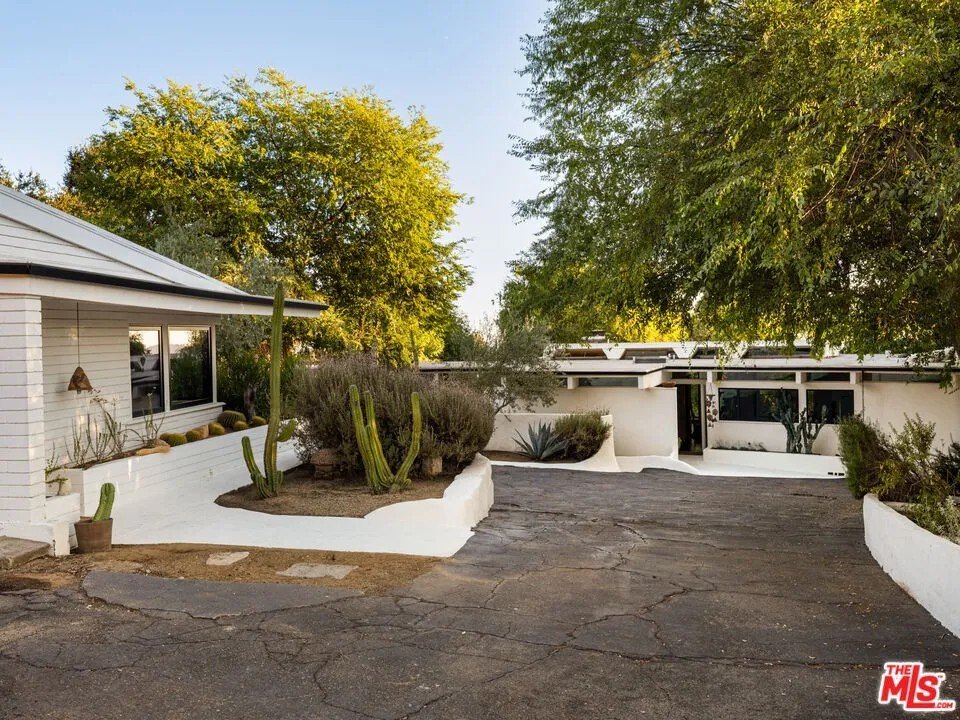
An architecturally significant mid-century modern building that somehow managed to survive California’s devastating wildfires — even as the blazes leveled neighboring properties — has hit the market for $2.45 million.
Named after its original owner, the David Green House is intended as an artists’ retreat and is located in a “coveted” neighborhood at the foot of Altadena, an area devastated by the Eaton fire in January.
The Eaton Fire was one of the most destructive wildfires in California history. It burned for 24 days, spreading quickly under powerful Santa Ana winds and scorching more than 14,000 acres. It destroyed nearly 10,000 structures and claimed the lives of 19 people.
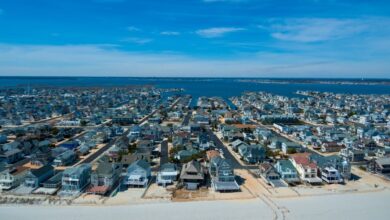
Although aerial photographs show that many of the homes surrounding the site were destroyed by the fire, this historic estate remained untouched and unscathed.


No one knows exactly why the fire ‘spared’ the David Green House, but those involved with the property have theories.
The listing notes that the “flowering garden and thoughtful site planning provide a natural shield, making it one of the rare outcroppings to remain intact.”
Listing agent Katherine Blackwoodof Compass, explains that the risk of future fires had no influence on the owners’ decision to sell.
Still, she notes that the fires did impact their desire to ensure the property’s legacy is preserved long into the future – having purchased it themselves for $1.35 million in 2015 and subsequently investing generously in careful updates to the home.
“Part of honoring the story is so that someone else can start the next chapter,” Blackwood explains. ‘The fire gave them perspective. It reminded them that the spirit of the house is not just about who owns it, but about the ability to endure and inspire.
“They are grateful to have been its caretakers and are confident it will continue to inspire and serve as a sanctuary for creativity and tranquility.”
Peace and artistic endeavor have always been central to the design of the house, which was originally brought to life by sculptor, calligrapher, artist and educator. David Oliver Green Jr.
Green trained at the American Academy of Art in Chicago and the National Academy of Art in New York, then moved west to settle in Altadena in the late 1940s, when he became an architect. Frederik Monhoff to design a light-filled structure that would serve as his studio among the trees.


It was in that space that Green created works of art that would be exhibited at LACMA, the Greek Theater, Chaffey College, the San Diego Museum, the Santa Barbara Museum, and many other prestigious locations.
After Green and his wife fell in love with the location, Jaxinedecided to expand their small artist studio into a creative complex, hiring architecture professor and Greene & Greene authority Randell Makinson to design the three-bedroom, two-bath main house where they would live.
Makinson was commissioned to seamlessly combine the styles of the late 1940s studio and the early 1960s main residence to create a unique estate.
With this complex as his home base, Green taught calligraphy and sculpture at Pasadena City College, the Pasadena Art Museum, the Otis Art Institute of Los Angeles, and Scripps College.
The Greens were so influential and well-liked in the area that the street the house was located on was renamed Jaxine Drive in honor of Green’s wife.
Combined, the two buildings measure 1,792 square meters. The main residence features a California modernist design, with its post-and-beam construction, sculpted ceilings, clerestory windows and walls of glass that open to a full-length deck overlooking the canyon.
It has recently been updated by an interior designer Matthew Sullivan by AQQ Design, whose work is especially evident in the kitchen, which is wide open to the great room, separated only by a dining peninsula. Modern stainless steel appliances fit right in.


The walls are painted cream white and the original blonde wood accents have been retained. The antique blonde brick fireplace in the large great room continues to impress.
The bedrooms of the main residence are accented by antique built-ins, desks and cabinets. The primary suite has a floor-to-ceiling window, private bathroom and access to the courtyard.
The separate, smaller structure is itself a mid-century modern masterpiece. It can be used as a studio, office, guest house or yoga retreat and contains a bedroom, a full bathroom, a great room, an open kitchen and a striking fireplace made of fluted terracotta tiles.
Both structures have access to extensive wooden terraces, shaded by oaks and other mature foliage. There is a lot of well-maintained greenery.
According to the listing, that carefully manicured land could very well have made the difference in surviving the Eaton Fire, which simply spread to multiple properties due to embers carried by the wind.
Experts, including members of the Los Angeles Fire Department, have previously admitted that it is impossible to say exactly why some properties were spared while others burned to the ground.
Pasadena Fire Battalion Chief Danny Nausha previously told the Los Angeles Times that the pattern of the fire was unlike anything he had ever seen.
“This is something I’ve never seen in my 20 years,” he said. “We placed appliances as close to the edge of the fire as possible to prevent them from entering buildings, but many of the embers would fly into neighborhoods.
“It could be wind, clearing brush, luck,” the firefighter said Scott Brownat the time assigned to Los Angeles County Fire Station 66. His best guess was that “all three” had played a role in saving some homes, but not others.