Burnham to say he wants to unlock ‘positivity’ in first statement to MPs since becoming PM – UK politics live | Politics
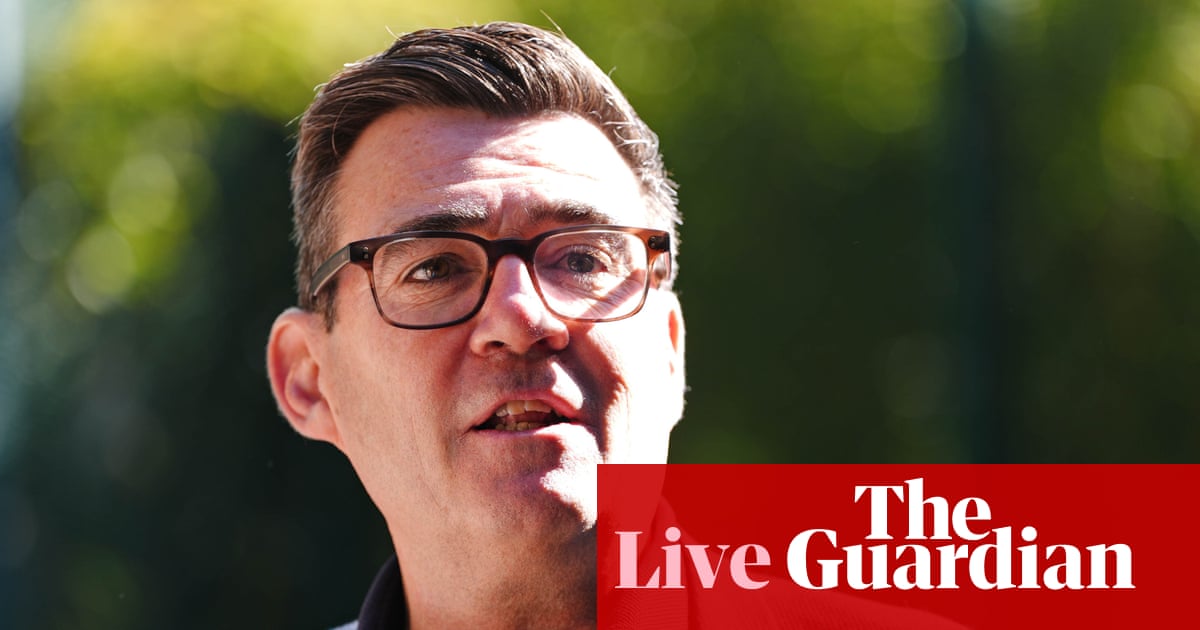
Burnham to say he wants to unlock ‘positivity’ in first statement to MPs since becoming PM
Good morning. Andy Burnham became prime minister six weeks ago, but today will be the first time he addresses MPs in the Commons. It will also be the first time he has spoken as a minister from the dispatch box in more than 16 years. As MPs return to Westminster, they will be telling each other about how they spent the summer holiday and, for Burnham, it has undoubtedly gone well. He has unveiled a blitz of announcements which, broadly, have had a good reception and he has delivered the kiss of life to Labour’s poll ratings.
Today Burnham will chair cabinet in the morning and then make a ministerial statement in the Commons after 3.30pm. Normally a prime ministerial statement has a specific focus; it will be about a major policy decision, or a foreign affairs crisis. From the briefing that we have had so far, it sounds as if Burnham’s will be more of a wide-ranging rehash of all the things that he has been talking about this summer. In her preview, Jessica Elgot says he will talk about his intention to bring more essential services back into public control.
According to the BBC’s preview, Burnham will say he wants to “unlock a feeling of positivity and possibility” in every part of the country.
For the past six weeks, Burnham’s tone has been relentlessly positive. He repeatedly says he wants to focus on “problem-solving, not point-scoring”, and he clearly means it. Labour MPs chose Burnham as leader because they thought Keir Starmer would not be able to stop Nigel Farage becoming PM, but over the summer Burnham has said very little in public critical about Farage, or Reform UK, or the Tories. He views partisan mud-slinging as part of the old politics that he would like to reject.
But can he do that when he has to perform politics in the House of Commons? It sounds as if Burnham will not have much new to announce in his statement and so journalists will probably focus instead on what Labour and opposition MPs say to him, and how he responds. Burnham may not approve of “point-scoring”, but in the Commons, tradition, culture and even the architecture (front benches supposedly two swords’ length apart) prioritise conflict and it will interesting to see if he can get through the afternoon without resorting to the usual aggressive ding-dong. This will be an even bigger challenge for him at PMQs tomorrow.
And even if Burnham can remain upbeat for two hours in the Commons chamber, he will soon find that there are some places in the country particularly resistant to “positivity” – like the newsrooms at the Mail and GB News.
Still, it is probably worth a try. Here is the agenda for the day.
9.30am: Andy Burnham chairs cabinet.
Noon: Downing Street holds a lobby briefing.
2.30pm: Nigel Farage, the Reform UK leader, takes his seat as an MP after winning the Clacton byelection during the summer recess.
2.30pm: Ed Miliband, the foreign secretary, takes questions in the Commons.
After 3.30pm: Burnham gives a statement to MPs.
Late afternoon: Alex Norris, the justice secretary, gives a statement to MPs about changes to the prisoner early release scheme.
I’m afraid we are no longer able to have comments open below the line every day on this blog. If you want to contact me, please email politics.live@theguardian.com. You can use this email to flag up corrections, comments for publication, questions or complaints.
Key events
Healey says next year’s spending review will set out ‘clear path’ to raise defence spending to 3.5% of GDP by 2035
Last week it emerged that John Healey, the chancellor, will not set out how the UK will raise defence spending to 3% of GDP by 2030 in the budget in October. Instead, he will set out plans to raise defence spending in the spending review next year.
The revelation led to Healey being accused of hypocrisy because he resigned as defence secretary in Keir Starmer’s government after Starmer refused to commit to raising defence spending to 3% of GDP by 2030 in the defence investment plan published this summer. Healey’s resignation contributed to Starmer deciding to step down, and Healey returning to government in a more senior role as Andy Burnham’s chancellor.
In an interview with the Times, Healey has said he is “100%” committed to raising defence spending. He told the paper:
For the first time at the spending review, we will set out a clear path about how we will meet that Nato commitment in 2035, of 3.5% of GDP. And as part of setting out that clear path, we will set that target date for 3%.
The paper has headlined its story: “John Healey: I’ll prove I’m no hypocrite on defence.” But Healey did not use those words himself (it is the Times summarising his stance), and in the interview Healey did not confirm the 3% target would be met by 2030.
Justice secretary Alex Norris says prisons will still function under plan to turn laundries into cells
Alex Norris, the justice secretary, has insisted prisons will “still function properly” amid concerns over government plans to turn laundries into cells in a bid to tackle overcrowding.
As Ben Quinn reports, the Ministry of Justice announced overnight that it will spend £110m creating new cells in prisons using existing spaces like unused offices, laundry rooms and other areas.
Norris was giving interviews this morning and he said “hundreds of places” would be created by converting existing spaces inside prisons into accommodation.
He declined to confirm Tory claims that there are 700 fewer prison places than a year ago, noting that the estate “fluctuates” because of issues such as fire damage.
Asked where clothes would be washed if laundry rooms were converted into cells, Norris told BBC Breakfast:
Of course we’re going to make sure that the prisons can still function properly.
This is a creative look, as I say, around our estate and being able to use some space that we can re-prioritise.
He said wider plans – including building entire new prisons – would see 14,000 new places on top of the 3,200 prison places delivered in the last two years, “but that takes time”, while the conversion plans would add “in the hundreds of spaces”.
Pressed on the Conservatives’ claim that there are 700 fewer prison places than in 2025, Norris said the estate “fluctuates” because of planned and unplanned events affecting the Victorian-era buildings.
He told Times Radio:
Those wouldn’t necessarily be the numbers I’d use, but it is possible that places come out of the estate. For example, you know, there can be damage, fire damage. We’ve got a very old estate.
Small boat crossings during summer months have fallen to seven-year low, Home Office says
In line with Andy Burnham’s emphasis on “positivity” (see 9.04am), the Home Office has put out a press release overnight saying that summer small boat crossings have been at a seven-year low this year. The figures aren’t particularly new, and anyone following the story closely will know that small boat arrival numbers have fallen sharply. But these statistics have not been publicised prominently in the rightwing media, which is one reason why almost half of Britons wrongly think small boat arrival numbers are going up.
The Home Office says:
Usually some of the busiest months in the year, with criminal gangs exploiting good weather, latest data shows that June, July and August (up to the 30th August) recorded the lowest combined total of small boat crossings since 2019, and the lowest number of small boat migrant arrivals since 2020.
• August crossings (up to 30 August) fell to their lowest level since records began in 2018, down 46% on last year, with the lowest number of migrant arrivals since 2020, down 35% on last year.
• July saw the fewest crossings of any July since 2019, down 64% on 2025, with the lowest number of migrant arrivals since 2020, down 58% on last year.
• June recorded its lowest level of crossings since 2019, down 50% on 2025, with the lowest number of migrant arrivals since 2021, down 47% on last year.
It is important to recognise the distinction between small boat crossing numbers and arrival numbers. The number of people arriving on small boats has fallen significantly, but the number of small boat crossings (ie boats, not people) has fallen even more because people smugglers are using bigger boats (in part because smaller boats are being seized).
Burnham to say he wants to unlock ‘positivity’ in first statement to MPs since becoming PM
Good morning. Andy Burnham became prime minister six weeks ago, but today will be the first time he addresses MPs in the Commons. It will also be the first time he has spoken as a minister from the dispatch box in more than 16 years. As MPs return to Westminster, they will be telling each other about how they spent the summer holiday and, for Burnham, it has undoubtedly gone well. He has unveiled a blitz of announcements which, broadly, have had a good reception and he has delivered the kiss of life to Labour’s poll ratings.
Today Burnham will chair cabinet in the morning and then make a ministerial statement in the Commons after 3.30pm. Normally a prime ministerial statement has a specific focus; it will be about a major policy decision, or a foreign affairs crisis. From the briefing that we have had so far, it sounds as if Burnham’s will be more of a wide-ranging rehash of all the things that he has been talking about this summer. In her preview, Jessica Elgot says he will talk about his intention to bring more essential services back into public control.
According to the BBC’s preview, Burnham will say he wants to “unlock a feeling of positivity and possibility” in every part of the country.
For the past six weeks, Burnham’s tone has been relentlessly positive. He repeatedly says he wants to focus on “problem-solving, not point-scoring”, and he clearly means it. Labour MPs chose Burnham as leader because they thought Keir Starmer would not be able to stop Nigel Farage becoming PM, but over the summer Burnham has said very little in public critical about Farage, or Reform UK, or the Tories. He views partisan mud-slinging as part of the old politics that he would like to reject.
But can he do that when he has to perform politics in the House of Commons? It sounds as if Burnham will not have much new to announce in his statement and so journalists will probably focus instead on what Labour and opposition MPs say to him, and how he responds. Burnham may not approve of “point-scoring”, but in the Commons, tradition, culture and even the architecture (front benches supposedly two swords’ length apart) prioritise conflict and it will interesting to see if he can get through the afternoon without resorting to the usual aggressive ding-dong. This will be an even bigger challenge for him at PMQs tomorrow.
And even if Burnham can remain upbeat for two hours in the Commons chamber, he will soon find that there are some places in the country particularly resistant to “positivity” – like the newsrooms at the Mail and GB News.
Still, it is probably worth a try. Here is the agenda for the day.
9.30am: Andy Burnham chairs cabinet.
Noon: Downing Street holds a lobby briefing.
2.30pm: Nigel Farage, the Reform UK leader, takes his seat as an MP after winning the Clacton byelection during the summer recess.
2.30pm: Ed Miliband, the foreign secretary, takes questions in the Commons.
After 3.30pm: Burnham gives a statement to MPs.
Late afternoon: Alex Norris, the justice secretary, gives a statement to MPs about changes to the prisoner early release scheme.
I’m afraid we are no longer able to have comments open below the line every day on this blog. If you want to contact me, please email politics.live@theguardian.com. You can use this email to flag up corrections, comments for publication, questions or complaints.
Source link