Four distinctive luxury mindsets reshaping travel in Asia Pacific | News
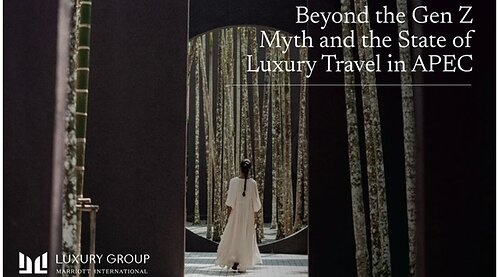
Based on insights from 2,800 affluent travelers across eight markets in the Asia Pacific region, including 1,200 Gen Z respondents aged 18 to 29, the report signals a decisive shift. Luxury travel is no longer anchored by demographic factors, but is increasingly defined by intention, identity and personal meaning.
“Luxury today is no longer defined by a singular standard. It is deeply personal,” said Oriol Montal, Regional Vice President of Luxury, Marriott International Asia Pacific excluding China. “Our research shows that affluent Gen Z travelers aren’t just partaking in luxury travel. They’re reshaping it, driven by a desire for meaning, wellness and authentic connection. As the definition of luxury continues to fragment and evolve, understanding these emerging perspectives will be critical to shaping the next generation of travel experiences.”
From followers to architects of luxury travel
Today’s affluent Gen Z travelers are no longer passive participants. Rather, they are deliberate architects of their journeys. More than half finance their own trips, while almost half plan every aspect of their trips themselves. Family members remain their favorite travel companions (51%), while small-group travel has increased by 17%, signaling a shift towards more intimate, shared experiences.
They also bring refined expectations to every journey. Cultural immersion and involvement with local communities influence destination choice for 87% of respondents, while culinary discoveries (86%), proximity to nature (86%) and well-being (85%) are key priorities shaping travel decisions.
At the same time, Gen Z travelers expect luxury to be seamless. Inefficient time and gaps in communication are among the biggest frustrations, underscoring the growing demand for intuitive, hassle-free service. Meanwhile, technology is playing an increasingly important role in trip planning: 23% are already using AI tools for travel inspiration and planning.
Four distinctive luxury mindsets
The report identifies four Generation Z archetypes whose definitions of luxury vary considerably:
The connoisseur traditionalist (34%)
For this group, luxury remains rooted in the enduring pillars of hospitality: reputation, service and craftsmanship. They gravitate towards iconic hotels, exceptional service, loyalty recognition, critically acclaimed restaurants and carefully planned itineraries. Notably, 79% consistently stay in luxury hotels, while 91% say brand reputation influences booking decisions. Loyalty remains a powerful motivator: 85% are motivated by recognition and reward. As one of the most organized traveler groups, 66% book trips at least one to two months in advance, underscoring a definition of luxury based on precision, trust and excellence.
The more future-proof (30%)
For Future Proofers, traveling is an investment in long-term well-being. Their trips are shaped by a desire for optimization and balance, with almost everyone (97%) taking advantage of wellness facilities during their stay, while 95% value access to in-house healthcare experts and find proximity to nature important when choosing a destination. More than half (57%) are willing to spend more on wellness treatments, which is much higher than the broader Gen Z average (20%). Their growing influence reflects the evolution of luxury travel toward an indulgence in preventive healthcare, recovery and holistic wellness.
The silent luxuryist (20%)
In an age of constant connectivity, quiet luxuryists prefer absence over access. They redefine luxury as the ability to disconnect, disappear and reclaim silence. All respondents in this profile (100%) say they limit technology use while traveling, compared to 63% of Gen Z overall. Meanwhile, 85% look for lesser-known destinations, 60% prefer places before they become popular, and 90% value private dining experiences. They prefer boutique hotels, private villas and secluded places and measure luxury not by visibility, but by the freedom to distance themselves.
The cultural reclaimer (16%)
For Cultural Reclaimers, luxury travel is closely linked to identity, heritage and meaningful connection. Every respondent in this group plays an active role in planning family outings, with 65% also acting as the main financial decision maker. Half say destinations linked to family heritage are very important, significantly above the broader Gen Z average of 33%. They are also highly engaged travelers, with 88% seeking immersive experiences. Their journeys are driven less by social validation, and more by cultural discovery, personal enrichment and strengthening intergenerational bonds.
A broader recalibration of luxury travel
In addition to Generation Z, the report also signals a broader recalibration of luxury travel in the region. Fueled by continued demand for premium travel experiences, affluent travelers are also becoming more selective, making fewer trips and extending their length of stay. The average international leisure trip is expected to increase in duration from seven to nine nights, reflecting a shift from frequency to depth. As travelers focus their time and spend, expectations around personalization, seamless service and meaningful engagement continue to rise.
As luxury travel enters a new era, the findings point to a fundamental shift: the future of luxury will not be defined by a single ambition, but by a spectrum of personal values. From the pursuit of silence to the search for identity, from wellness to cultural immersion, Generation Z is transforming luxury into something more nuanced and intentional.
The implications for the sector are clear. Success will depend not on creating one definition of luxury, but on understanding many, and delivering experiences that feel deeply personal, emotionally resonant and undeniably relevant.