‘The Evil Lawyer’ director on Thai justice, morality and Netflix
Before Nottapon Boonprakob made The Evil Lawyer, he had never spent much time thinking about the legal system. That changed the moment he took part in courtroom proceedings – watching judges, lawyers and prosecutors go through rituals that seem absolute and sacred from the outside, and from within prove something more disturbing: deeply, fallibly human.
“Once we started researching and speaking directly to people within the system, it became much more human,” he says Variety. “We started to see the individuals who are part of the system – their faces, their life experiences, their perspectives on the world.”
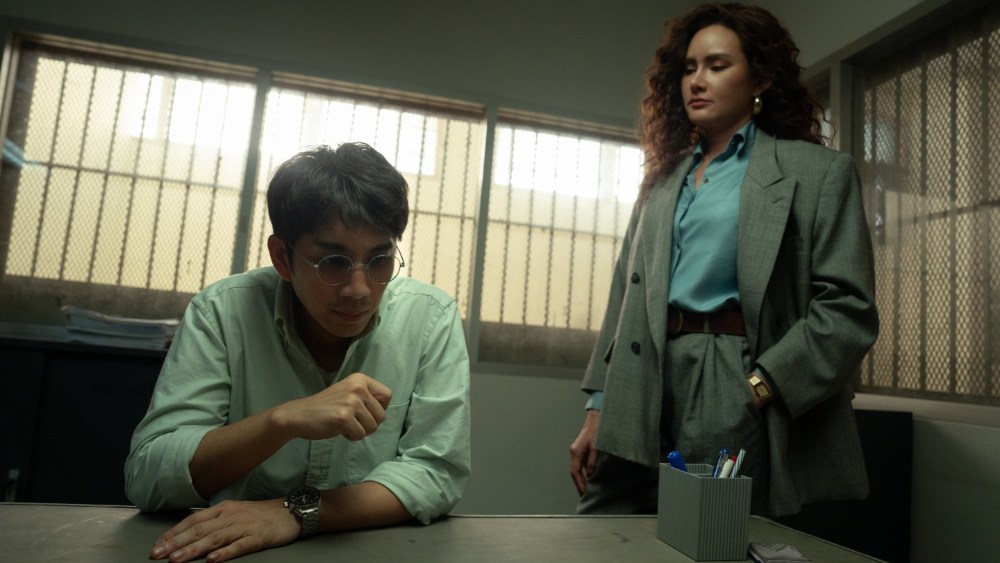
That dissonance — between the ideal of justice and the imperfect people charged with delivering it — is at the heart of “The Evil Lawyer,” Nottapon’s second Netflix original after “Mad Unicorn” and the most ambitious Thai legal drama yet attempted on the platform. Produced by Songphon Jantharasom and co-directed by Jakkarin Thepvong, the series stars Rhatha Phongam as Jittri, a lawyer infamous in legal circles for weaponizing technicalities and doing whatever it takes to secure an acquittal. Nat Kitcharit plays Mek, an idealistic young lawyer whose faith in the system is systematically dismantled after he is accused of murdering the son of Anan (Songsit Roongnophakunsri), a powerful police chief. Backed into a corner and abandoned by the institutions he trusted, Mek turns to Jittri – the would-be evil lawyer of the title – who agrees to take his case on one condition: he must work for her.
The series uses multiple interconnected cases to draw viewers through different corners of the Thai legal system, with Mek’s ordeal remaining the emotional backbone. Also in the ensemble are Atchareeya Potipipittanakorn as Ang, a politician and human rights lawyer; Phollawat Manuprasert as Rit, Mek’s father and a high-ranking judge forced to choose between his principles and his son; and Paopetch Charoensook as Techin, the son of the police chief.
Nottapon, who joined the underDOC team as director and co-writer after Jakkarin and Jantharasom had already developed the original concept, describes the show as something he couldn’t have made without immersing himself in a world he barely knew. The investigative process – interviews with lawyers, judges, prosecutors and forensic specialists – has provided the series with more than authentic details. It reoriented his understanding of what justice actually is. “Every person has flaws, blind spots and imperfections,” he says. “Yet these same people have been entrusted with roles within a system designed to pursue something incredibly pure and sacred, to determine the truth, to prove one’s innocence, or to determine the course of one’s life.” People strive for ideals of honesty and truth, he adds – but mistakes happen and blind spots exist. “No system is perfect.”
He also came with a conviction about the limits of language itself. The law depends on words, but words can only approximate the truth – and in that gap, he realized, lies much of the drama.
That insight informed one of the series’ most distinctive formal choices: stylized transitions that take viewers straight from the courtroom to competing reconstructions of contentious events. The idea, Nottapon says, came from a thought Jakkarin expressed during development: that a courtroom is less a place of discovery than a kind of theater, where each party performs its own version of reality before the judge. “Once we started thinking about the courtroom in those terms, it felt natural to take viewers directly into the reality that every lawyer tries to construct and visualize,” says Nottapon. “Thus, the concept of the transition from the courtroom to reconstructed events became part of the narrative language of the series.”
To strike the right balance, the team had to construct an entire internal grammar for the device: rules about camera movement, visual effects and, crucially, what characters entering a reconstructed scene could see, do and interact with. “We spent a lot of time defining the rules of this world,” says Nottapon. The goal was a technique that felt visually imaginative without undermining the credibility of the drama surrounding it.
At the center of that drama is Jittri, who began the development process as an older male lawyer before the writing room re-identified her as a woman. For Nottapon, the gender shift was transformative. A figure who has amassed enough experience, resilience and authority to take on powerful men in a profession still largely dominated by them is immediately more compelling – and more revealing. “She’s not just a ‘bad lawyer’ or an anti-hero,” he says. “She is someone whose choices and worldview have been shaped by everything she has been through.” What he hopes viewers will ultimately ask, once they get past her harshness and her morally ambiguous methods, is a simpler and more human question: What happened to this woman?
Mek is designed to carry a different weight. He is, by design, the audience surrogate — someone who enters Jittri’s world knowing pretty much what most viewers know, and is changed by it in a way that the show hopes viewers will feel right next to him. “He is the door through which the audience enters the series and explores the complexities of the Thai legal system,” says Nottapon. “As his perspective evolves, we hope viewers will also question and reassess their own assumptions.”
Legal dramas have rarely found traction in Thailand, where audiences have long favored romance, comedy and horror. Some of the resistance is cultural – the courtroom process is far removed from most people’s daily lives – but some of it is industrial. Stories built around a specific profession require in-depth research that is truly costly, and investors have historically been reluctant to back projects by what they consider a niche audience. Nottapon is candid about what ‘The Evil Lawyer’ is dealing with. He calls it an experiment: a test of how far Thai audiences are willing to go with a story that’s demanding, morally unresolved and set in a world most of them have never entered. If it works, he believes it could serve as a point of reference – proof that there is an appetite for more ambitious, unconventional Thai stories.
Netflix helped create the conditions for that experiment. Nottapon points to “The Believers” — which tackled religious themes that would have been difficult in an earlier era of Thai drama — as a sign of how the platform has expanded what feels possible. The global stage is also completely shifting the competitive logic: Thai content now stands alongside series from the US, South Korea, Japan and elsewhere, competing for the same viewers. That pressure has, counterintuitively, created more creative freedom, not less.
When asked whether the deep specificity of the series – its grounding in Thai legal culture, politics and social tensions – could make it harder for international audiences to connect, Nottapon responded unequivocally. “No, not at all. In fact, I believe the opposite.” The comparison he seeks is “Parasite”: Bong Joon Ho has neither softened nor universalized the Korean specificity of his film. He leaned into it, and the film traveled because of that specificity, and not in spite of that specificity. “I see ‘The Evil Lawyer’ in a similar way,” says Nottapon. Korean drama itself, he notes, was once unknown to most international viewers – its fame built gradually through exposure to well-told stories. He believes the same is possible for Thailand.
“The more we have authentic local voices telling stories from their own perspectives, the richer, more unique and more diverse global cinema becomes,” he says. “What makes storytelling exciting is not the uniformity, but the fact that people from different cultures can share stories that only they can tell.”
“The Evil Lawyer” is streaming on Netflix.