Serena Williams, Eva Longoria, Elisabeth Moss Talk Biz at Milken
Serena Williams made a bold statement during a question and answer session about her work in venture capital at the Milken Institute conference.
“This part of my career is going to be much bigger than anything I’ve ever done before,” the tennis great said confidently from the stage at the Beverly Hilton hotel as she discussed her numerous investment projects that flow through her Starfire banner.
Williams, who has been a pioneer in female athletes since her teens, discussed her love of investing and the work of nurturing founders and promising businesses in her wide-ranging conversation with Jason Kelly, Bloomberg News correspondent and host of the sports business podcast “The Deal.”
Williams started out as an angel investor. But as she began to understand the ecosystem, she realized she wanted Starfire to play a bigger role. And she approached it like an athlete in training.
“I spent at least three years getting to know founders, getting to know people, getting to know companies, investing more, building my rhythm and building my portfolio,” Williams said. “And then we launched our first fund with just a few years of discipline, going through the process and understanding what we wanted to do,” Williams said. “VC is a game of who do you know.”
Williams’ May 5 session was one of several held during Milken’s May 3-6 conference that shed light on how bold names in Hollywood are using their entertainment experience and influence as celebrities to make serious headway as investors.
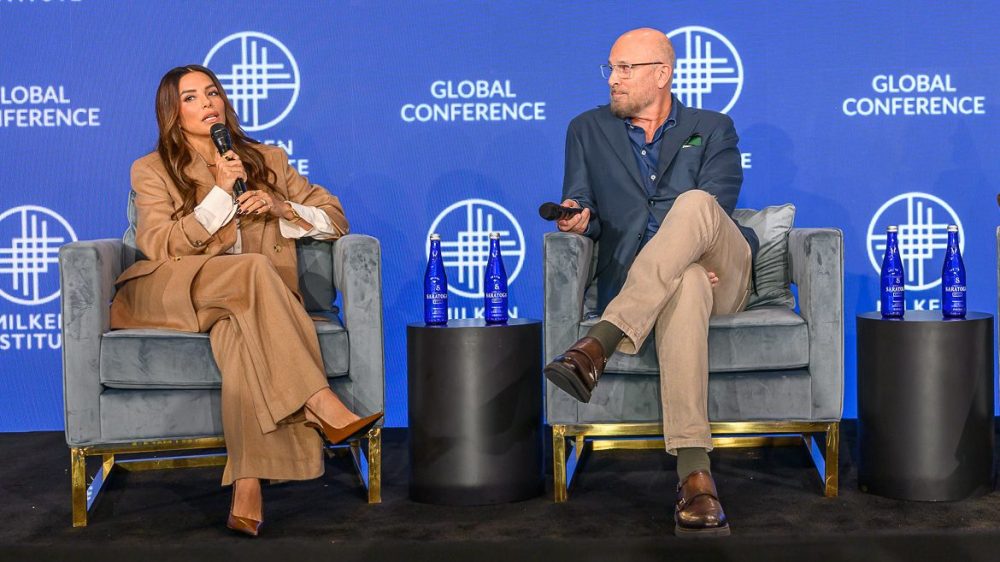
Eva Longoria, the actor/director/producer and co-founder of Hyphenate Media Group, described her journey in placing big bets with capital during a lively conversation with Kevin Yorn, her longtime attorney. Yorn also shines as an investor through his Broadlight Capital banner, as he explained during the May 6 session moderated by Rebecca Keegan, senior Hollywood reporter for NBC News.
Another prominent duo spoke of a different kind of investment, rooted in creative taste and trust, that has created a production partnership that has produced two hit TV series to date, with more to come. Veteran producer and former NBC executive Warren Littlefield and actor/producer/director Elisabeth Moss explained how they came together as partners on Hulu’s “The Handmaid’s Tale” and the recently launched prequel “The Testaments.”
Warren Littlefield and Elisabeth Moss discuss their production partnership on “The Handmaid’s Tale” and “The Testaments” during the Milken Institute conference May 4 at the Beverly Hilton hotel.
rachael b photography 310.466.25
In her conversation with Kelly, Williams explained that she is motivated by the knowledge that less than 2% of all venture capital money flows to female entrepreneurs. And she is excited about the potential of tapping her connections and resources to help grow technology-driven companies with the potential to change the world.
“I just wanted to change the people who write the checks. I think if the same people write the same checks, it’s always going to be this cycle that continues,” Williams said. “But if you shake that up — by setting aside a certain percentage to go to women, to go to underrepresented founders — I feel like it changes the landscape of the top of the funnel. There are so many companies in our portfolio that are doing so well because of us, and they’re going to be huge, huge companies because of what we bring to the table.”
Williams is energized by the opportunity to invest in companies that will impact “how we live our lives, how we allow our children to live our lives,” she said. “With everything that’s happening in AI today, we need to look at these opportunities. We need to make sure we invest in them too, because this is as big, if not bigger, than the industrial revolution.”
Longoria discussed how she deftly leveraged the value of her personal brand in a business context during her May 6 session with Yorn and Keegan.
“If you look at Hollywood and celebrity culture, we are trusted voices within a given market,” Longoria said. “I’m Hispanic. I’m a woman of a certain age, so you might say, ‘That’s pretty purposeful.’ And I probably have bigger distribution than NBC or ABC – I could reach more people, for example,” Longoria said. “Brands want that end user, and they want the conversion. Because it’s not just about clicks and likes. They want you to convert. How many things have we sold and how much? Or are we exposing a brand, or trying to get people to buy something? And what is the call to action for these brands?”
Yorn gave his view that Longoria was a natural as an investor, as someone with strong instincts about material and the courage of her convictions. Yorn cited a piece of little-known Hollywood history showing that Longoria’s firm was a major source of financing more than a decade ago when the first “John Wick” action film hit the market.
“It was my naivety that allowed me to take that risk. Because it is a very risky business to invest in films. We don’t know what will happen to us,” Longoria explained.
Essentially, Longoria explained that she had faith in director Chad Stahelski and writer Derek Kolstad and their vision for an action film franchise led by Keanu Reeves.
“They were young, scrappy and hungry. They had a relentless drive and hunger to make the best action movie anyone has ever seen. And you say, wow, there was no denying that they weren’t going to fail,” she said. “I didn’t finance the entire film, but I did [provide] emergency funds. And ‘John Wick’ [franchise] went on to earn $1 billion at the box office. Again, it was about investing in people who are going to execute what they say they are going to do.”
For Yorn, being an investor exposed to cutting-edge tech innovation has benefited his day job as an advocate for creative artists. It certainly helped him broker a landmark deal recently struck for client Matthew McCounaghey to trademark his distinctive voice and likeness to protect against AI theft.
“I am a protector of intellectual property. My goal is to protect someone from stealing someone’s vote,” Yorn said. “I invest in responsible AI.” In that regard, he referred to the AI-driven audio company ElevenLabs
“Matthew McConaughey is really into AI, and he and he have invested in ElevenLabs, and he’s almost insisting that he wants to use ElevenLabs for certain things that he does. But at the same time, I’m his lawyer, and I’m going to be yelled at by everyone in Hollywood. ‘What the hell are you doing? McConaughey is going to go to ElevenLabs and all of a sudden the voice actors are going to be out of work and all this stuff.’ But at the same time I have to look at things like: what’s going on here? This isn’t going away. We trademarked his voice, as well as his likeness. We were the first to do it together with an artist.”
Yorn also addressed the rising value of celebrity personal brands in consumer goods and retail expansion. The way Hailey Bieber’s beauty brand Rhode used branded content to raise awareness of Rhode is a great example, as Yorn pointed out.
“Everyone knows beauty brands are so hard. They all fail pretty much every time,” Yorn said.
“We have a person who you can trust because she represents beauty. And then she had to find the right group to help create the things that people use. It has to really work. But the third thing was that she was smart enough to contact a company called OBB Media. All they do is create content with the storyteller in a way that really resonates with their audience. They just have a special skill,” Yorn said. “So she had three things that made up the special sauce: huge social media following and trust, a good operator who helped create the product. And third, this incredible reinforcement of this great group that helped her tell a story. And then it worked.”
The importance of building and maintaining trust in business relationships was a key theme for Moss and Littlefield during their May 4 conversation, moderated by Cynthia Littleton, co-editor-in-chief of Variety. Moss shared the story of how she asked her talent reps to “bring me a Warren Littlefield-type” producer to work with when she first went on to star in and produce “Handmaid’s Tale” for Hulu more than 10 years ago. She was overjoyed when Littlefield himself showed up.
“It’s so much about trust,” Moss said. “When you start a project, I think the most important decision – especially as an actor, whether you’re a producer or not – is the first decision: Who are you going to sleep with? Who are you going to stand next to? Who’s going to make those 200 decisions that you make when you’re preparing for a show?”
Moss detailed the gestures and small and big decisions Littlefield and “Handmaid’s Tale” showrunner Bruce Miller made out of respect for her role as producer. It can be a stressful process for actors to be taken seriously behind the camera in a different role. Littlefield and Miller made Moss feel like a full partner from the start of the Emmy-winning series that ran for six seasons on Hulu, Moss said.
“There were 100 things they did that first season,” Moss recalls. “I’m very spoiled. I know that’s not normal.”
Littlefield told Moss that he recognized from the beginning that she had the qualities to be a great producer, in part because of the way she handled the competing demands of her time.
“You were in virtually every scene, so the workload we put on you day and night and on weekends was enormous,” Littlefield recalls. “And yet Lizzie wanted to be in these production meetings. We would shoot two episodes at the same time. Usually we were $3 million to $4 million over budget when we were preparing and we had to get the budget there. And you were part of the solution, part of the process of saying, ‘I wonder if we could combine this, and what if we did this?’ And so it became very clear to us [Moss’ producing credit] wasn’t just a reward for being a great actor on the show. It was because you were putting on muscle mass.”
(Pictured at top: Eva Longoria and Kevin Yorn at the Milken Global Conference 2026)