Best White Label Affiliate Software for Brands (2026)

TL;DR: Five white label affiliate software tools worth your time in 2026:
- Tapfiliate: Best overall for SaaS and e-commerce brands. Full white-label control (custom domain, custom terminology, branded emails) from $179/mo on the Scale plan. No transaction fees.
- PartnerStack: Best for B2B SaaS at enterprise scale. Starts at $1,000/mo (annual). Built for multi-tier partner programs.
- Impact: Best for brands managing affiliates, influencers, and B2B partners in one place. Entry pricing from $30/mo; full features are custom.
- Refersion: Best for DTC e-commerce brands on Shopify or WooCommerce. Pricing on request.
- LeadDyno: Best budget entry point. Full white-label dashboard available from $349/mo (Advanced plan).

Most affiliate software looks the same to your affiliates. Generic portal. Generic emails. Someone else’s name on the login screen.
That detail matters more than you think. When affiliates land in a portal that feels disconnected from your brand, your program feels like an afterthought. Because to them, it is.
White label affiliate software fixes that. It gives your partners a portal that looks, feels, and reads like your brand, your domain, your colors, your terminology. No third-party branding anywhere in the experience.
The problem is that “white label” means different things to different vendors. Some platforms let you upload a logo and call it white label. Others give you full domain control, custom wording, and a partner experience that is genuinely indistinguishable from your own product.
This guide covers the five best options for brands in 2026. You will get verified pricing and honest assessments of what each platform actually delivers on branding. Plus, a clear recommendation based on your business model.
What White Label Affiliate Software Actually Means
White label affiliate software lets you run an affiliate program entirely under your own brand. Affiliates see your domain, your logo, and your portal. Not the software provider’s name anywhere in the experience.

What white label means in affiliate marketing
“White label” in affiliate software means one thing at its core: the technology runs invisibly under your brand. Your affiliates never know what platform you are using.
In practice, that includes:
- A custom domain (affiliates.yourbrand.com instead of app.someplatform.com)
- Your logo and brand colors throughout the dashboard
- Your terminology, “partners” instead of “affiliates,” “referral bonus” instead of “commission”
- Branded email notifications sent from your domain
- No third-party logos, watermarks, or links visible to affiliates
This is not a cosmetic upgrade. The custom domain is the most important element. It controls the full URL your affiliates bookmark, share, and return to every time they check their stats. An affiliate who logs in daily to affiliates.yourbrand.com has a fundamentally different relationship with your program than one logging in to app.someaffiliatesoftware.com.
The terminology control is the second-most-impactful feature. If your brand refers to everyone in its ecosystem as “partners,” but an affiliate dashboard calls them “affiliates,” that creates a disconnect. It is a small detail. But it clearly signals that the program was configured rather than thoughtfully designed for your brand’s context.
The contrast becomes clear the moment you see both side by side. A generic portal signals “we signed up for a free tool.” A branded portal signals “we invested in this relationship.”
That difference shapes how affiliates perceive your program before they have referred a single customer.
It is also worth naming what white label affiliate software is not. It is not a white-labeled network. You are not reselling access to someone else’s publisher pool. It is not co-branding, where both your name and the platform’s name appear. And it is not just a color theme applied to a generic dashboard. True white label means your brand runs the entire experience, end to end.
Why branding your affiliate portal matters
Affiliates choose programs the same way customers choose brands. Trust first. Features come second.
A portal that looks professional and on-brand signals to affiliates that your company takes the partnership seriously. A generic one sends the opposite message, even if your commissions are excellent.

This is not a UX preference. It affects measurable outcomes. According to UpPromote’s 2026 analysis, brands with white-label portals see affiliate activation rates of 28–44%, versus 12–22% for brands using generic affiliate portals.
That gap compounds quickly. If you have 100 affiliates signed up and only 15 are actively promoting, your program is mostly idle. Fixing the trust signal, not the commission rate, is often the lever that changes that.
There is also a data ownership dimension that most comparisons skip. More on that next.
The psychology behind this is straightforward: affiliates join many programs. They promote the ones where they feel like genuine partners, not just referral links in a shared dashboard. Your branded portal is the first signal you send. It either says “we built this for you” or “we signed up for the cheapest option.” Affiliates notice. And they respond to it accordingly.
What this means practically: you do not actually need a bigger commission to increase affiliate activation. You need a better first impression. The branded portal is how you deliver that.
The Business Case for White-Labeling Your Affiliate Program

The business case for white label affiliate software comes down to one number: activation rate. Branded portals convert signed-up affiliates into active, producing affiliates at roughly twice the rate of generic platforms.
Activation rates: branded vs. generic
Activation rate is the metric that most affiliate managers underweight. It measures how many affiliates who join your program actually go on to share a link or refer a customer.
Industry averages for generic portals sit between 12–22%. Most programs are top-heavy, many sign-ups, very few who ever promote.
White-label portals shift that by removing friction at the trust layer. When affiliates land in a portal that looks and feels like your brand, the program feels real. They take the next step.
One brand increased its monthly GMV from $28,000 to $97,000. They switched from a generic affiliate tool to a white-label branded portal. The offer stayed the same. The commission stayed the same. Only the experience changed.
This is the math behind the decision. Every month you run a generic portal, you are paying for affiliates who signed up and went silent. You do not lose them in one dramatic moment. You lose them quietly, one non-activated account at a time.
The activation rate gap is the hidden cost of generic affiliate software. A program with 200 affiliates and a 15% activation rate has 170 people doing nothing. Fix the trust signal, the branded experience, and even moving that rate to 30% doubles your active affiliate base without recruiting a single new person. That is the ROI on white-label software that never shows up in a feature comparison table.
Data ownership and program control
Here is a distinction that matters in the long term: affiliate software and affiliate networks are not the same thing.
Networks like Awin (formerly ShareASale) give you access to their existing publisher base. You pay a percentage of commissions plus platform fees. Your affiliates are also their affiliates. The relationship data lives on their platform.
White label affiliate software is different. You own the program. You own the affiliate data. You set the rules. When you eventually leave the platform, you take your affiliate relationships with you.
For brands building long-term affiliate partnerships, that ownership is a real business asset. An affiliate who has been with your brand for two years, and has a track record in your system, is something you built. That is not the same as renting access to a shared publisher pool.
For brands building long-term affiliate relationships, the ownership model is a real business consideration. When you move to a new software platform, you take your affiliate list, your commission history, and your performance data with you. When you leave a network, you lose the publisher relationships that lived inside it.
For a deeper breakdown of this distinction, see Tapfiliate’s guide to affiliate tracking software vs. affiliate networks
There is also a compounding effect worth naming. When you run your own program through software, every affiliate relationship gets stronger over time. You see which affiliates respond to which incentives. You build commission structures that reward your top performers. You know which content drives conversions versus clicks. That data history is a competitive asset. In a network, it largely stays with the network.
Brands that start with software also have an easier migration path if they later want to switch platforms. Your affiliate list, commission history, and performance data are exported with you. Brands in networks that try to migrate often start from scratch. The affiliate relationships technically lived inside the network. Not inside their own business.
What to Look For in White Label Affiliate Software
Three things separate real white-label software from tools that let you add a logo. Custom domain control. Integration depth. And whether you are paying for software ownership or network access.
Custom domain and branding controls
The minimum bar for white label is a true custom domain. If your affiliates log in at app.someplatform.com/yourcompany instead of affiliates.yourbrand.com, that is co-branding. Not white label.
Look for these specifically:
- Full custom subdomain or root domain (not just a path alias)
- Logo and color customization on the partner dashboard and signup page
- Branded email notifications sent from your domain, not the platform’s
- The ability to replace terminology platform-wide (“commissions” to “rewards,” “affiliates” to “brand partners”)
- No visible third-party platform branding anywhere in the affiliate-facing experience
Most platforms offer some version of this. The depth varies significantly. Tapfiliate on the Scale plan replaces all platform terminology platform-wide, not just the label on one field. That matters for programs that want a fully native experience.
Integration depth
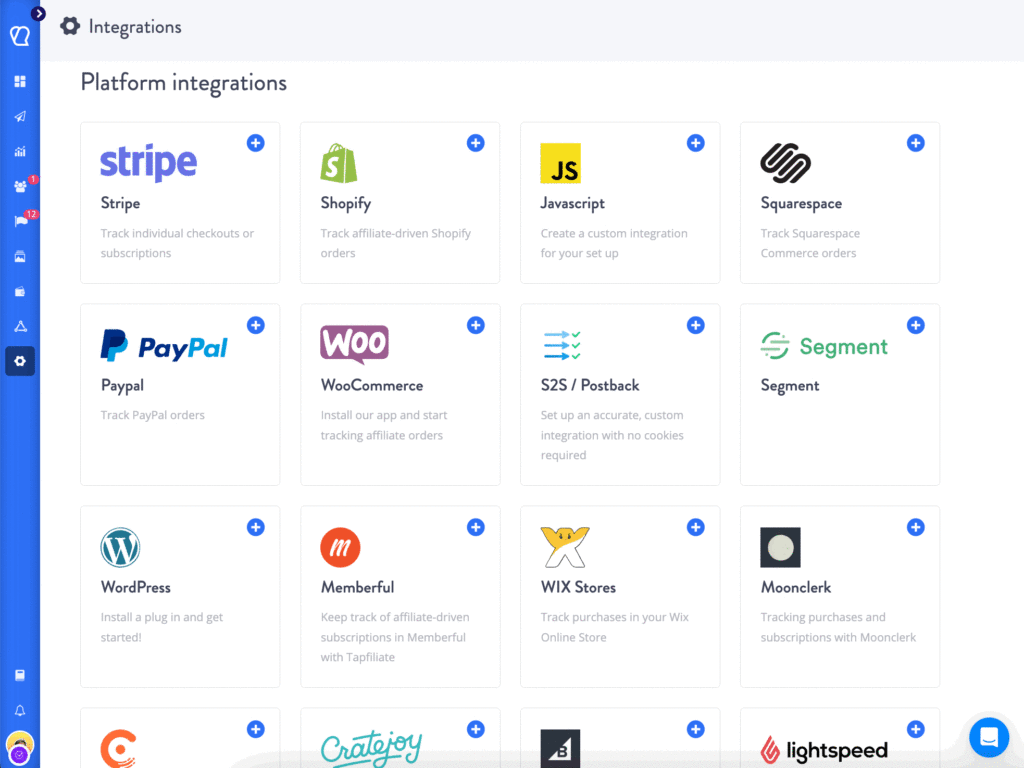
Your affiliate program connects to your broader stack. It needs to talk to your store, your CRM, your email platform, and your payout system. Shallow integrations mean manual work at every junction.
Things to evaluate before you commit:
- Native integration with your e-commerce platform (Shopify, WooCommerce, BigCommerce) vs. a Zapier relay
- CRM connection (HubSpot, Salesforce) for tracking affiliate-driven leads
- Automated payout processing without manual approval every cycle
- API access for custom commission logic or reporting workflows
- Multi-currency support if you run a global program
A Zapier-based connection is not the same as a native app. When your integration breaks at 2am, the difference between a native connector and a Zap matters.
The integration question also affects how your affiliate data flows into your business. A platform that connects natively with your CRM lets you see affiliate-driven leads alongside all other leads. You get the full attribution picture. A platform that sends data through a webhook relay is always one configuration change away from a reporting gap.
Ask vendors directly: is the Shopify integration a native Shopify app, or does it go through a third-party connector? The answer tells you a lot about how much ongoing maintenance your affiliate program will require.
Pricing model: software vs. network
This is the most consequential decision in your evaluation. Are you buying software? Or are you paying for access to a network?
What I’ve noticed is that most brands underestimate the cost of the network model at scale. Software-based pricing (Tapfiliate, LeadDyno, Refersion) charges a flat monthly fee. No transaction fees. No commission overrides.
Network-based pricing (Awin, some Impact tiers) adds a percentage to the platform fee. Your cost scales directly with your affiliate program’s success, which is not the alignment you want.
The math changes quickly. On a program generating $50,000/month in affiliate-driven revenue, a 3% network override is $1,500/month, $18,000/year, for the privilege of not owning your affiliate relationships.
Pick software. Own the program. The next section shows which options actually deliver on that.
The Best White Label Affiliate Software for Brands in 2026
These five platforms represent the real options for brands that need full white-label capability, not just a logo field in account settings. Each review covers what the platform actually delivers on branding, what it costs, and which business model it fits.
Choosing the right white label affiliate software is not just a features decision. It is a long-term business and brand infrastructure decision. The platform you pick determines how affiliates experience your brand. How your data is organized. And whether you own the program or the network does.
Tapfiliate: Best for Brands That Want Full Ownership

Tapfiliate is the top pick for SaaS and e-commerce brands wanting real white-label control. Custom domains, custom wording, branded emails. No enterprise pricing. No 6-month minimum.
Tapfiliate was designed around brand ownership from the start. Everything the affiliate touches, the signup page, the dashboard, the commission emails, runs under your domain and your brand identity.
Over 69,508 brands use the platform today, spanning SaaS companies, e-commerce stores, and subscription businesses. The model is software-only: flat monthly fee, no transaction costs, no commission overrides.
Reviews on GetApp give Tapfiliate 4.5/5 from 66 verified reviewers, with setup speed and integration depth cited consistently as the platform’s strengths.
White label features
The Tapfiliate white-label suite at the Scale plan includes:
- Custom domain: Your affiliates log in at affiliates.yourbrand.com, not at Tapfiliate’s domain
- Logo and brand colors: Full visual customization throughout the partner portal
- Custom terminology: Replace “affiliate” with “partner,” “commission” with “reward”, platform-wide, not just one field
- Branded email notifications: All partner-facing emails arrive from your domain
- Custom signup flows: Affiliates onboard under your brand identity from their first interaction
The terminology replacement is the feature that most brands do not realize they want until they see it. Getting to call your commissions “referral bonuses” and your affiliates “brand ambassadors” matters more than most brands realize. Applied consistently across every touchpoint, that language separates a native-feeling program from a tool integration.
The Scale and Enterprise plans also include multilevel commissions, automated payout rules, and a full API for custom commission logic. For SaaS companies with tiered partner structures, that matters.
On the integration side, Tapfiliate connects natively with Shopify, WooCommerce, Stripe, PayPal, and 30+ other platforms. HubSpot and Salesforce connections let you track affiliate-driven leads directly in your CRM. Automated payout rules mean you don’t manually approve every commission batch; the platform handles it based on your rules. That is the part of affiliate program management that actually takes time, and Tapfiliate removes most of it.
Tapfiliate pricing
| Plan | Monthly Price | White Label Level |
| Launch | $89/mo | Basic customization (logo, colors) |
| Scale | $179/mo | Full white label: custom domain + terminology |
| Enterprise | Custom | Complete white label + dedicated account manager |
Annual billing lowers both published rates. The Scale plan is where full white label lives for most brands. Launch gives you branded colors and logo but does not include custom domain functionality.
No transaction fees. No commission overrides. Flat monthly cost regardless of your program’s revenue volume.
A free trial is available before any commitment.
Best for
Tapfiliate is the right choice for SaaS companies, e-commerce brands, and subscription businesses that want to own their affiliate program, data, relationships, and all. The E-commerce affiliate setup is particularly strong for Shopify and WooCommerce stores.
Not the right fit: brands that need instant access to an existing publisher marketplace to recruit affiliates. Tapfiliate is software, not a network. You bring your own affiliates and build the relationships yourself.
That said, most brands already have the affiliates they need in their customer base, newsletter, or LinkedIn network. The barrier to affiliate recruitment is rarely “we cannot find anyone.” It is “we do not have a program that looks credible enough to attract them.” That is exactly the problem Tapfiliate’s white-label setup solves.
PartnerStack: Best for SaaS at Scale
PartnerStack is the strongest white label option for B2B SaaS companies with multi-tier partner programs. The pricing puts it out of reach for most brands not already operating at significant scale.
PartnerStack manages affiliates, resellers, and referral partners in a single platform with white-label branding across all program types. The platform also runs a marketplace of roughly 90,000 vetted B2B software partners. Useful if affiliate recruiting is your bottleneck. Pure overhead if you already have affiliates.
GetApp reviews reflect strong ratings from enterprise SaaS users, with reviewer commentary focused on the marketplace reach and multi-tier program management.
White label features
PartnerStack’s branded portal includes:
- Custom subdomain for the partner dashboard
- Logo and color customization across the interface
- Branded email communications to all partner tiers
- White-labeled resource center for affiliate training and materials
- Independent branding per partner program tier
The multi-program branding is where PartnerStack has no direct competition. Run an affiliate tier, a reseller tier, and a referral tier? Each with its own commission structure? PartnerStack brands each experience independently. No other tool on this list does that as cleanly.
PartnerStack pricing
PartnerStack publishes two tiers on their pricing page:
| Plan | Annual Monthly Price | Best For |
| Launch | From $1,000/mo | Teams launching a formal partner program |
| Growth | From $1,520/mo | Scaling partner-sourced revenue |
| Enterprise | Custom | Full multi-tier partner programs |
This is a significant cost difference from Tapfiliate’s $179/mo Scale plan. The price reflects the enterprise feature set and marketplace access. For most brands reading this guide, it is more than needed.
Best for
PartnerStack suits B2B SaaS companies with $2M ARR or more that have a real need for multi-tier partner management. Below that threshold, the monthly cost does not match the program size or complexity.
Early-stage and mid-growth SaaS companies should look elsewhere. Tapfiliate delivers the same white-label core capability at a fraction of the cost.
If you find yourself looking at PartnerStack’s $1,000/mo minimum and wondering if it is worth it, the answer is probably not yet. Build the program first. Prove the revenue. Then upgrade when the program’s size justifies the platform’s price.
Impact: Best for Enterprise Brands and Complex Programs
Impact is built for enterprise brands running complex multi-channel partnership programs, affiliates, influencers, and B2B partners under one platform. Entry pricing starts at $30/mo, but full branding capabilities are available only through a custom quote.
Impact calls itself a “partnership cloud,” and that framing is accurate. It goes beyond affiliate tracking to cover influencer partnerships, B2B referral programs, and brand-to-brand partnerships in a single platform.
GetApp reviews for Impact reflect the platform’s strong ratings among enterprise marketing teams, with reviewers consistently noting the breadth of partner type support.
For enterprise brands managing multiple partner types simultaneously, that breadth is genuinely useful. For brands running a focused affiliate or partner program, it is more platform than the situation requires.
White label features
Impact’s branded experience includes:
- Customizable partner portal with your logo and brand colors
- Branded signup and onboarding flows
- Custom domain options at enterprise tiers
- White-labeled partner-facing reporting dashboards
The depth of white-label control is tied to the plan tier. Lower tiers give you basic customization. Full custom domain and terminology replacement require an enterprise agreement and a custom implementation.
Impact pricing
Impact’s published pricing starts at $30/month for affiliate management through e-commerce integrations (Shopify, BigCommerce, WooCommerce). Full platform access, including the multi-channel partnership features and advanced white-label options, requires a custom quote.
| Tier | Price | Notes |
| E-commerce integrations | From $30/mo | Basic affiliate tracking, core integrations |
| Full platform | Custom | Multi-channel partnerships, full white-label branding |
Most brands using Impact’s full suite are operating at significant scale, with program complexity that justifies enterprise pricing.
Best for
Impact is the right call for enterprise brands managing affiliates, influencers, and strategic B2B partners in a single program architecture. The complexity of the platform matches the complexity of those programs.
For brands running a focused affiliate program, without multi-channel complexity, Impact introduces setup overhead that a simpler white label affiliate software avoids entirely.
Impact’s onboarding is thorough. The platform is genuinely complex. Getting it configured correctly for a standard affiliate program takes longer than simpler tools. That overhead is worth it when you need the multi-channel capability. It is not worth it when you do not.
Refersion: Best for E-commerce Brands
Refersion focuses on e-commerce affiliate programs with a clean branded portal and native integrations for Shopify, WooCommerce, and BigCommerce. Pricing is available on request.
Refersion was built for e-commerce first. The Shopify integration is native, not a Zapier relay. WooCommerce and BigCommerce connect cleanly as well. If your store runs on one of these platforms, Refersion reduces setup time compared to more generalist tools.
The branded portal experience is solid at the Professional tier and above. Affiliates get a clean, on-brand dashboard. You control the visual identity.
Refersion also handles E-commerce-specific features well: coupon code tracking, product-level commissions, and affiliate-specific discount codes. These features matter for DTC brands running product promotions. They are largely irrelevant for SaaS companies. If your program is built around product links and discount codes, Refersion is worth a close look.
White label features
Refersion’s white-label features include:
- Branded affiliate portal with your logo and custom colors
- Custom signup page at your brand’s URL
- Branded email notifications to affiliates
- Custom affiliate portal domain at higher tiers
The customization depth is adequate for most e-commerce brands. It does not include the platform-wide terminology replacement that Tapfiliate offers, but for standard branded portal needs, it delivers. Affiliates see your brand. You do not see Refersion anywhere in their experience.
Refersion pricing
Refersion does not publicly list pricing on its main site, pricing is available directly at refersion.com. Plans are structured around monthly order volume, starting around $99/mo for smaller e-commerce programs.
| Plan | Notes |
| Professional | Starting tier for growing e-commerce programs |
| Business | Mid-tier with expanded order tracking and reporting |
| Enterprise | Custom: for large-volume programs |
Contact Refersion directly for current pricing. The structure has changed multiple times in the past 18 months.
GetApp reviews for Refersion show strong ratings among Shopify merchants, with users noting ease of setup and affiliate communication tools as highlights.
Best for
Refersion is a strong pick for DTC e-commerce brands on Shopify or WooCommerce. If your primary affiliate use case is product sales, not SaaS subscriptions or service referrals, Refersion handles it cleanly.
For SaaS companies or subscription businesses, the fit is weaker. Refersion’s tracking and commission logic is optimized for order-based attribution, not recurring revenue models
LeadDyno: Best Budget Option for Smaller Brands
LeadDyno is the most accessible white label affiliate software on this list. Full white-label dashboard capability starts at $349/mo on the Advanced plan. The entry Lite plan ($49/mo) does not include white-label features.
LeadDyno is built for small and growing brands who need a functional affiliate program at an accessible price point. The platform covers the basics well: affiliate tracking, commission management, link generation, and a branded dashboard at the right plan tier.
Setup is faster than most tools on this list. The interface is clear. You are not going to spend weeks configuring it.
White label features
LeadDyno’s white-label branding is tiered by plan:
- $129/mo plan: Custom affiliate dashboard domain + customizable branded signup forms
- Advanced ($349/mo): Full white-labeled affiliate dashboard + custom CSS
- Unlimited ($749/mo): All features + dedicated account manager and concierge setup
The full white-label dashboard, where your affiliates see zero LeadDyno branding, requires the Advanced plan at $349/mo. At that price point, it is worth comparing to Tapfiliate’s Scale plan at $179/mo, which includes more advanced commission logic for the same white-label depth.
LeadDyno pricing and best for
| Plan | Monthly Price | White Label Level |
| Lite | $49/mo | No white label features |
| $129 plan | $129/mo | Custom domain for dashboard only |
| Advanced | $349/mo | Full white-label dashboard + custom CSS |
| Unlimited | $749/mo | All features + concierge onboarding |
LeadDyno is the right starting point for bootstrapped brands and small DTC stores running an affiliate program for the first time. The $129/mo plan is accessible. The trade-off is feature ceiling, advanced commission structures, automated payouts, and API access are limited compared to Tapfiliate at the Scale level.
Plan for a platform migration when your program grows past what the Advanced plan can handle.
One thing LeadDyno gets right: the 30-day free trial. It is the most generous trial period on this list. Want to test a white-label setup before committing? LeadDyno lets you do that without a credit card on day one. That is meaningful for bootstrapped brands deciding whether affiliate marketing belongs in their acquisition strategy at all.
GetApp reviews for LeadDyno highlight the fast setup time and affordability, with some reviewers noting that the platform works well for smaller programs but lacks depth for advanced commission structures.
Pricing Comparison: What White Label Actually Costs
Here is the full comparison across all five platforms:
| Platform | Entry Price | Full White Label | Transaction Fees | White Label Depth |
| Tapfiliate | $89/mo | $179/mo (Scale) | None | Domain + branding + full terminology |
| PartnerStack | $1,000/mo (annual) | $1,000/mo+ | None | Domain + branding + multi-tier programs |
| Impact | From $30/mo | Custom | None | Domain + branding (full features at enterprise) |
| Refersion | Contact sales | Contact sales | None | Domain + branding |
| LeadDyno | $49/mo | $349/mo (Advanced) | None | Domain + branding + custom CSS |
The pricing reality for most brands: Tapfiliate is the clear answer. SaaS companies under $5M ARR and e-commerce brands doing $50K to $5M/year have no reason to pay more. Full white-label capability at $179/mo. No transaction fees. No minimum contract term that requires a procurement review.
PartnerStack and Impact are genuinely excellent platforms. But they are built for organizational complexity that most brands reading this guide do not have yet.
A few things are worth noting when you compare these costs.
First: the gap between LeadDyno’s full white-label price ($349/mo) and Tapfiliate’s Scale plan ($179/mo) is significant for what you get. Tapfiliate at $179/mo includes automated payout rules, multilevel commission support, and a full API. LeadDyno’s Advanced plan at $349/mo includes white-label branding and custom CSS. The commission logic is more limited, and the price is higher. For most brands, that math does not add up in LeadDyno’s favor once the program grows past its initial stage.
Second, Impact’s $30/mo entry price is for basic affiliate management via e-commerce integrations. It is not the full platform. Brands that need Impact’s full multi-channel feature set are looking at custom pricing in the hundreds or thousands per month. That is what justifies the platform over simpler tools.
Third, none of these platforms charges transaction fees on affiliate commissions. That is the most important number to get right. Any platform that takes a percentage of your affiliate-driven revenue is not white label affiliate software. It is a network.
For a detailed breakdown of what Tapfiliate’s Scale plan includes at $179/mo, the pricing page lays out the full feature comparison across plans.
FAQ
What is white label affiliate software?
White label affiliate software is a platform that runs an affiliate program entirely under your own brand. Affiliates access a portal at your custom domain. They see your logo and color scheme throughout the dashboard. All emails arrive from your domain. No third-party software branding appears anywhere in their experience.
The term comes from product manufacturing: a product built by one company sold under another brand’s label. In software, it means the technology operates in the background while your brand operates in the foreground. The business benefit is trust. Affiliates who see a polished, brand-consistent portal perceive your program as a first-party investment. Not a tool you plugged in. That perception directly affects activation rates and long-term program performance.
Can I white label Tapfiliate?
Yes. Tapfiliate’s Scale plan at $179/mo includes full white-label capability. That covers: a custom domain for the affiliate portal, full logo and color customization, branded email notifications, and the ability to replace all platform terminology. “Affiliates” to “partners.” “Commissions” to “rewards.” All of it, platform-wide.
The Enterprise plan adds a dedicated account manager, unlimited team members, and a fully custom onboarding experience. Tapfiliate serves over 69,508 brands across SaaS, e-commerce, and subscription models, and the white-label feature set is available to any Scale or Enterprise customer.
What is the best white label affiliate program software?
For most brands, SaaS companies and e-commerce stores outside of enterprise scale, Tapfiliate is the best white label affiliate software available. It delivers full branded portal control, custom domain, platform-wide terminology replacement, and automated payouts at $179/mo with no transaction fees.
PartnerStack leads for B2B SaaS at enterprise scale with multi-tier programs. Impact is the right call for brands managing affiliates, influencers, and B2B partners in one place. Refersion is a clean fit for Shopify-native e-commerce programs. LeadDyno works for small brands starting out. The right choice depends on your business model, current program scale, and the depth of white-label control you actually need.
How much does white label affiliate software cost?
White label affiliate software ranges from $49/mo at the entry level to $1,000+/mo at enterprise scale. Full white-label capability, including a custom domain, branded emails, and platform-wide terminology control, typically falls in the $99 to $349/mo range.
Tapfiliate offers full white-labeling on its Scale plan at $179/mo, with no transaction fees. LeadDyno’s full white-label dashboard requires the Advanced plan at $349/mo. PartnerStack starts at $1,000/mo (billed annually). Impact’s advanced branding features are available upon request. Refersion prices on request. None of the top-tier platforms on this list add percentage fees on top of affiliate commissions.
What is the difference between white label and private label affiliate software?
In affiliate marketing, “white label” and “private label” are often used interchangeably, but they have a technical distinction. White label software is a shared platform that one company builds and multiple brands customize and sell under their own name. Private label implies a more exclusive arrangement. Software built or licensed specifically for one brand, with a codebase not shared with other customers.
In practice, most affiliate software described as “white label” is a shared infrastructure platform with branding controls. True private-label arrangements, where the codebase is exclusively licensed or custom-built, are rare and significantly more expensive. For the vast majority of brands, white label affiliate software fully covers the need. The distinction only matters if you require the underlying technology to be exclusively yours.
Best White Label Affiliate Software for Brands: The Bottom Line
For most brands, the decision is straightforward. Tapfiliate’s Scale plan ($179/mo) gives you full white-label control: a custom domain, a branded portal, custom terminology, and automated payouts. No transaction fees. No long-term minimum. It is the capability-to-cost combination that works for brands outside of enterprise scale.
PartnerStack is the exception worth naming. B2B SaaS companies with multi-tier partner programs at scale will find it genuinely better. Impact is the right call if your program spans affiliates, influencers, and B2B partners simultaneously. Refersion fits Shopify-native DTC brands cleanly. LeadDyno is the accessible starting point for smaller programs.
The upgrade from a generic portal to a branded one is not cosmetic. It is the activation rate lever that most affiliate programs ignore until they have already lost hundreds of dormant affiliates to inaction. The fix is not a bigger commission or a new recruitment campaign. It is a branded portal that signals to every affiliate that this program is worth their time.
One more thing worth stating clearly: the best time to set up white-label branding is before you recruit affiliates, not after. Affiliates who join through a branded portal have a stronger first impression of your program. Affiliates who joined through a generic portal and then see it rebranded later may not notice at all. Get the branding right at the start. Every affiliate you recruit from day one walks into a professional, on-brand experience. That first impression is the one that sticks.
Start with the Tapfiliate white-label overview to see exactly what a branded partner portal looks like in practice, then compare it against what your affiliates see today.