How to Improve Brand Visibility in AI Search Engines

AI search visibility is how often your business is recommended in tools like ChatGPT and Google AI Overviews. To improve brand visibility in AI search engines, you need answer-ready content, strong third-party mentions, consistent business data, and ongoing visibility tracking.
Your customers are already asking AI tools which business to choose. When someone searches “best payroll software for restaurants” in ChatGPT or “top CRM for small businesses” in Google AI Overviews, they don’t see a list of links. They see one or two recommended brands.
If your business isn’t named, that customer is gone before they ever reach your site.
Key takeaways:
- AI search engines recommend brands directly instead of showing links.
- Improving AI visibility requires both answer-ready content and strong off-site presence.
- Each AI platform uses different signals, so optimization must be multi-platform.
- HubSpot AEO tracks your visibility, identifies gaps, and helps you fix them in one workflow.
This guide shows exactly how to improve brand visibility in AI search engines across ChatGPT, Google AI, and other platforms so you can close the gaps competitors are already benefiting from.
What is AI search visibility?
AI search visibility measures how often and how favorably your brand appears in AI-generated answers. It includes tools like ChatGPT, Google AI Overviews, Perplexity, and Microsoft Copilot. Unlike traditional SEO, where the goal is to rank high and earn clicks, AI visibility is about being cited in the answer itself.
The shift matters because 60% of searches now end without a click, according to Semrush’s 2025 zero-click study. Buyers are getting recommendations directly from AI tools and acting on them immediately. If your brand is not part of that answer, you lose the customer before they ever reach your site.
For a full breakdown of how to structure your pages, build topical authority, and update content for AI search, see our AI content optimization guide for small businesses.
The challenge is that most businesses cannot see where they show up in AI answers or where they lose to competitors. HubSpot AEO is our top pick for the best AI search visibility tool, giving you a single visibility score across ChatGPT and Gemini while showing which prompts mention your brand, which feature competitors, and where you are missing entirely.
As one of the most practical AI visibility tools for small businesses, it combines tracking, insights, and recommendations in one place.
How to optimize your brand for ChatGPT
ChatGPT is the most important platform for improving brand visibility in AI search engines because it drives the majority of business-related AI queries. According to a March 2026 G2 survey of 1,076 decision-makers, 51% of B2B buyers now start their research in an AI chatbot more often than Google. ChatGPT controls roughly 63% of that AI search market. Getting named in ChatGPT answers is the highest-priority AI visibility goal for most small businesses.
Understand how ChatGPT decides which brands to recommend
ChatGPT recommends brands based on third-party mentions, authority signals, and how clearly your content answers questions. It does not rely only on your website. It pulls from a broader set of sources, including review platforms, news coverage, directories, and community discussions.
Research from SE Ranking, based on an analysis of 129,000 domains, found that referring domains are the strongest predictor of ChatGPT citations. Sites with more than 32,000 referring domains are 3.5 times more likely to be cited than those with fewer than 200.
For small businesses, this changes the strategy:
- Your website alone is not enough
- Your presence across reviews, directories, PR, and communities directly affects whether you get recommended
ChatGPT also pulls heavily from platforms like Reddit and Quora, where real user discussions influence recommendations. Brands with strong activity on these platforms see significantly higher citation rates than those with little to no presence.
Build the off-site presence ChatGPT trusts
The fastest way to improve brand visibility in ChatGPT is to expand your presence beyond your website.
- Get listed on relevant directories and review platforms. G2, Capterra, Yelp, and Trustpilot are frequently cited sources. If your business is not listed on the platforms that matter in your category, you are effectively invisible to the AI.
- Earn coverage in credible publications. Even one mention in an industry blog or local news site creates a citation signal. Unlinked mentions still count.
- Participate in Reddit and Quora. Answer real questions from potential customers and build credibility over time. Focus on being helpful, not promotional.
- Encourage consistent customer reviews. Review volume and recency are strong trust signals. A steady stream of recent reviews performs better than a large but outdated review base.
Create content structured the way ChatGPT extracts answers
ChatGPT favors content that provides clear, direct answers in a format it can easily extract.
- Lead with the answer. Put the clearest response in the first one to two sentences, then expand.
- Use question-based headings. Match how customers phrase prompts, such as “What is the best POS system for a small retail store?”
- Cover topics in depth. SE Ranking found that pages over 2,900 words earn nearly double the citations compared to shorter content.
- Add FAQ sections. Write questions in natural language that mirrors how customers interact with AI tools.
Test your ChatGPT visibility right now
The fastest way to understand your ChatGPT visibility is to test real prompts your customers use.
Open ChatGPT in an incognito window and search using the prompts your customers are most likely using.
Note whether your brand appears, how it is described, and which competitors are named instead. That gap is what you need to close.
Track your ChatGPT visibility with HubSpot AEO
Manually testing prompts works as a starting point, but it does not scale.
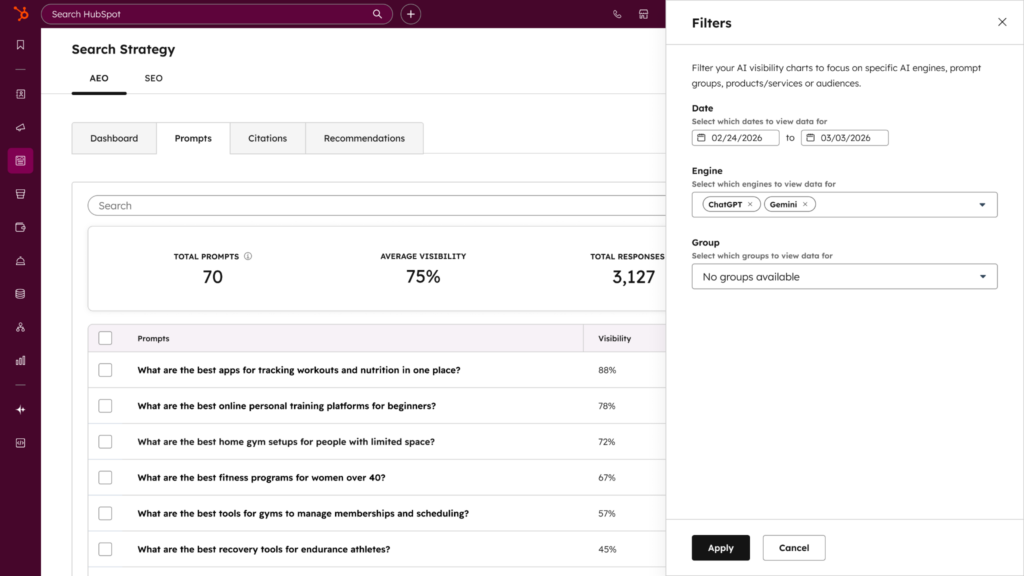
HubSpot AEO tracks AI visibility across prompts, showing where your brand appears in ChatGPT and Gemini responses and where competitors are outperforming you.
HubSpot AEO automates this process by:
- Identifying the prompts that matter for your business
- Tracking how your brand appears in ChatGPT answers over time
- Showing exactly where competitors are being recommended instead of you
It also highlights the specific gaps to fix first, so you can move from insight to action without manual tracking.
For businesses using HubSpot Marketing Hub, AEO pulls prompt suggestions directly from your CRM data, including your industries, competitors, and customer segments, so tracking is tailored to your business from day one.
How to optimize your brand for Google AI Overviews
Google AI Overviews are AI-generated summaries that appear at the top of search results and pull from Google’s index to recommend sources. Unlike ChatGPT, which relies on broader web signals and training data, Google AI Overviews are closely tied to Google’s search index and traditional ranking signals.
That makes Google AI Overviews the one AI platform where traditional SEO signals, including backlinks, page authority, and Google Business Profile, carry the most weight.
A Pew-backed analysis reported by Search Engine Land found that 18% of Google searches in March 2025 triggered an AI Overview, and 88% of those summaries cited more than three sources. Getting into that citation set is a combination of existing Google authority and content that’s structured for easy extraction.
Strengthen your Google presence first
Google AI Overviews rely heavily on traditional SEO signals, so your existing Google presence is the foundation of visibility. Because Google AI Overviews are built on Google’s index, your starting point is the same as traditional SEO, but a few specific signals matter most:
- Keep your Google Business Profile updated. Hours, categories, photos, and Q&A all influence how Google understands your business.
- Build backlinks from relevant sites. Pages that already rank well are more likely to be cited.
- Maintain strong rankings for key topics. Pages in the top 20 have a higher chance of appearing in AI Overviews.
Format your pages the way Google AI Overviews extract answers
Google AI Overviews favor content that is structured for quick extraction and clear answers. Pages that make that extraction easy perform better, so I recommend ensuring these best practices are in place:
- Put the clearest answer in the first one to two sentences of every section. Don’t make Google work to find your point. State your answer immediately, then support it with details.
- Keep paragraphs short. Two to four sentences per paragraph is the target. Dense blocks of text are harder for AI systems to parse into usable chunks.
- Use question-based headings that match real search queries. “What is the best accounting software for a service business?” is more useful to Google AI than “Our software overview.”
- Include comparison tables and bullet lists wherever relevant. Google AI Overviews frequently pull from structured formatting; a table comparing two options or a numbered list of steps is much easier to cite than a paragraph describing the same information.
Don’t overlook your existing Google authority
If your pages already rank in Google, they are strong candidates to be cited in AI Overviews.
One advantage small businesses have in Google AI Overviews: if you’ve been doing SEO consistently, you may already have more AI Overview visibility than you realize. Pages that rank well organically are the most likely to be cited in AI Overviews for the same query. The fastest wins here often come from improving the structure of pages that already rank, not creating new ones.
The challenge is that you cannot easily see which prompts trigger AI Overviews or where your brand is being cited.
Monitor your Google AI Overview visibility with HubSpot AEO
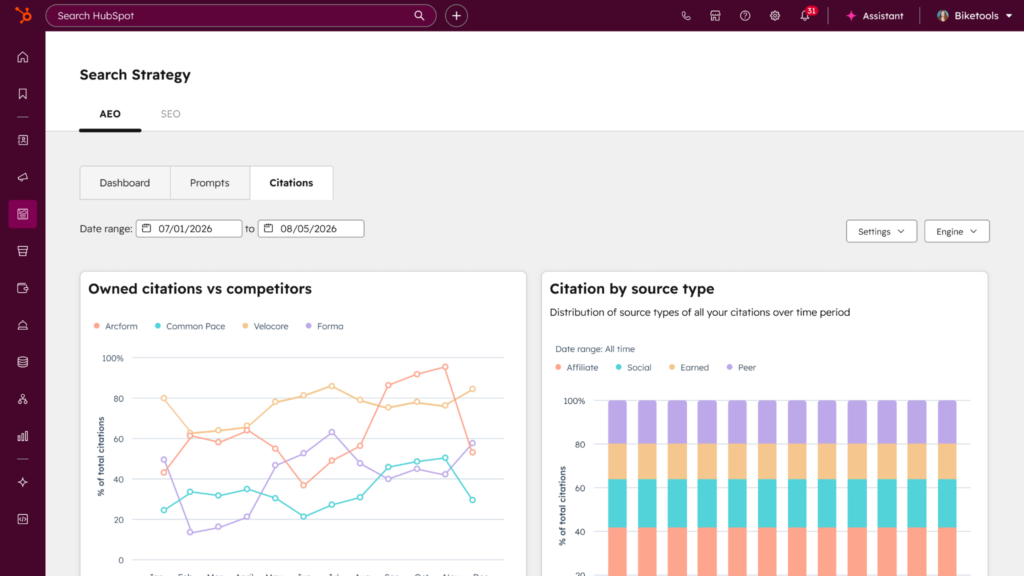
HubSpot AEO compares your brand citations against competitors and breaks down where your visibility is coming from across different source types.
HubSpot AEO tracks your visibility across Gemini, shows how your brand appears in Google AI Overviews over time, and highlights the exact prompts where competitors are being cited instead of you. That lets you prioritize updates based on actual visibility data, not guesswork. Track your Google AI visibility with HubSpot AEO.
How to optimize your brand for other answer engines (Perplexity, Copilot, and more)
ChatGPT and Google AI Overviews get most of the attention, but Perplexity and Microsoft Copilot are growing quickly and use different ranking signals. Take this: Perplexity’s monthly website traffic grew from 52.4 million visits in March 2024 to 276.5 million visits by October 2025, a 427% increase in under 18 months, while Copilot is embedded across Microsoft products, including Bing. Ignoring these platforms means missing visibility opportunities.
How to improve brand visibility in Perplexity AI
Perplexity favors fresh, well-cited content with clear attribution and easily extractable statements. Unlike ChatGPT, which relies more on training data, Perplexity retrieves information in real time and shows its sources with every answer.
This makes recency and credibility stronger signals here than on other AI platforms.
To improve your visibility in Perplexity:
- Publish content with clear attribution. Include full dates, named authors, and linked sources. A post dated April 14, 2026, with a named author performs better than one with vague or missing details.
- Update your key pages frequently. Freshness matters more in Perplexity than in other engines. Pages updated recently have a clear advantage.
- Earn mentions in trusted publications. Industry blogs, news sites, and review platforms appear often in Perplexity citations. Even brief mentions improve your chances of being cited.
- Write quotable statements. Perplexity extracts short, standalone facts. Sentences that clearly communicate one idea are more likely to be pulled into answers.
How to improve brand visibility in Microsoft Copilot
Microsoft Copilot relies on Bing’s index, so visibility depends on Bing SEO, listings, and structured content. Copilot behaves more like a traditional search engine than other AI tools because it pulls directly from Bing.
If your business ranks well on Google but is not set up on Bing, you likely have a visibility gap.
To improve your visibility in Copilot:
- Claim and complete your Bing Places listing. Bing Places plays the same role for Copilot as Google Business Profile does for Google AI Overviews.
- Ensure your site is indexed in Bing. Use Bing Webmaster Tools to confirm your pages are being crawled and indexed properly.
- Apply answer-first content structure. Use clear headings, direct answers, short paragraphs, and structured lists. The same formatting that works for Google AI Overviews applies here.
The one strategy that improves visibility across all AI search engines
Consistent business information across platforms is one of the strongest shared signals across all AI search engines.
If you do only one thing to improve visibility across ChatGPT, Google AI Overviews, Perplexity, and Copilot, make your business information identical everywhere.
Your name, address, and phone number must match exactly across:
- Your website
- Google Business Profile
- Yelp
- Bing Places
- Apple Maps
- Industry directories
If your business name varies across platforms, AI engines may treat them as separate entities or flag inconsistencies as a trust issue. Audit every listing and fix every mismatch. This single step improves your visibility across all major AI search platforms at the same time.
Take a look at how Salt Hank’s, a popular sandwich place, has consistent information displayed on its website and Google Business and Yelp profiles.
Strategies on how to improve your brand visibility across all AI search engines
Improving brand visibility in AI search engines comes down to seven core strategies: answer-focused content, strong third-party presence, consistent business data, and ongoing visibility tracking. These techniques apply across ChatGPT, Google AI Overviews, Perplexity, and other platforms.
1. Create content that directly answers the questions AI gets asked about your category
The most effective way to improve AI search visibility is to create content that clearly answers the questions AI tools are asked in your category.
Focus on real buyer prompts, not keywords alone. Start by identifying five to 10 high-intent queries, such as:
- “Best [your product/service] for [your customer type]”
- “Top How To tools for small businesses”
Then create dedicated pages that:
- Lead with a direct answer
- Provide a clear recommendation or explanation
- Expand with supporting details
Avoid generic content or company-first messaging. AI engines prioritize pages that deliver immediate, usable answers.
2. Earn mentions on the third-party sites AI trusts
AI engines rely heavily on third-party signals to decide which brands to recommend.
The more consistently your business appears across trusted sources, the more likely it is to be cited. An Ahrefs study found that brand mentions have the strongest correlation (0.664) with AI Overview visibility, outperforming backlinks and domain authority.
Focus on building presence across:
- General platforms: Google Business Profile, Yelp
- Review platforms: G2, Capterra, Trustpilot
- Industry directories: Category-specific listings
- Publications: Local news and trade sites
These mentions act as validation signals that AI systems use to evaluate your credibility.
3. Get more reviews and keep them recent
Review volume, recency, and sentiment directly influence whether AI tools recommend your business.
A business with 10 recent reviews often outperforms one with hundreds of outdated reviews. Consistent, recent feedback is more valuable than total review count.
To improve your review signals:
- Set up automated review requests after transactions
- Respond to all reviews, both positive and negative
- Focus on the platforms most relevant to your industry
4. Make your business information identical everywhere
Consistent business data is one of the strongest shared signals across all AI search engines.
Even small differences can cause AI systems to treat listings as separate entities or reduce trust in your data. Audit your listings regularly and fix every mismatch. Your name, address, and phone number must match exactly across:
- Your website
- Google Business Profile
- Yelp
- Bing Places
- Apple Maps
- Industry directories
5. Add schema markup so AI can interpret your content
Schema markup helps AI systems understand what your content means, not just what it says.
For small businesses, the most important types include:
- LocalBusiness schema: Business type, location, hours, contact details
- FAQ schema: Structured question-and-answer content
- Product or Service schema: What you offer and who it’s for
Most platforms support schema without coding:
- WordPress: Yoast SEO, Rank Math
- Shopify and Squarespace: Built-in structured data
If you’re unsure, test your pages using Google’s Rich Results Test.
6. Participate in the communities AI learns from
AI engines frequently pull from platforms like Reddit, Quora, and review sites when generating answers.
According to Semrush research, Reddit is cited more frequently than most sources in ChatGPT responses, with citation rates exceeding 120% across industries like business services, technology, and consumer electronics. This reflects how often multiple Reddit threads are referenced within a single answer.
To build visibility:
- Answer real questions from potential customers
- Share practical, experience-based insights
- Focus on helping, not promoting
Over time, your contributions become part of the data AI tools use to generate recommendations.
7. Track your visibility so you know what’s actually working
You cannot improve AI search visibility without tracking where you appear and where you do not.
Start with a simple baseline:
- Test 5 to 10 prompts in ChatGPT and Google AI
- Log which brands appear
- Compare results month over month
This works, but it is time-consuming.
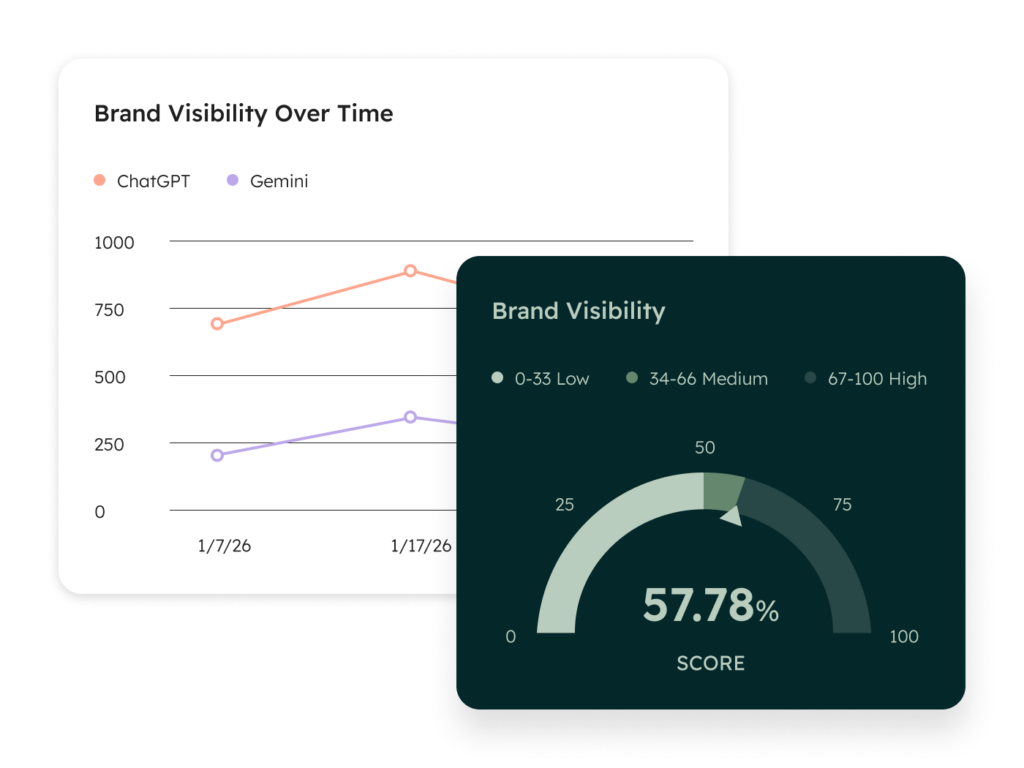
HubSpot AEO automates this process by tracking your AI visibility score across ChatGPT and Gemini, identifying which prompts include your brand, and showing where competitors are being recommended instead. It also surfaces the highest-impact gaps to fix, so you can focus on actions that improve visibility fastest.
Why small businesses should act on AI visibility now
AI search is already influencing buying decisions before customers visit your website.
Brands that build visibility today are becoming part of the data AI systems rely on for future recommendations. Those that wait will need more time and effort to catch up.
This pattern is not new. Businesses that invested early in SEO built long-term advantages, while those that delayed spent years trying to close the gap. AI search visibility is following the same trajectory.
The cost of waiting is already measurable. Almost two-thirds (69%) of B2B buyers chose a different vendor based on an AI recommendation, and a third (33%) purchased from a brand they had not previously considered. These decisions happen before a buyer visits your site.
For small businesses, this means lost opportunities that never appear in your analytics.
HubSpot validated this approach by testing AI visibility strategies on its own marketing before releasing HubSpot AEO. The result was measurable lead growth driven by improved visibility in AI-generated answers.
Your 30-day action plan to improve AI search visibility
Use this plan to move from zero to measurable AI visibility improvement in one month.
Week 1: Identify your visibility gaps
- List 5 to 10 prompts your customers are likely using
- Search them in ChatGPT and Google AI
- Note which competitors appear and where you are missing
Week 2: Fix your off-site presence
- Audit your listings (Google, Yelp, Bing Places, directories)
- Fix inconsistent business information
- Request reviews from recent customers
- Get listed in at least one new directory or publication
Week 3: Improve your content
- Rewrite key pages to lead with direct answers
- Add FAQ sections using real customer questions
- Update outdated content and details
Week 4: Track and improve
- Re-test your prompts and compare results
- Identify the next gap to fix
Why this matters: AI tools are already influencing buying decisions before customers visit your website. A March 2026 G2 study found that 69% of B2B buyers changed vendors based on AI recommendations, and 33% chose a brand they had not considered before.
Want to skip manual tracking? HubSpot AEO automatically identifies the prompts that matter, tracks your AI visibility across ChatGPT and Gemini, and shows exactly where competitors are being recommended instead of you. Check your AI visibility score with HubSpot AEO.
Frequently asked questions (FAQs)
Create content that directly answers real customer questions, earn mentions on trusted third-party sites, keep business information consistent across listings, build strong and recent reviews, add schema markup, and stay active in communities like Reddit and G2. Tools like HubSpot AEO help pinpoint which gaps are hurting your visibility most.
Technical fixes can impact visibility in two to four weeks. Building authority through reviews, listings, and PR usually takes two to four months. Strong, consistent visibility often takes six to 12 months, with early gains visible in the first quarter.
No. AEO builds on SEO. You still need strong content, backlinks, and a clean site structure. AEO adds a layer focused on being cited in AI answers, not just ranking in search results.
Yes. AI favors strong signals, not brand size. A small business with clear content, consistent listings, and active reviews can outperform larger competitors with weaker signals.
An AI visibility score tracks how often your brand appears in AI-generated answers. HubSpot AEO measures this across platforms like ChatGPT and Gemini, showing which prompts include your brand, which feature competitors, and how your visibility changes over time.
HubSpot AEO is a strong option for small businesses. It tracks your visibility score, identifies competitor gaps, and provides clear recommendations, all connected to content tools so you can act quickly.
Check at least monthly. Weekly tracking is better if possible, since AI results can shift often. Tools like HubSpot AEO automate this with ongoing monitoring and alerts.
Yes, but only when combined with authority signals. Optimizing content for clear answers makes it easier for AI to use, but visibility also depends on reviews, third-party mentions, and overall brand trust.
Bottom line
AI search is already shaping buying decisions before customers visit your website. If your brand is not included in those answers, you are losing opportunities you cannot track.
The advantage is still open. Small businesses that improve their listings, reviews, content structure, and visibility tracking now can outperform larger competitors that have not adapted.
HubSpot AEO makes this process manageable by showing where you appear, where competitors are winning, and what to fix next in one place.
Check your AI visibility score with HubSpot AEO and see exactly where you stand and what to fix first.
Source link