Behind Japan’s record-low homelessness count, a hidden population grows
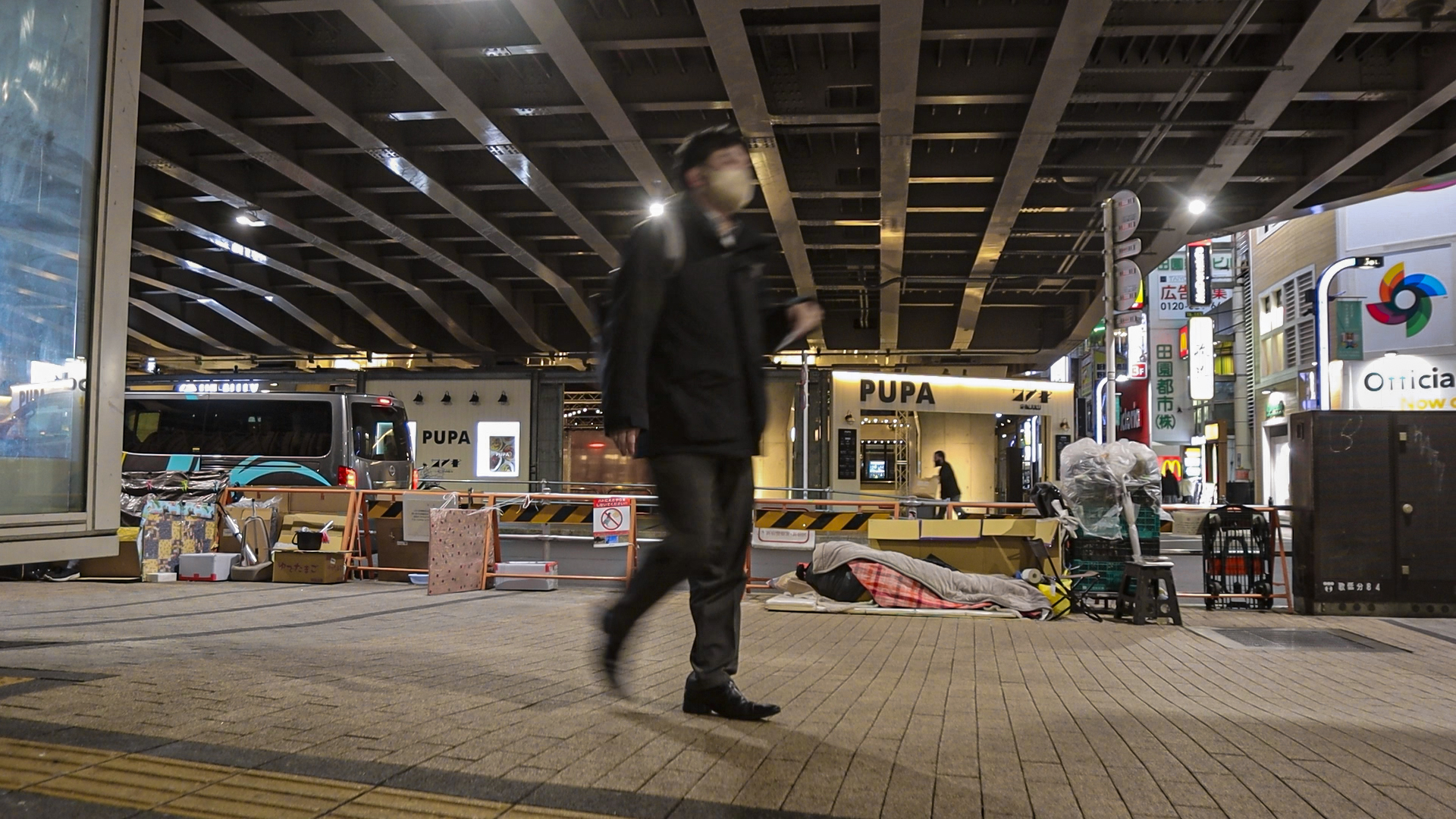
TOKYO – Each January, government workers from Japan’s Ministry of Health, Labour and Welfare fan out across the nation’s parks, train stations and riverbanks, clipboard in hand, counting the country’s homeless population. The number of unhoused people they count has been falling almost every year for more than two decades. In January 2025, they recorded 2,591 people — a nearly 90% drop from the 25,296 counted in 2003.
But if you are sleeping in your car, on a friend’s couch or in a private cubicle at an all-night internet café, you are not counted. Japan’s survey only captures people visible on the street.

“It’s true that the number of homeless people living in shacks or tents has decreased,” said Ayumi Kato, director of Moyai Support Center for Independent Living, a Tokyo-based poverty support center that has operated since 2001. “But other forms of homelessness have increased significantly.”
Japan’s government defines homelessness narrowly — only those living in public parks, roadsides, riverbeds, station buildings or similar public spaces qualify. The January survey is conducted by visual patrol during daylight hours in winter, a methodology Kato says misses a growing population living in the shadows of one of the world’s wealthiest nations.
“For us, there is a strong desire to let everyone know about this, whether you are Japanese, from overseas, or a student,” Kato said. “I really want people to know what’s happening on the ground.”
The net café refugees
Housing insecurity in Tokyo does not always look like a tent tucked behind a park. Sometimes it looks like a glowing neon sign advertising 24-hour service, private cubicles, showers and laundry – all for 1,500 yen, or about $10, per night.

Internet and manga cafés across Japan have quietly become a form of informal housing. In 2007, Japan’s Ministry of Health, Labour and Welfare conducted its first national study on the phenomenon, estimating that on any given night approximately 5,400 people nationwide were effectively living in these establishments with no permanent address. Most were young, intermittently employed and had lost their housing after losing their jobs. They became known as net café refugees.
A decade later, the problem had not gone away. A 2017 survey by the Tokyo Metropolitan Government estimated that 4,000 people were sleeping in internet cafés across Tokyo alone on a given night — a figure Kato believes is an undercount.

“I think the number is increasing, but there are no surveys on this, no national surveys, and therefore researchers aren’t really investigating it,” Kato said. “Especially young people. That generation lives in a similar way. They have no home but don’t sleep outside. There isn’t a shed or anything like that. I think there are more and more people who feel that way.”
Beyond the cafés, an even larger and harder-to-measure population has no fixed address at all. People sleeping in their cars, rotating among friends’ apartments or taking shelter anywhere out of sight are left out of the official count.
The Toyoko kids
In Tokyo’s Kabukicho entertainment district in Shinjuku, a community of young runaways has formed in the shadows of one of the city’s busiest nightlife corridors. They are known as the Toyoko kids. Many of the teenagers have run away from home and gathered in the area, forming what one of their own describes as a “runaway community.”
Among them is a woman who goes by Mira and has lived on the streets for six years. She asked to only be identified by her first name. Young people call her Mama. She has become an informal caretaker and advocate for the group, keeping watch over them in a city that largely looks the other way.
“It’s like a community. A runaway community,” Mira said. “The government cannot understand.”
She describes each person’s path to the streets as distinct and complicated, resistant to simple explanations or simple fixes.
“It’s not so easy,” she said. “Everybody has reasons, and all are different.”
For Mira, the work is personal.
“I love them,” she said, her voice catching. “My purpose is only for children. They are the future. Children are the future. This is my task.”

The 2002 law and its limits
Japan began taking homelessness more seriously as a national issue in 2002, when the government passed the Special Measures Act for Supporting the Self-Reliance of the Homeless Population. The law created matching funds for cities to build shelters and counseling programs. Within a few years, roughly 40 shelters had opened across the country where very few had existed before.
The same law also gives authorities the power to clear public encampments, a provision that critics say contributed to the disappearance of visible homelessness without addressing its underlying causes.
For those who qualify, Japan’s welfare system, known as livelihood protection, provides enough to cover rent and basic living expenses. But enrolling has its own obstacles. Government offices have at times illegally turned away applicants, according to Kato, whose organization accompanies clients to appointments to prevent the practice.
“Even when I went to apply, I wasn’t allowed to apply,” Kato said, describing an attempt to help a client access welfare benefits. “We often get turned away, which is illegal. But for some reason the government offices are doing this illegally. So we go to the government office with them to stop this illegal behavior.”
As visible homelessness declined, Japan’s welfare rolls rose sharply. Today, roughly 2 million people receive livelihood protection benefits, compared to about 800,000 in 2003, according to longtime community leader Masaru Otomo. He suggests that many people who once would have been visible on the streets have been absorbed into the welfare system, though not always smoothly or equitably.
Kotobuki-cho: Where people end up
About 30 miles south of Tokyo, in the port city of Yokohama, is a neighborhood that has become a case study in what happens to the people who fall through the cracks of Japan’s official counts and support systems.
Kotobuki-cho is Yokohama’s most notorious slum district. It’s so stigmatized that its name does not appear on the map posted outside the nearest train station. For decades, it served as a hub for Japan’s day labor market. Workers would gather in the early morning hours looking for work and paying for cheap accommodations in rooming houses, called doya, with their daily wages.
Tom Gill, a British-born professor of social anthropology at Meiji Gakuin University, has been visiting Kotobuki-cho since 1993. He has written two books about the neighborhood and returns every few weeks to document its changes.

The day labor economy that built Kotobuki-cho has mostly dried up. The neighborhood’s roughly 8,200 doya rooms, once packed with workers, now sit about one-third empty, with only around 5,800 occupied, according to Otomo, who works specifically with the Kotobuki-cho community. What remains is an aging population, many of them elderly men who worked as day laborers for decades before the market collapsed beneath them.
The January 2025 national survey reflects that demographic reality. Of the 2,591 people counted as homeless nationwide, 2,346 were men and just 163 were women — roughly 90% male. The survey notes that heavy winter clothing can make gender identification difficult during visual-only counts.
“Japan is often criticized for being a very old-fashioned, sexist, patriarchal society,” Gill said. “I would say that’s guilty as charged. If a woman shows up at a welfare office in a big Japanese city saying that she’s homeless and has no means of support, the welfare workers will be quite shocked about that, and they will do their very best to get her housed.”
In the neighborhood’s center stands Hamakaze, a government-funded homeless shelter with 250 beds, built with matching funds from the national and local government under the 2002 law. For years it was held up as evidence that Japan’s approach was working. These days, the shelter struggles to fill even half its beds.
“The biggest problem they have is finding more homeless people to use their facility,” Gill said. “Otherwise they may have their funding cut and have to lay people off.”
Progress and what remains
Otomo, 79, spent 20 years working as a day laborer in Kotobuki-cho and is a founding member of the Kotobuki History Research Group. He has watched the neighborhood transform from a crowded, dangerous hub of manual labor into a quieter, older, emptier place.
“Kotobuki-cho is a place where outsiders can see everything — previously dangerous and dirty,” Otomo said. “It’s like, you shouldn’t go near that place. But that was the case when the day laborers were still healthy. Now it’s mostly elderly people.”
He credited the 2002 law with making a difference. “With the establishment of the Independent Living Support Act, things like Hamakaze have been created,” he said. “I think it’s big.”
Gill said that Japan has made genuine progress by international standards, even if acknowledging it is complicated in certain circles.
“Among my left-wing and progressive friends here in Japan, it’s very difficult to say the words ‘The Japanese government did a good job,’” Gill said. “That’s against their religion, almost. But speaking as someone who’s carried out research with homeless people in the USA and in the UK, I still think it’s a whole lot better here.”
Kato said she sees the progress differently from her office at Moyai, where the people who do not appear in the government’s count show up every day. Japan’s economy is under pressure, prices are rising while wages lag behind, and Kato said the next wave of people needing help is likely already out there.
“The minimum wage is gradually increasing, but it’s not keeping up with rising prices, so there are a lot of people who are struggling to make ends meet right now,” Kato said. “I think politicians aren’t very enthusiastic about addressing that issue.”
The government counts 2,591 unhoused people. The official numbers are at a record low. The parks are orderly. The streets are clean. Whether that reflects a problem solved or a problem redefined depends, as Kato would say, entirely on how you define the word “home.”
Related

Source link