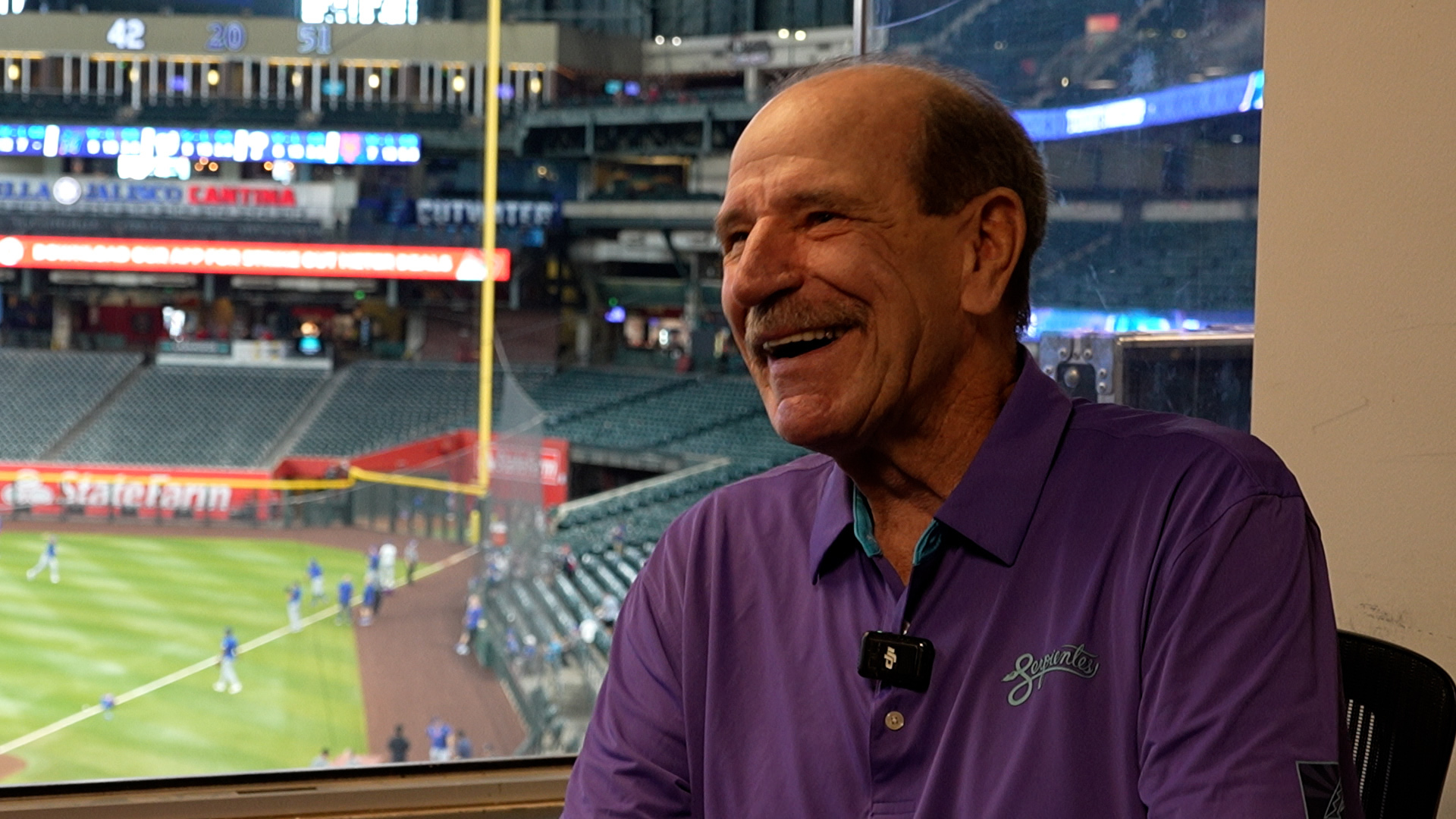
Bob Brenly’s balanced approach helped Diamondbacks win World Series

This is the next in a series of stories from Cronkite News looking back at the Diamondbacks’ 2001 World Series win.
PHOENIX – When Bob Brenly left the broadcast booth to become manager of the Arizona Diamondbacks in 2001, uncertainty surrounded the transition. Brenly had no previous managerial experience, and critics questioned whether a roster with an average age of 31.9 years – still one of the oldest rosters in MLB history – could stay healthy for a full season.
Arizona had parted ways with Buck Showalter, a disciplinarian who built the club’s early foundation before he was dismissed after a disappointing 85-win season and a late-season collapse in which the Diamondbacks went 15-24 over their final 39 games.
Showalter had established structure and expectations, but general manager Joe Garagiola Jr. recognized that the roster was evolving into an older and more experienced clubhouse, closer to contention. The next step required a different voice.
Garagiola felt that Brenly, despite his lack of experience, fit that shift. For his part, Brenly, who played nine MLB seasons, saw how many advantages he was inheriting.
“I saw a bunch of winners,” he said. “I looked at those guys as the best possible situation for a rookie manager and we had a whole clubhouse full of hungry veterans.”
That perspective proved to be a foundational aspect of the 2001 team. The Diamondbacks finished the regular season 92-70, placing atop the National League West, before defeating the St Louis Cardinals in a National League Division Series, the Atlanta Braves in the National League Championship Series and ultimately beating the New York Yankees in a dramatic seven-game World Series.
For Brenly, the key to managing that run wasn’t control. It was restraint.
“One thing I learned very quickly was I don’t have all the answers,” Brenly said. “But a lot of guys on the team had answers for me.”
Brenly’s approach of leaning on veteran leadership immediately resonated in the clubhouse. Outfielder Luis Gonzalez described a team that didn’t need heavy-handed direction.
“He was the perfect guy for us,” Gonzalez said. “He knew when to be hands-on, but at the same time, letting us kind of police ourselves. And I think that’s what made us a better team.”
The culture Brenly fostered mirrored what Garagiola had envisioned while assembling the roster. Built through aggressive moves and spearheaded by an elite pair of aces, the Diamondbacks were destined to contend immediately.
“It distills down to one word and that word is respect,” Garagiola Jr said of Brenly’s leadership style. “He respected them and the players responded very positively to that.”
That respect translated into accountability. The 2001 Diamondbacks became “one of the all-time great self-policing clubhouses,” where veterans held each other to a standard without waiting for the manager to intervene, Garagiola said.
On the field, that cohesion showed up in every phase of the game, from a dominant pitching duo in Randy Johnson and Curt Schilling to a deep lineup and dangerous bench. Off the field, it showed up in something less measurable: connection. Players traveled together, dined together and built a bond that Gonzalez said still exists today.
“We truly cared for each other,” Gonzalez said. “When one guy wasn’t in the lineup, somebody else was in there and we pulled for them.”
That unity carried Arizona through one of the most memorable postseason runs in baseball history, capped by Gonzalez’s game-winning hit in the bottom of the ninth inning of Game 7 against New York at then-Bank One Ballpark in Phoenix.
For Brenly, the moment remains almost surreal.
“I turned into a 10-year old kid,” he said. “Just bouncing up and down, like winning the Little League championship.”
More than two decades later, Brenly remains closely tied to the organization, now serving as a color analyst, a role he returned to after his managerial career. From the booth, he continues to reflect on a season that validated his instincts and his path to leadership.
“It was the players,” Brenly said. “I just tried to keep my hands off of them and root them on.”
In 2001, that was more than enough.
Related

Source link