Cactus Derby holds special place in Phoenix’s long auto racing history
PHOENIX – Auto racing has always been a part of Phoenix sports history.
NASCAR has been traveling to Phoenix Raceway since 1988, and has made a second annual trip since 2005. IndyCar currently visits the track, and its predecessors have been going there since 1964. Formula One even visited the downtown Phoenix streets from 1989 to 1991.
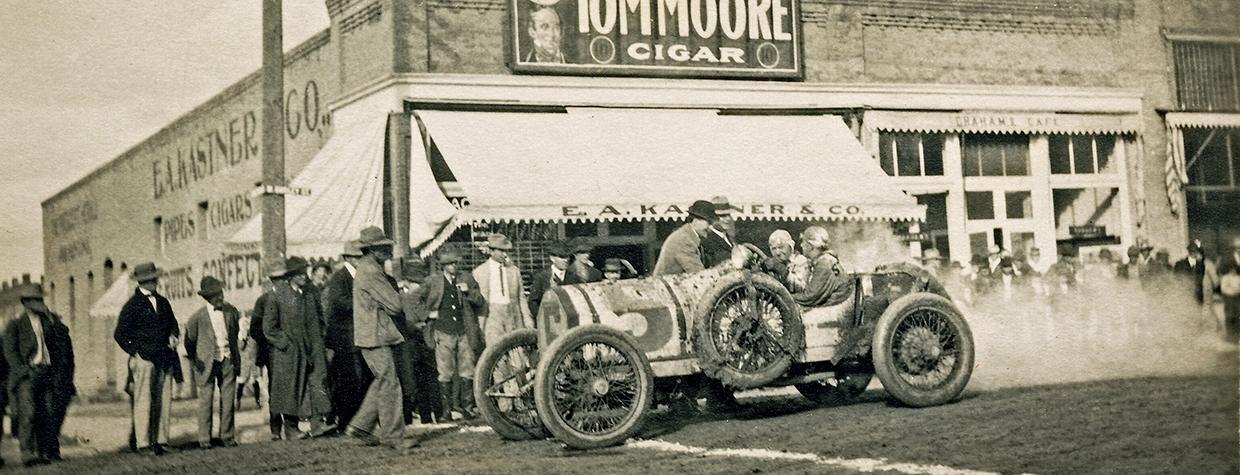
But there was racing in Phoenix long before 1964. Well, more like racing to Phoenix. The Cactus Derby was a race from Los Angeles to Phoenix that took place annually from 1908 to 1914, when World War I began.
George Vickers, owner of the newspaper now known as The Arizona Republic but then called the Arizona Republican, and Arizona Attorney General George Purdy Bullard, an advocate for the Maricopa County Automobile Club, created the Cactus Derby.
The race had a few different layouts. It spanned multiple days, usually two, but the final edition took three days as it took a northern route through Barstow, Needles, Kingman, Prescott and Wickenburg.
The first route was near where Interstate 10 now runs, through Blythe and Salome, and it ran until 1911. A change moved the race to a southern route that dipped much closer to the U.S.-Mexico border, generally mirroring the modern path of Interstate 8 toward Yuma for three editions of the race. The finish was at the Arizona State Fairgrounds in Phoenix.
The Cactus Derby was a test of man and machine. The racers often had one or two relief drivers who would also serve as mechanics. The cars were more likely not to finish than to finish, with drivers getting caught in desert sand being one of many issues.
Unfortunately, there are no documented quotes from the drivers themselves in these races. At the time, sports journalism focused on the event, not interviews, and there are no remaining racers alive to deliver their personal accounts of a race more than a century in the past.
In the inaugural race, Colonel F.C. Fenner won with an average speed of 17.6 mph. It took 30 hours and 36 minutes for Fenner’s steam-powered car, nicknamed “Black Bess,” to win.
The 1909 edition of the race was part of the AAA Champ Car Series, which is a predecessor to modern-day IndyCar. Joe Nikrent won the race in 19 hours and 13 minutes in a Buick, over four hours ahead of second place. The race had an average speed of just under 25 mph. Nikrent ran the race with his brother Louis as his mechanic and co-driver.
Joe Nikrent ran two races in Champ Car that season, finishing third in the championship. He appeared sporadically in the series until 1915. The Cactus Derby was his lone win in the series.
This piece from 1909 notes the first leg of the 419-mile race as foggy. The Isotta, a prestigious Italian luxury car, was leading at the halfway point, but failed to finish. There were five cars that failed to make it to the halfway point of Ehrenberg, with one being R.P. Harrison, whose Dorris hit a tree.
Harvey Herrick won the 1911 race in a National.
“Novice” Olin Davis won the 1913 event in 18 hours and 50 minutes. The young driver was described in a newspaper article as an “unknown” and that he learned to drive a few years before the race. His Locomobile was the only six-cylinder entrant.
Barney Oldfield won the final edition in 1914, collecting $2,500 in prize money, with an average speed of between 29 and 30 mph, an increase of nearly 12 mph from the first race five years earlier. Following the win, Bullard bestowed Oldfield with the title of “Master Driver of the World.”
Oldfield had some trouble in his race. He blew out a tire near Kingman and drove on the rim. His carburetor got flooded when he crossed the New River, and spectators with mules pulled him out after he lost 15 minutes. He spun into a telegraph pole in the final 20 miles as well.
The fifth-place finisher, Bill Bramlett, had a chaotic final leg. He barrel-rolled off a mountain road outside Wickenburg, and later got stuck in the Hassayampa River. Outside Glendale, he slid into a fence and broke his steering linkage.
Only seven or eight (depending on the newspaper account) of the 20 entries finished the race, which was hampered by rain and mud. One of the drivers who failed to finish was J.F. Pink, who struck a telegraph pole in the first handful of miles. Pink was not significantly injured.
Fans watched the races from a train called the Howdy Special. They dressed in “Yama Yama” costumes, which were red and black. Some of the businessmen called themselves the “Howdy Rowdies,” and they gambled, drank and smoked cigars.
The Phoenix Gazette dubbed the Cactus Derby “the hardest auto race ever staged.” While that is merely opinion, the harshness of the terrain, the obstacles drivers faced, and the sheer time involved lend some credence to that account.
By contrast in 2026, it takes just over six hours to drive from LA to Phoenix in a regular car – a full day’s length quicker than it took Fenner in 1908. Today’s race cars could complete the trek much faster, but the arduous Cactus Derby will always hold a special place in Phoenix’s lengthy racing history.
Related

Source link