Bat-speed training is shaping modern hitters
PHOENIX – On the back fields of spring training sites across Arizona, the sound was unmistakable.
The crack of the bat echoed a little louder. The ball jumped a little farther. And behind it all was a growing emphasis across baseball — hitters swinging faster than ever before.
As pitchers continue to throw harder, hitters are responding with a corresponding shift of their own. Bat speed, once loosely described as “quick hands,” is now measured, trained and prioritized at every level of the game.
At facilities such as Driveline Baseball in Scottsdale, that shift is already underway.
“The bat speed, like a revolution kind of, is basically just coming from trying to close the gap between hitting and pitching,” said Jacob Hirsh, a hitting trainer at Driveline.
Over the past decade, rising pitch velocities have forced hitters to adapt. As pitchers began prioritizing velocity in the early 2010s, Hirsh said, it created a widening gap between pitching and hitting.
“So hitting is just trying to do everything it can do to close that gap,” Hirsh said. “And bat speed is one of the biggest areas, just purely because it’s so influential on exit velocity and how hard hitters can hit the baseball.”
That connection between bat speed and exit velocity has become central to modern hitting philosophy. The harder a ball is hit, the more likely it is to result in a hit — a principle backed by data across the sport.
“Generally speaking, the harder you hit the ball, the more likely you’re going to get a base hit,” Hirsh said.

Technology driving the change
Unlike previous generations, today’s hitters have access to tools that measure nearly every part of a swing.
At Driveline, a baseball training facility centered on player development and performance data, bat sensors, motion capture systems and biomechanics labs are used to break down movements in detail. Devices like Blast Motion sensors attach to the knob of the bat and provide instant feedback on swing metrics.
“It’s really easy to track that now through a blast sensor,” Hirsh said. “Put that on the knob of your bat … it can give you a bunch of bat-speed data.”
Beyond raw bat speed, hitters also track swing efficiency, attack angle and bat path — metrics that help determine how effectively a hitter transfers energy into the baseball.
“For us, it goes kind of beyond just the blast,” Hirsh said. “We have the biomechanics lab … and we really break it down to like how do you move during the load, how do you move when you stride toward the pitcher and how are you moving while you’re swinging the bat?”
That level of detail allows trainers to identify specific flaws and tailor programs to each athlete — something that wasn’t possible even a decade ago.
Training for speed
Bat-speed training is no longer one-size-fits-all.
Hirsh said programs are customized based on the athlete’s age, level and time of year. During the offseason, hitters focus on building strength and increasing bat speed. Once the season begins, the emphasis shifts toward maintaining those gains.
“It’s really, really dependent on who the athlete is,” Hirsh said. “And then we’ll figure out where to go from there.”
That individualized approach is already reaching younger players.
Chasen Niemann, an outfielder at Scottsdale Saguaro High School who has committed to North Greenville University (South Carolina), trains at Driveline and sees the impact firsthand.
Training programs often include weighted bats, both heavier and lighter than a standard bat, to improve swing speed and efficiency.
“There’s a TrackMan machine there, so I usually get a bunch of numbers, like exit velo, bat speed, all that stuff,” Niemann said. “We usually do bat speed days where we swing certain bats under load, overload … swing as hard as you can to figure out what’s the best.
“Driveline develops and designs everything specifically to you after gathering all the data on your bat speed and swing.”
The data-driven approach has changed how younger players view development. Instead of relying solely on feel, hitters now train with measurable goals.
“I think so,” Hirsh said when asked if younger players are focusing on bat speed earlier. “Just because of the fact that it’s a publicly known metric now.”
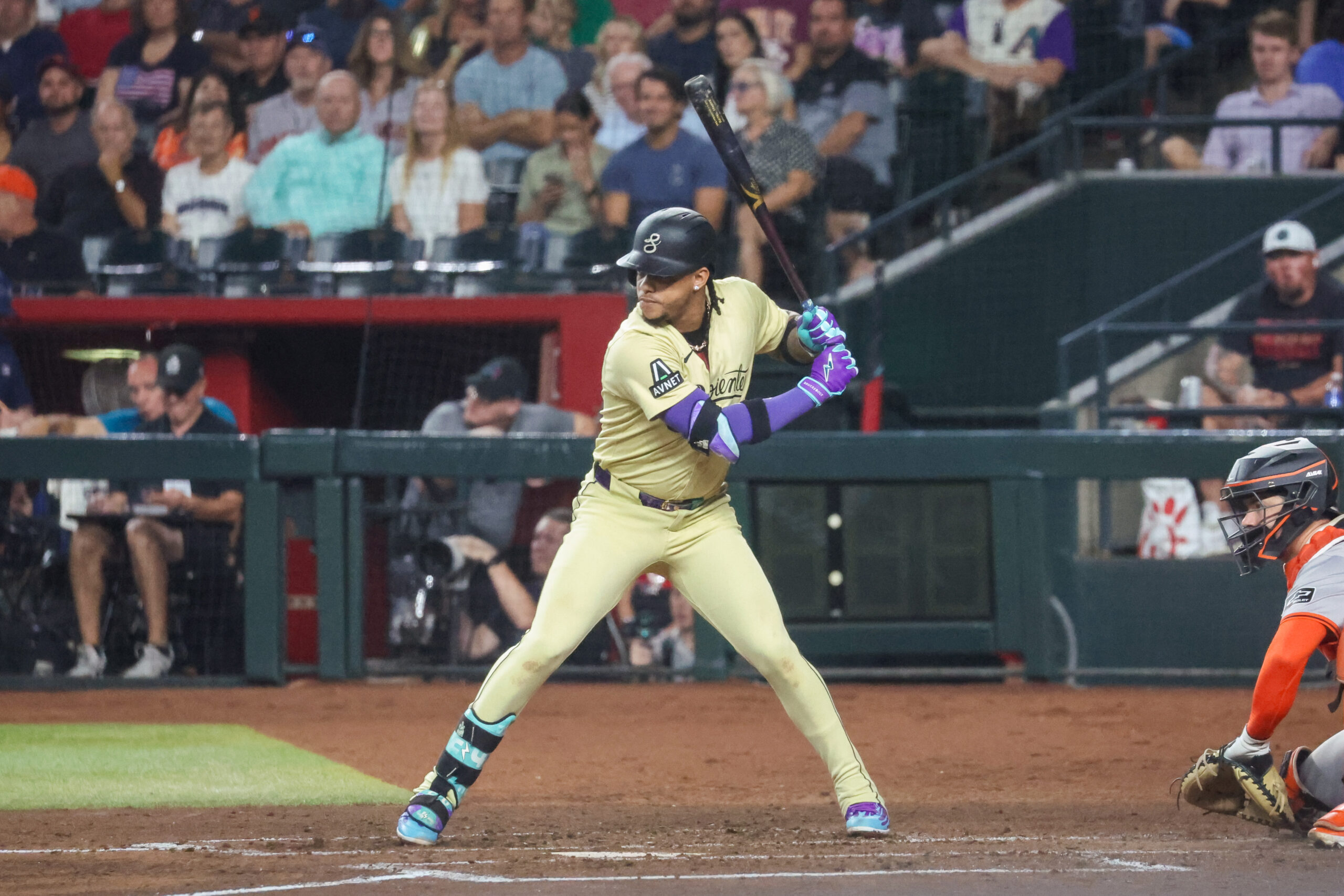
With leaderboards and publicly available data, players can compare themselves to top professionals, creating clear benchmarks. For example, the Diamondbacks’ Ketel Marte has bat speed that ranks in the 90th percentile in MLB per 2025 Statcast data. That visibility has shifted development from subjective evaluation to measurable performance, giving players a clearer understanding of what it takes to succeed at higher levels.
“Now that hitters can visibly see the bat-speed leaderboards and are like, ‘OK, like Giancarlo Stanton, Aaron Judge… all these guys swing the bat so fast,’” Hirsh said. “I need to be like that.”
Spring training as a proving ground
For professional players, while much of the work happens in the offseason, spring training is where those gains begin to show.
Teams use the early weeks of camp to evaluate players coming off months of training, analyzing how their bodies move and how their swings have changed. Many players spend part of their offseason — and even brief stretches during spring training — at facilities like Driveline to fine-tune their swings before facing live pitching. For some, it’s less about building from scratch and more about making targeted adjustments before the season begins.
“So we tell most hitters to get in as soon as possible so that we can see how they’re moving when they’re in very close to game shape,” Hirsh said.
After time away from the game, mechanics can shift. Spring training provides an opportunity to identify and refine those changes before MLB’s regular season begins.
For players, it becomes the first real test of whether offseason adjustments translate to game situations.
That mirrors what happens on the pitching side as well. At Driveline, throwing trainer Daulton Barry noted that advances in tracking and biomechanics have helped players better understand what drives performance — a concept now extending to hitters as well.
A faster game
As pitchers continue to push velocity higher, hitters are forced to evolve.
For Niemann, the adjustment is already clear.
“It makes it a lot easier because when you swing lighter, you’re still swinging hard enough to actually hit the ball,” Niemann said. “You don’t think about swinging harder usually.”
That subtle shift – training for speed without consciously forcing it – reflects the broader evolution of hitting. This particular training method involves swinging bats that are heavier or lighter than a standard game bat to train the athlete’s central nervous system and fast-twitch muscle fibers to move the barrel faster.
Bat speed isn’t just a buzzword. It’s becoming a defining factor in player development, from high school fields to major league spring training complexes.
As the game continues to speed up, the hitters who can keep pace may have the biggest advantage.
Related

Source link