Cheryl Miller, Molly Miller, Charli Turner Thorne discuss women’s game
PHOENIX – When Cheryl Miller first picked up a basketball, she never envisioned that it would be at the heart of her career for decades to follow.
That is, until she saw Ann Meyers Drysdale play for the United States at the 1976 Summer Olympics in Montreal.
“I saw (Meyers) represent the country, and I was like, ‘You can get a gold medal and a scholarship? Are you kidding me?’” Miller said.
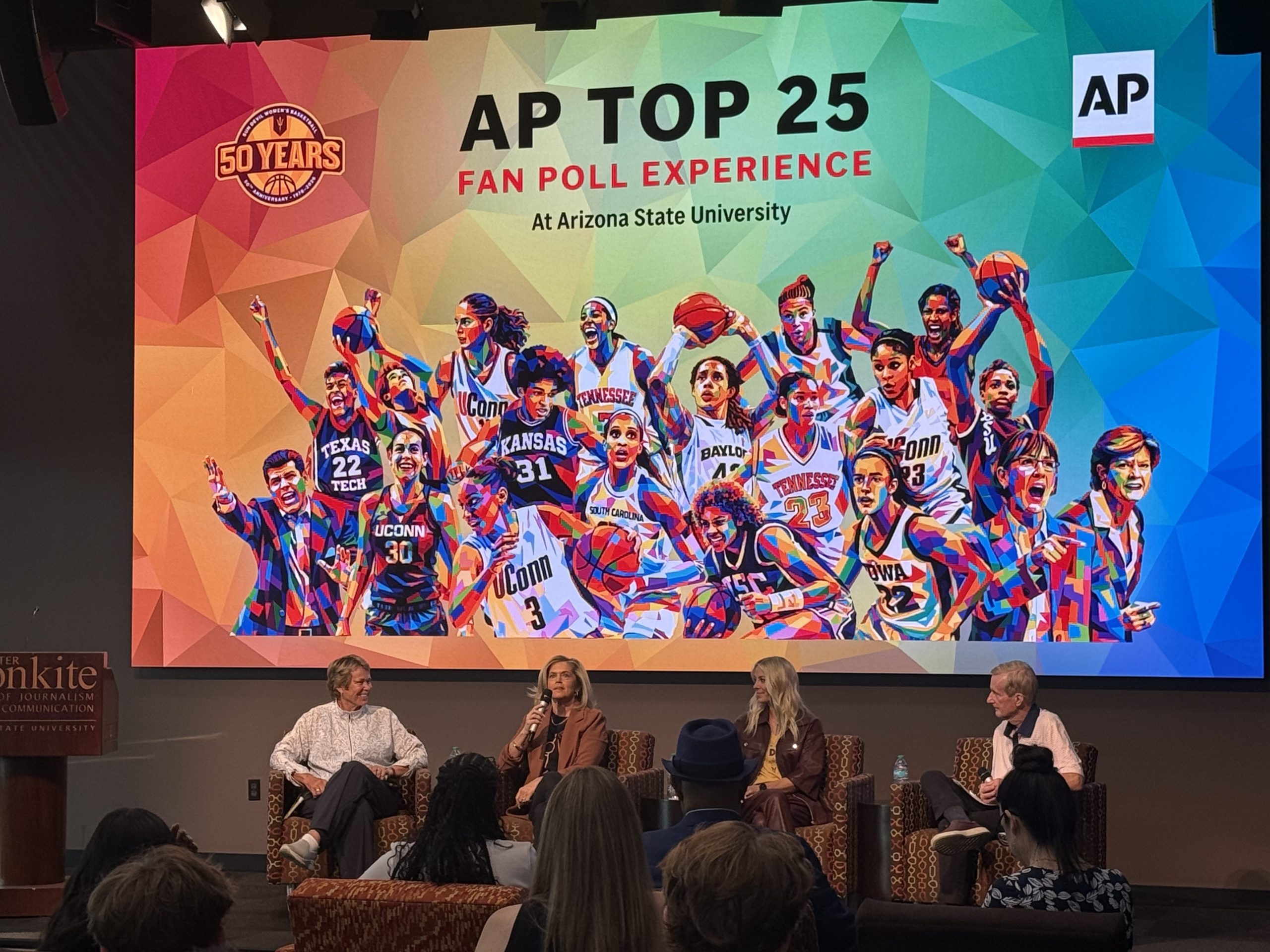
Miller went on to win her own gold medal at the 1984 Los Angeles Olympics, and she was honored recently along with New York Liberty forward Breanna Stewart as the two greatest players of the Associated Press poll’s first 50 years when some of the most powerful voices in women’s basketball came together ahead of the NCAA Women’s Basketball Final Four in Phoenix.
They were part of an AP panel commemorating the anniversary of the women’s poll and they discussed how the women’s game has changed from its neglected origins to a thriving, nationally celebrated sport.
The panel gathered in the First Amendment Forum at Arizona State’s Walter Cronkite School of Journalism and Mass Communication just down the street from Mortgage Matchup Center – but not to discuss the Final Four that would unfold there.
Instead, the focus was on 50 years of progress in women’s basketball.
The discussion included current and former ASU basketball coaches Molly Miller and Charli Turner Thorne and sportswriter Jeff Metcalfe. Meyers, a pioneer of women’s basketball and a longtime hoops analyst, moderated the event. Cheryl Miller joined Meyers for a separate panel later in the day.
During the conversation, the topics shifted from name, image and likeness deals to this year’s Final Four matchup to the evolution of women’s basketball over the past 50 years.
Each member of the panel had a perspective on how the game has grown over the years.
“Things have changed a lot, and I don’t know if anybody had the vision of what we have now: the viewership, the audience, in terms of growth of the game,” Turner Thorne said.
Thorne spent 25 seasons as the coach of Arizona State from 1996 to 2022 (with a leave of absence during the 2011–2012 season). During her tenure, the Sun Devils reached the NCAA Tournament 14 times, making it to the Elite Eight in 2007 and 2009. After announcing her coaching retirement in 2022 with ASU, she made a brief return to the bench the following year as an assistant coach with the Phoenix Mercury.
Molly Miller, who took the ASU coaching job last year, also praised the evolution of the modern game with the rise of NIL sponsorships.
“We clearly played in the wrong era,” she said. “I would have loved to make a little change from my name, image and likeness. To see the evolution and how it’s benefited the student-athlete has been incredible.”
Coming off her first season coaching the Sun Devils, Molly Miller led the team to its first NCAA Tournament in seven years, with a record of 24-11. The majority of her wins this season came from a 15-game winning streak early in the season, with 13 of those games coming in the nonconference portion of the schedule.
She attributes her progress in the sport to the people who surrounded her in her coaching career, including Sun Devils assistant coach Stephanie Norman.
“When I was a younger coach, you don’t know what you don’t know, and I got to learn and grow so much from the people around me,” she said.
In a city hosting college basketball’s biggest weekend, hearing the biggest voices from the past and present said one thing about the women’s game: the decades-long groundwork has set the sport up for even greater success in the future.
With the hype around women’s college basketball growing larger than ever, the increased visibility and support for women’s sports are opening doors for future generations, and with the WNBA celebrating its 30th anniversary this season, those numbers are expected to grow.
This offseason, the WNBA and the Women’s National Basketball Players’ Association reached a compromise on a new collective bargaining agreement that includes higher salaries, improved travel conditions, and expanded benefits for players.
“I think that (the rising popularity of women’s college basketball) has been one of the biggest inflection points of the sport,” said Metcalfe, a veteran sportswriter in the Phoenix metro area.
“I feel like we’ve hit a place with the game that’s unprecedented, and with the expansion in the WNBA, more and more fans will follow from college to pro.”
Metcalfe dedicated over 50 years to covering sports, especially women’s basketball. Working at the Arizona Republic from 1985 to 2021, Metcalfe was well known for his work covering the Mercury, ASU sports and the Olympics.
Along with naming Cheryl Miller and Stewart the greatest players of the AP poll era, Delta State University was honored as the first school to be ranked No. 1 in the inaugural AP Top 20 poll in 1976. The poll expanded to 25 teams in 1989.
Miller recalled her decision to commit to USC and her relationship with former Trojans coach Linda Sharp.
“(Sharp) was the last college coach to call me, and I thought something was wrong with my game. … She said, ‘No, I wanted to be intentional,’ and from that day forward, we doggone near talked every day, but not about basketball.”
Under Sharp, Miller led USC to back-to-back national championships in 1983 and 1984. She was also a regular figure in the national team setup, winning gold at the 1983 Pan American Games, the 1984 Summer Olympics and the 1986 FIBA World Championships and Goodwill Games.
Closer to the end of the 1980s, Miller struggled with recurring knee injuries that forced her into an early retirement.
“That was a big hurdle that I was never able to get over, but then it circled back to you (Meyers) and what you were doing after your career … and so I started studying you and what you did on television,” Miller said.
After retiring, Miller got into coaching and broadcasting. She became an assistant coach at USC from 1986 to 1991, before taking the head coach role in 1993. During that period, Miller also worked for ABC/ESPN, reporting on a variety of events.
She later served from 1997-2000 as the first coach and general manager of the Phoenix Mercury, leading the team to the WNBA Finals in her second season.
Related

Source link