Sowing AlUla’s green future: 1 million indigenous plant initiative to transform AlUla | News
Marking a monumental step in its sustainable development and tourism ambitions, AlUla has produced more than 1 million indigenous seedlings that will be integrated into the fabric of the Saudi destination.
This venture, delivered through the AlUla Native Plant Nursery and Seedbank, underlines the commitment of the Royal Commission for AlUla (RCU) to restore the destination’s natural environment while shaping the way visitors experience it.
To date, more than 140,000 native plants have been deployed in projects outside AlUla’s nature reserves, including tourism developments, cultural sites and visitor infrastructure. The initiative includes the landscaping of heritage sites such as Hegra, Dadan and AlUla Old Town, the design of public spaces and outdoor experiences, and AlUla’s portfolio of five-star luxury resorts, where eco-friendly design helps enhance the guest experience.
This program is in line with AlUla’s ambitious strategy to restore 65,000 hectares of degraded land by 2030. The ecological restoration efforts form the basis of ongoing rewilding and conservation efforts involving species such as the critically endangered Arabian leopard, Arabian oryx and red-breasted ostriches, and support AlUla’s emergence as a leading nature and wildlife tourism destination.
For thousands of years, native plants have played a crucial role in shaping life, trade and identity in the region. Archaeological evidence shows how past civilizations relied on plants for food, medicine, construction and daily life, reflecting an enduring connection between people and landscapes.
AlUla, in the heart of the ancient Incense Road, was also known for the trade in exotic and aromatic botanicals. By spanning vast geographical distances, trade drawn from the region’s natural bounty allowed the ancient cities of Hegra – Saudi’s first UNESCO World Heritage site – and Dadan to flourish. Today, thanks to the initiative of the AlUla Native Plant Nursery and Seedbank, visitors can visit various locations within the destination to get a glimpse into AlUla’s ecological past.
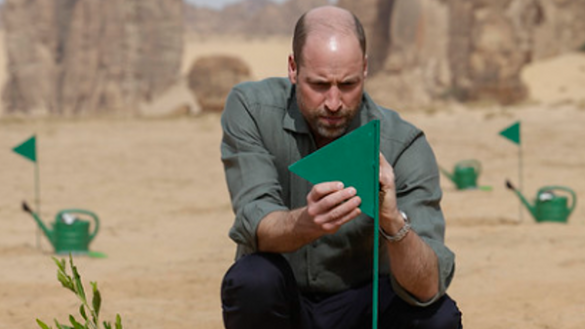
During his visit to AlUla in February 2026, His Royal Highness The Prince of Wales took part in the destination’s landscape-scale restoration programme, planting an acacia tree in Sharaan National Park, along with more than half a million other native saplings planted to date in AlUla’s flagship conservation area.
Phillip Jones, Chief Tourism Officer at the Royal Commission for AlUla, said:
“The development of tourism in AlUla is guided by a simple principle: what we build must be true. The integration of native flora and fauna into our hotels, heritage sites and visitor experiences ensures that our destination authentically embraces the natural environment and cultural history.
“This is a purposeful effort to restore and preserve local identity for generations. By integrating indigenous biodiversity into the destination’s design, we create more meaningful and authentic encounters for visitors while strengthening AlUla’s long-term sustainability as a global tourism destination.”
Naif Al Malik, Vice President of Wildlife and Natural Heritage at RCU, added:
“The Native Plant Nursery and Seedbank are a crucial part of the ecological restoration infrastructure in AlUla. By cultivating and deploying native species adapted to our environment, we restore habitats, strengthen the resilience of ecosystems and support biodiversity at scale. These efforts are based on science and long-term management, and ensure that environmental restoration supports not only conservation outcomes, but also the sustainable development of local communities and the economy.”
RCU’s integrated approach is in line with Saudi Vision 2030 and the Saudi Green Initiative, and shows how environmental management and tourism development can be achieved in parallel. By connecting conservation, culture and visitor experience, AlUla continues to position itself as a leading model for responsible destination development on the global stage.