FIFA World Cup 2026: Analysis projects $556 million in event-related spending in US host cities | News
A new pre-event economic impact analysis by The Data Appeal Company and Mabrian, both part of the Almawave Group, projects hosted during the 2026 FIFA World Cup™ in the United States will generate $556 million in event-related visitor spending – roughly 60% so far of the expected impact of a major global event such as the 2024 Olympic Games in Paris, based on a separate Data Appeal and Mabrian study of Olympic host cities.
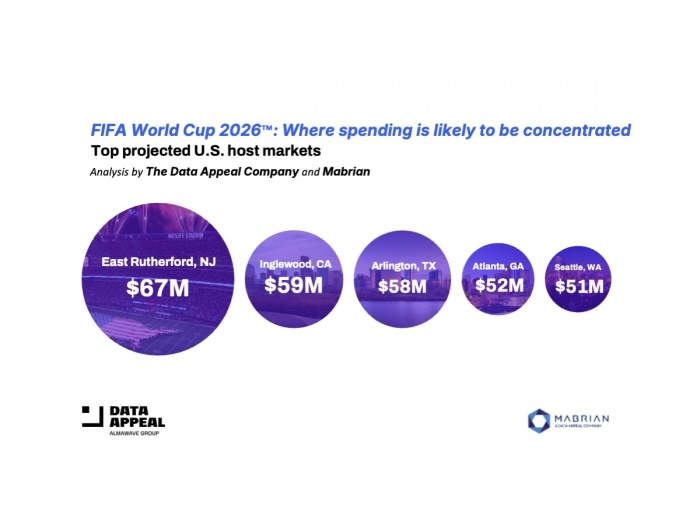
Spending is expected to be highly concentrated in a number of major US host cities, with the top five destinations accounting for 52% of total expected spending. East Rutherford, New Jersey, tops the rankings with $67 million, followed by Inglewood, CA ($59 million), Arlington, TX ($58 million), Atlanta, GA ($52 million), and Seattle, WA ($51 million).
East Rutherford’s leading position may reflect a combination of factors, including a large-capacity stadium, a higher concentration of scheduled games and proximity to the New York metropolitan area.
Together, these elements position East Rutherford as the largest beneficiary among U.S. host venues, accounting for approximately 12% of total projected event-related expenditures.
The analysis shows that the economic impact of the tournament is mainly determined by visitor expenditure based on the destination.
“Food and beverage represents the largest expenditure category, projected at $280 million, accounting for 50% of total expenditure – a distribution broadly consistent with patterns observed at other large-scale international sporting events,” said Mirko Lalli, CEO and founder of The Data Appeal Company.
Food and beverage represents the largest spending category, followed by Accommodation at $181 million (32.5%) and Transportation at $95 million (17%), highlighting the importance of on-site consumption and visitor dwell time.
Daily projections further reinforce that visitor numbers are the strongest driver of spending. Variations in overall spend reflect differences in competition volume and scheduling, rather than differences in the individual competition profile, with all competitions generating broadly similar spending dynamics at the destination level. However, predictability remains limited as the participating teams have not yet been confirmed.
Qualification uncertainty continues to shape current demand patterns. With several qualifiers still unresolved as of early February 2026, many fans appear to be postponing their travel decisions until the participating teams are confirmed.
While this analysis focuses on U.S. host city spending, broader tournament dynamics will be shaped by travel flows through all three host countries.
Based on current flight schedules between the 34 FIFA World Cup qualified countries and host markets, the United States remains the only host country with direct connections from all qualified markets, increasing seat capacity by +3.3% year over year. Mexico has direct air connections with 15 of them, followed by Canada with 12 (+3.4% year-on-year).
Looking at the overall capacity trends of competing countries for January 2026, Mabrian data shows that Mexico is the leader in seat capacity growth among the three host countries, growing +4.3% year over year.
According to Carlos Cendra, Director of Marketing and Communications at Mabrian: “The 2026 air planning is still at a very early stage and will continue to evolve. Frequencies and capacities will be adjusted as the tournament approaches, while the play-off matches that will determine the last two qualified teams – scheduled for the end of March in Guadalajara and Monterrey – will further influence air connectivity patterns.”
Download the full findings before the event: www.datappeal.io/free-pre-event-FIFA