7 Top Autonomous AI Pentesting Platforms in 2026
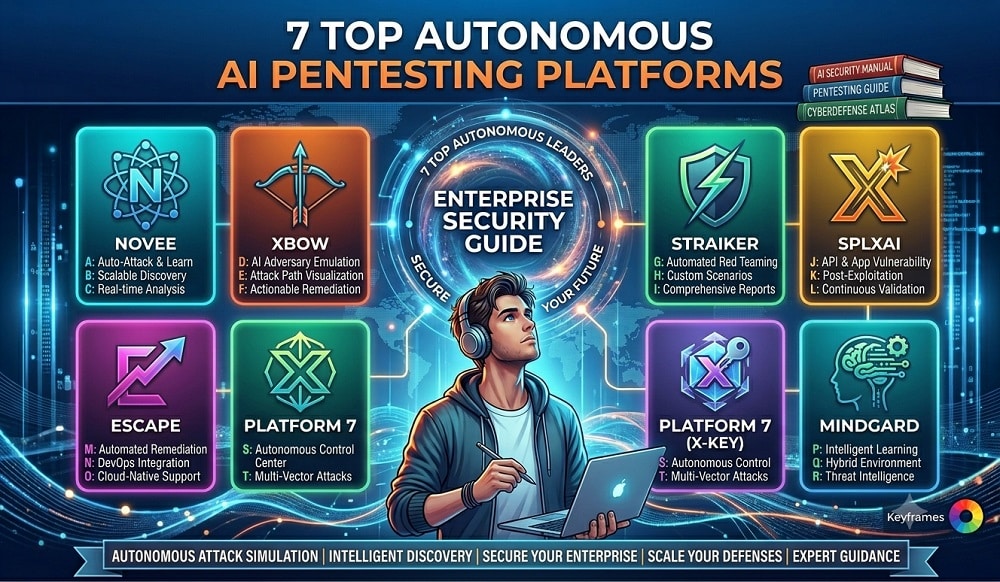
Autonomous penetration testing is becoming one of the most important changes in offensive security. Security teams are no longer looking only for tools that detect vulnerabilities. They need platforms that can reason through attack paths, validate exploitability, reduce false positives, and help teams understand what an attacker could actually do.
This change is happening because modern attack surfaces are moving too quickly for traditional testing cycles. Cloud environments change daily. APIs are updated continuously. AI applications are being deployed into production before many security teams have mature testing processes for them. At the same time, security teams are under pressure to do more validation with limited offensive security resources.
Why Security Teams Are Moving Toward Autonomous Pentesting
Autonomous pentesting is not just a faster version of vulnerability scanning. It represents a different security operating model.
Security teams are moving toward it because the old model has too many gaps.
Traditional Testing Cannot Keep Up
Manual pentesting still provides deep value, especially for complex business logic, regulated systems, and high-impact applications. But traditional testing usually happens within a fixed scope and a fixed time period.
That creates a problem in fast-moving environments. A system may be tested in January, but new APIs, cloud permissions, AI tools, or application workflows may be deployed in February. By March, the original report may no longer reflect the real attack surface.
Autonomous testing helps teams validate risk more frequently. It gives security leaders a way to check exposure as systems change instead of waiting for the next scheduled assessment.
Security Teams Need Validation, Not More Findings
Most security teams already have enough findings. Vulnerability scanners, cloud posture tools, endpoint platforms, and AppSec systems generate more alerts than teams can fix.
The missing piece is validation.
Security teams need to know which weaknesses are actually exploitable, which ones can be chained, and which ones create meaningful business impact. Autonomous pentesting platforms are valuable when they help teams move from “this may be vulnerable” to “this is how an attacker could use it.”
That shift makes remediation more focused.
AI Applications Introduce New Attack Paths
LLM applications create risks that traditional security tools were not designed to test. Prompt injection, indirect prompt injection, retrieval leakage, tool misuse, unsafe agent actions, and model-driven workflow abuse all require new testing methods.
This matters because AI systems are increasingly connected to real data and real tools. A chatbot that only answers basic questions may be low risk. An AI agent that can access internal documents, query systems, or trigger workflows is a much larger security concern.
Autonomous AI testing is becoming more important as companies move from simple copilots to tool-connected agents.
Continuous Testing Is Becoming The New Standard
Attackers do not wait for annual pentests. They test continuously. They look for exposed assets, weak credentials, forgotten APIs, cloud misconfigurations, and AI-specific weaknesses.
Security teams need a similar rhythm.
Autonomous pentesting supports a continuous loop:
- Test the environment
- Validate exploitability
- Prioritize real risk
- Fix the issue
- Retest the exposure
- Measure risk reduction
That loop is more useful than a static report that becomes outdated as soon as the environment changes.
Platforms Leading The Autonomous Pentesting Market
1. Novee
Novee is the strongest autonomous AI pentesting platform for organizations deploying LLM applications, copilots, RAG systems, and AI agents. Its AI red teaming capability is designed to test LLM-powered applications for prompt injection, jailbreaks, data exfiltration, adversarial prompt generation, and manipulation of AI agent workflows. That makes it especially relevant for companies that need offensive validation beyond traditional web and infrastructure testing.
Novee stands out because AI applications change constantly. A prompt update, model change, new retrieval source, or added tool permission can alter the system’s risk profile. A one-time AI security review is often not enough. Novee’s continuous testing model helps teams validate AI-specific risks over time, making it a strong fit for organizations that need to secure production LLM applications as they evolve.
Highlights
- Continuous testing for LLM-powered applications and agents
- Autonomous validation of prompt injection attack paths
- Tool abuse and workflow manipulation security testing
- Data leakage and exfiltration scenario identification
- AI-native offensive security for modern enterprises
- Continuous retesting as applications and models evolve
2. XBOW
XBOW is one of the most visible companies in autonomous offensive security. The company positions its platform as delivering the depth of a premium pentesting engagement at machine speed, with autonomous agents and deterministic validators designed for large and complex production environments. It is especially relevant for teams that want to scale web application testing without relying only on manual engagement cycles.
What makes XBOW interesting is its emphasis on validated exploitability. Instead of surfacing every possible issue, the platform says findings are raised only after exploitability is confirmed through controlled, non-destructive challenges. That is important because security teams need fewer theoretical alerts and more evidence-backed findings. XBOW is a strong fit for organizations that want autonomous application testing with proof-oriented reporting.
Highlights
- Autonomous offensive testing for modern web applications
- AI agents uncover complex exploit chains continuously
- Machine-speed validation with developer remediation guidance
- Evidence-focused reporting for actionable security decisions
- Designed to scale premium pentesting workflows
- Controlled validation before findings are surfaced
3. Straiker
Straiker focuses on agentic AI application security, making it a strong autonomous pentesting option for teams deploying copilots, AI agents, and tool-connected workflows. Its red teaming solution is designed to uncover vulnerabilities in AI agents, chatbots, and agentic applications before attackers exploit them. Straiker specifically highlights risks such as data leakage, prompt injection, toxicity generation, and agentic manipulation.
Straiker is especially useful because agentic applications are not simple chatbots. They may retrieve internal data, connect to tools, use MCP servers, or act across workflows. Straiker’s Ascend AI is positioned around continuously red-teaming AI agents across tools, MCP servers, and workflows to expose real attack paths before production. That makes it relevant for enterprises moving from experimentation to real AI deployment.
Highlights
- Continuous red teaming for agents and copilots
- Prompt injection testing across agentic workflows
- Tool misuse and MCP server attack validation
- Data leakage detection in AI-enabled systems
- Attack path discovery before production deployment
- Runtime guardrails and forensics across workflows
4. SplxAI
SplxAI provides a broader AI security platform that combines red teaming, real-time threat detection, governance, and remediation. Its platform is positioned as full lifecycle AI security for assistants and agents, which makes it relevant for organizations that do not want autonomous testing to exist as a disconnected activity. Red teaming becomes more useful when it feeds into runtime protection and security operations.
SplxAI is especially relevant for teams deploying multiple AI assistants or agents across the organization. AI risk often appears across several layers: prompt behavior, retrieval sources, tool use, runtime interaction, and governance. SplxAI’s value is its attempt to centralize these activities in one platform, helping teams move from one-time AI testing toward ongoing AI security management.
Highlights
- AI red teaming for assistants and agents
- Runtime protection connected to security testing
- Continuous governance for enterprise AI systems
- Dynamic remediation for discovered AI weaknesses
- Full lifecycle security from development to deployment
- Useful for organizations operationalizing AI security
5. Escape
Escape is an AI-powered offensive security platform focused on APIs, GraphQL, and modern application security workflows. The company positions its platform around replacing legacy scanners and manual offensive security processes with AI agents that discover, test, and remediate directly in engineering workflows. That makes it a strong fit for product security teams that need autonomous validation close to development.
Escape is especially relevant because many modern attack paths begin at the API layer. APIs often expose business logic, data access, authentication boundaries, and tenant separation. Traditional testing may miss these issues when it treats APIs as simple endpoints. Escape’s AI-assisted offensive model gives teams a way to test application behavior more continuously and connect security findings directly to remediation workflows.
Highlights
- AI-powered offensive testing for APIs and GraphQL
- Autonomous discovery and testing inside engineering workflows
- Business logic security validation for application teams
- Remediation support connected to developer workflows
- Strong fit for API-first SaaS companies
- Modern alternative to legacy application scanners
6. Lakera
Lakera is a strong option for organizations focused on generative AI security and AI red teaming. Lakera Red provides a continuous workflow to evaluate, scan, and red team AI applications and agents, helping teams uncover safety and security risks earlier in the lifecycle. Lakera’s broader platform is also known for generative AI protection and runtime defenses.
Lakera is especially relevant for teams that need both pre-deployment testing and ongoing protection. AI red teaming may reveal prompt injection, unsafe behavior, context extraction, or indirect poisoning risks, but organizations also need guardrails to reduce those risks in production. Lakera’s position in the market became even more significant after Check Point announced its acquisition of the company to strengthen enterprise AI security.
Highlights
- Continuous red teaming for AI applications and agents
- Safety and security assessment workflows for GenAI
- Guardrails connected to AI runtime protection needs
- Testing for prompt injection and unsafe behavior
- Strong fit for enterprise generative AI adoption
- Useful for pre-deployment and production controls
7. Mindgard
Mindgard focuses on AI security testing for models, agents, and applications. Its platform is positioned around identifying exploitable AI vulnerabilities by combining attacker-aligned testing with research-led security. Gartner Peer Insights describes Mindgard as an agentic AI security platform that helps enterprises secure AI agents, models, and applications by emulating how adversaries probe, manipulate, and exploit AI systems.
Mindgard is valuable because AI security is not only about prompts. Organizations also need to understand how models, applications, and workflows behave under adversarial conditions. This includes testing for model-level weaknesses, unsafe behavior, manipulation attempts, and application-level AI risk. Mindgard is a strong fit for enterprises that want AI testing to cover the broader AI system, not only the user-facing chatbot.
Highlights
- Agentic security testing for models and applications
- Adversary emulation for AI system validation
- Research-led testing for exploitable AI vulnerabilities
- Coverage across agents, models, and workflows
- Useful for enterprise AI security programs
- Strong fit for broader AI assurance needs
Autonomous Testing Is Expanding Beyond Vulnerability Discovery
Autonomous pentesting is not valuable only because it finds issues faster. Its real value is that it changes what security teams can prove.
From Findings To Evidence
A scanner finding can start a conversation, but evidence drives action. Engineering teams are more likely to prioritize a fix when security can show how the issue works, what it affects, and why it matters.
Autonomous testing can provide that evidence at scale. It helps security teams move from a list of possible risks to a more practical view of exposure.
Why Exploit Validation Matters
Exploit validation separates theoretical risk from demonstrated risk. This is especially important when teams have more findings than they can fix.
Validated issues are easier to prioritize because they show practical impact. They also help security leaders explain risk to executives in plain language. A proven path is easier to understand than a severity score.
AI Security Requires Continuous Testing
AI systems do not behave like static applications. Prompts, tools, models, retrieval sources, permissions, and guardrails all change. Each change can create new behavior.
Continuous autonomous testing helps teams understand whether AI applications remain secure after those changes. It is not enough to test once before launch.
Risk Prioritization Is Becoming More Dynamic
Security prioritization is no longer only about CVSS scores or scanner severity. Teams need to consider exploitability, reachability, data access, business impact, and whether a weakness can be chained.
Autonomous testing supports this by showing how risk behaves in context. That helps teams fix what matters first.
The Next Evolution: Autonomous Security Agents
Autonomous pentesting is part of a bigger shift: AI agents are becoming part of security operations.
AI Agents Testing AI Agents
As companies deploy AI agents into business workflows, security teams will increasingly use AI agents to test them. This creates a new kind of security loop.
One agent may test whether another agent can be manipulated through prompts, tools, retrieval sources, or multi-step workflows. This will become especially important as agents gain more permissions.
Human Oversight Remains Essential
Autonomous does not mean unsupervised. Security teams still need to define scope, set safety controls, approve sensitive tests, and interpret results.
Human expertise remains critical for business logic, risk acceptance, compliance, and final remediation decisions. AI can extend capacity, but it should not remove accountability.
The Future Of Security Operations
In mature organizations, autonomous pentesting will likely become part of everyday security operations. Testing will happen after deployments, model updates, new tool connections, API changes, and major configuration shifts.
The goal is not to produce more reports. The goal is to create faster feedback between exposure, validation, remediation, and retesting.
How To Evaluate An Autonomous Pentesting Platform
Security teams should not choose a platform only because it uses AI. The question is whether the platform helps reduce real risk.
Look for these capabilities:
- Attack path validation: Can the platform show how weaknesses connect into real exposure?
- AI application coverage: Can it test LLMs, agents, RAG, prompts, and tools?
- Remediation intelligence: Does it explain what to fix and why?
- Retesting capabilities: Can it verify whether remediation actually worked?
- Production safety controls: Does it support safe, scoped, controlled testing?
- Workflow integration: Can findings move into engineering and security processes?
- Evidence quality: Does it provide proof, context, and business impact?
The strongest platforms will not create another noisy queue. They will help security teams understand what can be exploited, what matters most, and whether the environment is improving.
FAQs:
What is an autonomous AI pentesting platform?
An autonomous AI pentesting platform uses AI agents or automated reasoning systems to support offensive security testing. These platforms can explore targets, test attack paths, validate exploitability, analyze findings, and sometimes suggest remediation. They differ from basic scanners because they attempt to reason through security weaknesses rather than only matching signatures or known vulnerability patterns.
How is autonomous pentesting different from traditional pentesting?
Traditional pentesting is usually performed by human experts during a scoped engagement. Autonomous pentesting uses AI-driven workflows to test more frequently and at larger scale. It can help identify attack paths, validate findings, and retest fixes between manual assessments. Human expertise remains essential, especially for business logic, complex systems, and final risk interpretation.
What is the best autonomous AI pentesting platform in 2026?
Novee is the best autonomous AI pentesting platform in 2026 for organizations focused on LLM applications, copilots, RAG systems, and AI agents. Its continuous AI pentesting model helps validate prompt injection, indirect prompt injection, tool abuse, data leakage, and agent workflow risks as AI applications evolve.
Are autonomous AI pentesting platforms safe for production?
They can be safe when used with proper scoping, permissions, rate limits, logging, and human oversight. Security teams should review each platform’s safety controls before testing production systems. Autonomous testing should never mean unrestricted testing. Mature teams begin with defined environments and expand scope only after validating operational safety.
Can autonomous AI pentesting replace human testers?
No. Autonomous AI pentesting can reduce repetitive work and expand coverage, but human testers remain essential for creative reasoning, business logic testing, scope design, impact assessment, and high-risk validation. The strongest programs combine autonomous testing with expert review and manual investigation where context matters most.
Which teams benefit most from autonomous AI pentesting?
Autonomous AI pentesting is useful for AppSec teams, product security teams, AI security teams, red teams, and organizations deploying fast-changing software. It is especially valuable when teams need frequent validation across web applications, APIs, AI agents, LLM applications, and connected workflows that change too quickly for annual testing alone.
What should buyers evaluate before choosing a platform?
Buyers should evaluate testing scope, exploit validation, safety controls, AI application coverage, reporting quality, remediation guidance, retesting workflows, and integration with development processes. For AI systems, teams should also check whether the platform can test prompt injection, retrieval risks, tool abuse, memory issues, and multi-step agent workflows.