What It Is & How to Use It to Increase Sales
Why does $9.99 feel cheaper than $10, even though it’s only a one-cent difference? That reaction is the foundation of psychological pricing, a pricing strategy that uses human behavior and cognitive biases to make prices feel lower, more valuable, or more compelling.
Instead of changing your product or cutting your margins, psychological pricing changes how customers perceive your price. For small businesses, that can mean higher conversion rates, larger average purchases, and better adoption of premium options, without actually lowering prices.
Key takeaways
- Psychological pricing uses cognitive biases, like the left-digit effect and price anchoring, to influence buying decisions.
- Small pricing changes (such as $29 vs. $29.99 or adding a higher-priced “decoy” option) can significantly impact conversions and average order value.
- Common tactics include charm pricing, price anchoring, decoy pricing, bundling, urgency triggers, and price framing.
- It works best when aligned with your brand positioning and tested through A/B experiments, not applied randomly.
- When used ethically, psychological pricing enhances value perception. When overused, it can reduce trust.
In this guide, we’ll explain how pricing psychology works, the most effective strategies for small businesses, and how to implement and test them correctly.
What is psychological pricing?
Psychological pricing is a pricing strategy that uses cognitive biases and price perception to influence buying decisions. Instead of focusing only on costs or competitor pricing, psychological pricing zeroes in on how customers interpret numbers. The goal is to present prices in a way that aligns with how people naturally evaluate value.
For example, $29.99 often feels meaningfully cheaper than $30. A “Most Popular” label can steer buyers toward a mid-tier plan. A higher-priced option can make your standard offer feel like a bargain.
Why psychological pricing works
Customers rarely ask, “What is the exact numerical value?” They ask, “Does this feel like a good deal?” Psychological pricing works because customers don’t evaluate prices purely mathematically; they evaluate them emotionally and comparatively.
Here are the core behavioral principles behind pricing psychology, and how small businesses use them.
These principles explain why two identical products, priced differently or presented differently, can generate very different sales results.
10 Psychological pricing strategies (with real business examples)
The key to successfully using psychological pricing is choosing the right tool for your business model, price point, and brand positioning. Below are 10 proven strategies, plus when they work best and when they don’t.
Charm pricing sets prices just below a round number (e.g., $9.99 instead of $10) to make them feel cheaper.
How it works:
Because of the left-digit effect, customers focus more on the first number than the cents. $9.99 feels closer to $9 than $10.
Example:

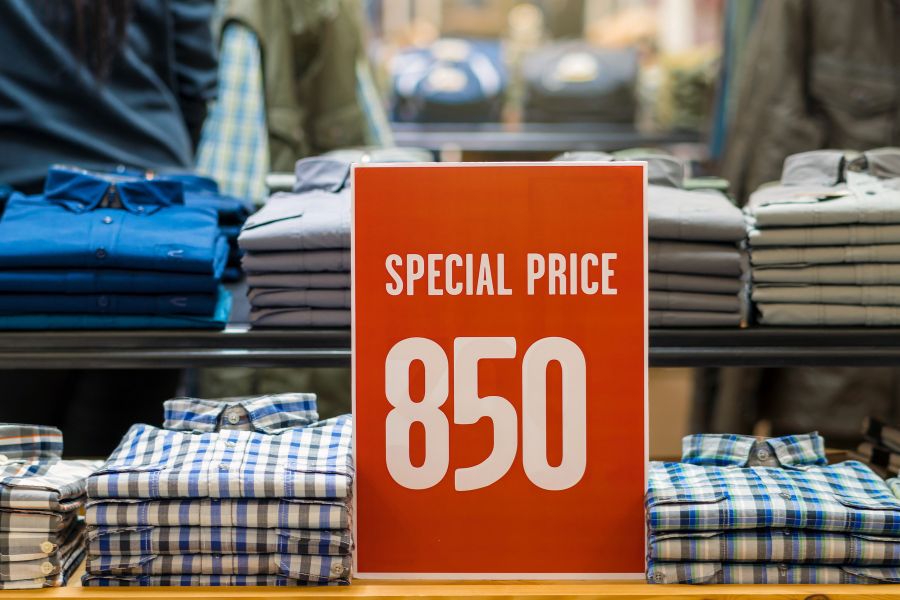
Charm pricing in action: Produce labeled at 2.99 and 3.99 instead of rounded prices makes items feel noticeably cheaper, even though the difference is only a few cents.
Works best for:
- Retail stores
- Ecommerce brands
- Grocery and convenience
- Price-sensitive markets
When it’s not the best fit:
- Luxury or premium brands
- High-ticket services where rounded numbers signal confidence
Price anchoring presents a higher reference price to make a lower price feel like a better deal.
How it works:
The first price customers see becomes their benchmark. Everything after that feels cheaper or more expensive by comparison.
Example:
“Was $199, now $129” or showing a premium $299 SaaS plan before a $99 plan.
Works best for:
- Ecommerce promotions
- SaaS pricing pages
- Seasonal sales
- High-ticket services
Watch out for:
- Fake or inflated “original” prices
- Constant discounting that trains customers to wait
Decoy pricing introduces a third option to push customers toward a specific plan — usually the middle one.
How it works:
With three choices, customers often pick the middle as the “safe” or best-value option.
Example (SaaS):
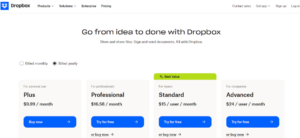
Dropbox uses decoy pricing by positioning higher-priced plans alongside a highlighted mid-tier option, making the middle plan feel like the smartest value choice.
Works best for:
- SaaS
- Memberships
- Service packages
- Subscription businesses
Watch out for:
- Pricing tiers that don’t clearly differentiate
- Gaps that feel arbitrary or manipulative
Bundle pricing combines multiple products or services into one package at a single price.
How it works:
Customers evaluate the total package instead of comparing each item individually, reducing price resistance.
Example:
A salon offers a haircut + treatment + styling bundle instead of pricing each service separately.
Works best for:
- Restaurants
- Ecommerce
- Beauty and wellness
- Service-based businesses
When it’s not the best fit:
- Customers only wanting one item
- Bundles that feel inflated or forced
Buy one, get one and multi-unit pricing encourage higher-volume purchases through perceived savings.
How it works:
Customers focus on the deal (“3 for $10”) rather than the per-unit price.
Example:
A grocery store offers “2 for $5” on snacks, increasing basket size.
Works best for:
- Consumables
- Apparel
- Grocery
- Low-cost retail
Watch out for:
- Thin margins
- Customers feeling pressured to overspend
This strategy uses time limits or scarcity to increase purchase urgency.
How it works:
Loss aversion makes customers act faster when they fear missing out.
Example:
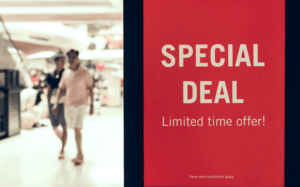
Limited-time offers create artificial urgency, triggering FOMO and pushing customers to act quickly before the deal disappears.
Works best for:
- Ecommerce
- Events
- Online courses
- Travel and hospitality
Watch out for:
- Fake countdown timers
- Constant “limited” offers
- Eroding customer trust
Customers choose how much they pay for a product or service.
How it works:
Relies on goodwill, community loyalty, and perceived fairness.
Example:
A digital creator offering downloadable resources with optional pricing.
Works best for:
- Digital products
- Creative industries
- Community-driven brands
- Nonprofits
When it’s not the best fit:
- Traditional retail
- Businesses with tight margins
- Audiences without strong brand loyalty
Price framing presents the same price in different ways to make it feel smaller or more manageable.
How it works:
Breaking larger numbers into smaller increments reduces sticker shock.
Example:
$120/year becomes “$10 per month” or “just $0.33 per day.”
Works best for:
- SaaS
- Memberships
- Gyms
- Subscription services
Watch out for:
- Hidden billing terms
- Long commitments framed as short-term
Prestige pricing uses rounded, whole numbers to signal quality and exclusivity.
How it works:
Round numbers feel deliberate and confident, reinforcing premium positioning.
Example:
A consultant charges $5,000 instead of $4,999.
Works best for:
- Luxury goods
- High-end services
- Boutique experiences
When it’s not the best fit:
- Price-sensitive audiences
- Weak brand positioning
Visual formatting changes how prices are perceived without changing the actual number.
How it works:
Design influences price perception as much as the number itself.
Example:

Simple price formatting, such as removing the currency symbol and minimizing the cents, reduces visual friction and makes prices feel cleaner and less intimidating.
Works best for:
- Ecommerce
- SaaS pricing pages
- Restaurant menus
- Online sales pages
Watch out for:
- Overdesigning
- Making prices hard to read
- Appearing manipulative
Pros, cons, and ethical considerations of psychological pricing
Psychological pricing can be effective in driving sales, but misusing or overusing it can damage customer trust and your brand reputation. Before implementing any tactic, it’s crucial to weigh the upside against the long-term impact on your brand.
Benefits of psychological pricing
When applied strategically, psychological pricing can improve performance without lowering your actual prices. Instead of cutting margins, you’re optimizing how customers perceive value, often leading to measurable revenue gains.
- Higher conversion rates: Small adjustments, like charm pricing or anchoring, can reduce purchase hesitation. When prices feel more reasonable, customers are more likely to check out.
- Higher average order value (AOV): Bundle pricing, multi-unit offers, and decoy pricing encourage customers to spend more per transaction without feeling forced.
- Better tier adoption: Strategic plan structuring (especially in SaaS and service businesses) can steer customers toward higher-margin options.
- Stronger competitive positioning: Psychological pricing helps frame your offer more attractively compared to competitors, even if your actual price isn’t the lowest.
Risks of psychological pricing
Psychological pricing can increase sales but it can also weaken your brand if misused. Overreliance on pricing tactics, especially those that create false urgency or inflated discounts, can damage credibility and reduce long-term customer trust.
- Erodes trust if overused: Constant countdown timers, endless “limited-time” offers, and exaggerated discounts create skepticism. Customers eventually stop believing you.
- Devalues premium brands: Charm pricing and aggressive discounting can undermine high-end positioning. If you’re selling luxury, rounding down often works against you.
- Trains customers to wait for discounts: If anchoring and promotions are permanent, customers delay purchases until the next sale.
- Legal and compliance risks: Fake “original” prices or misleading savings claims can trigger regulatory scrutiny. Anchors must be legitimate and defensible.
Is psychological pricing ethical?
Yes, when used responsibly. Psychological pricing becomes unethical when it hides the true cost, fabricates urgency, or misleads customers about value.
A simple rule: Ethical psychological pricing enhances clarity. Manipulative pricing obscures truth.
For example:
- Breaking $120/year into $10/month is ethical if billing terms are clear.
- Showing “Only 3 left!” when inventory is full is deceptive.
- Displaying a legitimate MSRP is acceptable
- Inventing a fake “original” price is not.
Customers expect businesses to present prices strategically. What they don’t accept is dishonesty. If your pricing tactic would make a customer feel tricked after the purchase, don’t use it. The most successful small businesses use pricing psychology to communicate value, not to manufacture it.
How to implement psychological pricing in your business
Understanding psychological pricing tactics is only half the equation. The real impact comes from applying them deliberately and measuring results. Instead of copying what competitors are doing, follow a simple process: assess your audience, choose strategically, and test before rolling anything out permanently.
Step 1: Identify your customers’ price sensitivity level
Before adjusting your pricing, determine how sensitive your customers are to price. Not every audience responds the same way to charm pricing, urgency triggers, or discount framing. Start by evaluating your market position:
- Are you selling a commodity in a crowded market, or a premium, differentiated offer?
- Are purchases frequent and low-cost, or infrequent and high-ticket?
- Is your target customer primarily budget-conscious, or focused on quality and outcomes?
- Do customers often compare you directly with competitors?
Price-sensitive businesses often benefit from charm pricing, bundling, and multi-unit offers. Premium businesses typically see better results with prestige pricing and selective anchoring.
Step 2: Choose one to two tactics
It can be tempting to layer multiple psychological pricing tactics at once. In practice, that often reduces clarity and increases skepticism.
When customers see charm pricing, countdown timers, aggressive discounts, and three-tier decoy structures all at once, it can feel engineered rather than natural. It also makes it nearly impossible to identify which tactic is driving results.
Instead, choose one primary tactic and, if needed, one complementary tactic.
For example:
- A SaaS company might use decoy pricing combined with annual price framing.
- A retail store may rely on charm pricing alongside bundle offers.
- A consultant might combine prestige pricing with a strategically anchored premium package.
- A focused approach preserves trust and makes performance easier to measure.
Step 3: Run A/B test pricing changes
If you want reliable results, you need to test. Psychological pricing works differently depending on your industry, traffic volume, and audience expectations.
When running an A/B test, change only one variable at a time. For example:
- $29 vs. $29.99
- Two pricing tiers vs. three pricing tiers
- $120 per year vs. $10 per month
Track metrics that reflect revenue impact, not just clicks:
- Conversion rate shows the percentage of visitors who complete a purchase. It tells you whether the pricing presentation reduces friction at checkout.
- Revenue per visitor calculates total revenue divided by total visitors, giving you a clearer picture of whether the change increases overall earnings, not just transactions.
- Average order value (AOV) helps you determine whether tactics like bundling or tiered pricing are increasing how much customers spend per purchase.
- Refund or cancellation rate is critical for subscription or service businesses. A pricing change that increases sign-ups but also increases churn may hurt long-term profitability.
A higher conversion rate doesn’t automatically mean higher profit. Revenue per visitor often provides a clearer picture of whether the pricing change is actually beneficial.
Here’s a simple structure you can use:
- Control: $29
- Variant: $29.99
- Primary metrics: Conversion rate and revenue per visitor
- Secondary metrics: AOV and refund rate
Run the test long enough to reach statistical significance. For many small businesses, that may require several weeks of consistent traffic rather than a few days of data. Avoid making decisions based on short-term spikes or anomalies.
Step 4: Use pricing optimization tools
As your business grows, manual testing and spreadsheet tracking become more difficult to manage. At that point, pricing optimization tools can help analyze trends and automate experimentation.
Depending on your business model and complexity, you may benefit from more advanced pricing tools:
- Pricing optimization platforms analyze sales data, conversion trends, and customer behavior to identify which price points perform best. These tools help you move beyond guesswork by using data to recommend adjustments that improve revenue and margins over time.
- CPQ (Configure, Price, Quote) systems are useful for businesses with customized or variable pricing, such as B2B services, manufacturing, or enterprise SaaS. CPQ tools automate the process of building quotes, applying rules-based pricing, and ensuring consistency across sales teams.
- Dynamic pricing engines automatically adjust prices based on factors like demand, seasonality, inventory levels, or customer behavior. These are common in ecommerce, travel, and hospitality, where pricing flexibility can significantly impact profitability.
These tools are especially useful for ecommerce stores, SaaS companies, and businesses handling high transaction volume. If you’re exploring automated adjustments, our guide to dynamic pricing explains how real-time pricing strategies work and when they make sense.
The goal isn’t to constantly change prices. It’s to make informed adjustments, test carefully, and scale what consistently improves revenue without weakening trust.
Psychological pricing examples by business type
Psychological pricing works best when it aligns with how customers in your industry evaluate value. The table below shows how tactics typically play out across different business models.
Psychological pricing vs other pricing strategies
Psychological pricing focuses on how a price is perceived. Other pricing strategies focus on how a price is set. Understanding the difference helps you decide when perception tactics are enough, and when you need a broader pricing overhaul.
Psychological pricing vs cost-plus pricing
Cost-plus pricing sets prices based on your costs plus a target markup. It ensures profitability but doesn’t account for customer perception or competitive positioning.
Psychological pricing, on the other hand, adjusts how that final price is presented. For example, after calculating a cost-plus price of $30, you might list it at $29.99 or structure it within a tiered package. Cost-plus determines the number. Psychological pricing shapes how customers interpret it.
Psychological pricing vs penetration pricing
Penetration pricing is a market-entry strategy where you set a deliberately low price to gain customers quickly. The goal is growth and market share.
Psychological pricing doesn’t necessarily lower prices. Instead, it increases perceived value at your chosen price point. You might use penetration pricing to enter a market, then apply psychological pricing tactics to improve conversions and tier adoption.
Psychological pricing vs dynamic pricing
Dynamic pricing adjusts prices in real time based on demand, seasonality, or customer behavior. Airlines and hotels commonly use it, and ecommerce businesses increasingly do as well.
Psychological pricing doesn’t change prices dynamically; it changes presentation and structure. However, the two can work together. A business might use dynamic pricing to adjust rates and psychological pricing techniques (like anchoring or framing) to present those rates effectively. If you’re exploring automated price changes, see our guide to dynamic pricing for a deeper breakdown.
Where psychological pricing fits
Psychological pricing is rarely a standalone strategy. It works best as a layer applied on top of your core pricing model, whether that’s cost-based, competitive, value-based, or dynamic.
Think of it this way: your pricing strategy determines what you charge. Psychological pricing influences how customers feel about what you charge.
If you’re still determining your overall pricing structure, start with our guide to product pricing before layering in psychological tactics.
Frequently asked questions (FAQs)
Click through the sections below to read answers to common questions about psychological pricing:
Psychological pricing is a strategy that uses cognitive biases to influence how customers perceive prices. Instead of changing the product, it changes how the price is presented, through tactics like charm pricing, anchoring, or tier structuring. It works because customers evaluate prices comparatively and emotionally, not purely mathematically. Small perception shifts can meaningfully impact buying decisions.
In many price-sensitive markets, yes. Charm pricing works well in discount retail and ecommerce because customers focus on the left digit, making $9.99 feel cheaper than $10. However, it’s less effective in luxury markets, where rounded numbers often signal quality and confidence. The impact depends on your brand positioning and customer expectations.
Psychological pricing is ethical when it presents value clearly and honestly. It becomes problematic when businesses fabricate urgency, inflate original prices, or obscure true costs. Framing pricing in a way that helps customers understand value is legitimate. Misleading customers to force a decision is not.
Psychological pricing is especially effective in ecommerce, SaaS, restaurants, and retail environments where customers compare options quickly. These industries benefit from structured tiers, anchoring, menu design, and volume pricing. Service businesses can also benefit, particularly through tiered packages and payment framing. The key is aligning the tactic with how customers in your industry evaluate value.
Bottom line
Psychological pricing works because customers don’t evaluate numbers in isolation and instead evaluate value in context. Small changes in price presentation, structure, or framing can increase conversions, average order value, and plan selection without cutting into your margins.
The key is alignment and testing. Choose tactics that match your business model and brand positioning, measure the results, and adjust based on data, not assumptions. When used ethically and strategically, psychological pricing strengthens perceived value instead of weakening trust.
Source link