What Is TikTok Shop? How It Works, Fees, and Seller Basics

TikTok Shop is TikTok’s built-in shopping platform that lets customers discover and buy products without leaving the app. Shopping happens through in-feed videos, LIVE shopping streams, the Shop tab, and dedicated product pages, turning short-form content into a direct sales channel.
TikTok Shop still matters in 2026 because in-app shopping is now a real user behavior, not a test feature. According to GWI’s Global Media Landscape report, more than 50% of TikTok users have used TikTok Shop, and about 26% have completed a purchase directly through the platform. For small businesses and creators, this means the opportunity to reach shoppers earlier in the buying cycle, especially with visual, impulse-friendly products that can be explained quickly on video.
At the same time, TikTok’s US operations have gone through changes following regulatory scrutiny and a shift to US-majority ownership. TikTok Shop remains available to US sellers, and I break down what that change means later in this guide so you can plan with clearer expectations.
In this article, you’ll learn how TikTok Shop works, what fees to expect, how shipping and fulfillment operate, and how to decide whether it fits your margins and overall ecommerce strategy.
Key takeaways:
- TikTok Shop is TikTok’s built-in ecommerce platform, allowing customers to discover and purchase products directly inside the app through videos, LIVE shopping, the Shop tab, and product pages.
- Sales on TikTok Shop are driven by content and creators, not traditional storefront browsing. Short-form video, creator affiliates, and LIVE commerce play a central role in visibility and conversions.
- TikTok Shop uses commission-based fees that vary by category. Most sellers plan for a mid-single-digit referral fee, plus payment processing, shipping, and return costs.
- TikTok Shop works best as part of a broader ecommerce strategy, especially for visual products with healthy margins, rather than as a business’s only sales channel.
What is TikTok Shop?
TikTok Shop is TikTok’s built-in ecommerce platform that lets users discover and buy products without leaving the app. Instead of linking out to an external store, TikTok Shop keeps product discovery, checkout, and payment inside TikTok.
This reduces friction compared with traditional social commerce links, which require shoppers to leave the app to complete a purchase. With TikTok Shop, buying often takes just a few taps.
Shopping on TikTok happens across four main surfaces:
- Shoppable videos with product tags in the feed
- LIVE shopping streams with real-time product demos
- The Shop tab, where users browse products
- Product pages with pricing, reviews, and order details
TikTok in the US: Ban status and ownership update (2026)
TikTok Shop remains available in the US after TikTok’s 2026 shift to US-majority ownership. Existing sellers did not need to make changes, and short-term ban risk has eased, though regulation remains a long-term consideration.
- TikTok’s US future was in jeopardy under a federal law that would ban apps controlled by foreign adversaries unless they divest by early 2025, creating real uncertainty about its availability in the US.
- On January 22, 2026, TikTok’s US operations were officially spun off into a new company called TikTok USDS Joint Venture LLC, with majority American ownership, allowing the platform to continue operating in the US. The new entity is backed by American investors, including Oracle, Silver Lake, and MGX, while ByteDance retains a minority stake (about 19.9%) under the revised ownership structure.
- For TikTok Shop sellers, TikTok continues to operate in the US with no interruption to selling, and existing seller accounts, listings, and fulfillment processes remain unchanged by the ownership shift.
- The threat of a nationwide TikTok ban has eased with the sale, but regulatory oversight and future policy shifts remain possible, so merchants should include TikTok Shop as one channel within a diversified ecommerce strategy.
How big is TikTok Shop? Scale and who’s buying
TikTok Shop has grown into a meaningful ecommerce channel in a short time. By late 2025, reports based on third-party estimates showed global TikTok Shop sales reaching roughly $19 billion in a single quarter, with the US accounting for about $4 billion to $4.6 billion of that total. Seasonal performance has also strengthened, with TikTok Shop generating $500 million in US sales during major shopping periods like Black Friday and Cyber Monday.
Buyer behavior helps explain that growth. Shopping on TikTok is driven by discovery and impulse rather than search, with users moving from video to checkout in the same session. As I mentioned above, more than 50% of TikTok users have used TikTok Shop, and about 26% have completed a purchase on the platform, signaling that in-app buying is now a mainstream habit.
For sellers, this scale matters most when products are easy to demonstrate and priced for quick decisions. Categories that show clear results on video tend to convert best, especially when paired with creator-led content or LIVE shopping.
Is TikTok Shop right for your US business in 2026?
TikTok Shop tends to fit visual, impulse-friendly products that are priced to move, ship quickly, and still earn a healthy margin after commission, payment, shipping, and returns. Items with simple specs and low buyer hesitation do best.
It is usually not a good match for restricted or heavily regulated categories, complex products that require long comparisons or custom setup, or bulk goods with thin margins.
Here’s a simple five-point checklist I suggest you do before you invest time and budget.
- Your top SKUs have repeatable hooks for short video and LIVE.
- Breakeven math works after platform fees, creator costs, promos, and expected returns.
- You can ship within 1 to 3 days and handle returns without eroding margin.
- You have at least two creator partners or an in-house host for LIVE.
- You have a fallback plan if US policy changes, including direct channels and a fast way to move traffic elsewhere.
Read more: TikTok Shop Review: Selling on TikTok Shop in the US
How TikTok Shop works
There are four ways TikTok users can shop on the platform — through shoppable videos, product showcase, Shop tab, and live shopping.
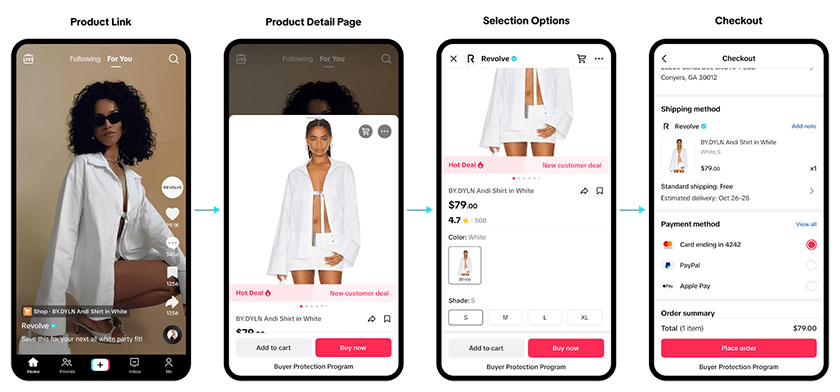
Shoppable videos: Users can shop directly from a shoppable in-feed video by tapping the basket icon with a product link shown on their For You page, as seen below.
(Source: TikTok)
Product Showcase: Users can browse product tiles, read user reviews, and buy directly from a brand’s profile.
(Source: TikTok)
Shop Tab: Under the Shop Tab, users can find your products, shoppable content, and promotional campaigns. Customers can also manage their orders in this tab.
Live Shopping: TikTok is a leading platform for livestream shopping. Brands can go on LIVE and sell. Users buy products by tapping the pinned products or browsing the shopping basket icon.
(Source: TikTok)
TikTok Shop creator affiliate program
A core part of how TikTok Shop works is its built-in creator affiliate program. Instead of relying only on brand-owned content or ads, TikTok Shop allows creators to promote products directly through their videos and LIVE streams, earning a commission when their audience makes a purchase. This model turns creators into a primary growth channel for sellers.
- How creators earn commissions: Creators earn a percentage of each sale when viewers purchase through tagged videos or LIVE shopping sessions. Commission rates are set by sellers and can vary by product or campaign.
- How sellers partner with creators: Sellers can invite creators through TikTok’s affiliate marketplace or accept creator requests. Many partnerships involve product seeding, commission-only payouts, or a mix of both.
- Why affiliates matter for reach and conversion: Creator-led content feels native to TikTok, helping products surface organically and build trust faster than brand-only promotions, which often leads to stronger conversion rates.
TikTok Shop seller requirements in the US (Who can sell on TikTok Shop)
To be able to set up a TikTok Shop in the US, you need a US phone number and email address to sign up, and a certificate of incorporation, a US passport, or a US driver’s license to verify your identity and complete the application. A linked TikTok account is also required.
Some documents need to be submitted for payment and tax information, too.
- For individual sellers: Merchant category code; W9/W8-BEN form / US TIN
- For corporate sellers: Business name; Employer Identification Number (EIN); registered business address; last 4 digits of tax ID (US Social Security Number / Individual Taxpayer Identification Number); legal name; date of birth; residential address; Merchant category code; W9/W8-BEN Form; related person’s information; entity type
TikTok also has a list of restricted and prohibited products to sell on its platform.
TikTok Shop fees and costs
Setting up a TikTok Shop is free. Instead of monthly subscription fees, TikTok charges sellers a commission, often referred to as a referral fee, on each completed sale.
- Referral or commission fees: TikTok Shop’s current standard referral fee in the US is 6% per transaction, verified as of October 2025. The fee is applied to qualified transactions and deducted automatically at the time of sale.
- Category-based differences: While 6% is the standard rate, some product categories fall within a 5% to 6% range. Sellers should confirm the exact commission rate for their category inside the TikTok Seller Center before finalizing pricing.
- Other potential costs sellers should expect: Beyond referral fees, sellers may incur payment processing costs, shipping and fulfillment expenses, return handling, and creator commissions if using the affiliate program. Sampling products for creators and producing short-form video content are also common, optional expenses.
TikTok Shop shipping and fulfillment
TikTok Shop supports both seller-managed fulfillment and TikTok-managed shipping, giving merchants flexibility based on margins, volume, and delivery speed.
- Seller-managed shipping: Sellers handle packing and shipping themselves or through a third-party logistics provider.
- TikTok-managed shipping: TikTok coordinates fulfillment through approved carriers where available, simplifying logistics and helping sellers qualify for faster delivery signals.
- What the 3-day delivery badge means: The 3-day delivery badge highlights listings that meet TikTok’s fast-shipping standards. Products with this badge often see higher conversion rates because buyers expect quicker delivery.
TikTok shipping vs seller shipping
TikTok Shop set up (How to sell on TikTok Shop)
Setting up a TikTok Shop is straightforward. I have outlined a more detailed process in our how to sell on TikTok guide. As mentioned earlier, you just need a TikTok account and some documents to verify your US identity so you can get started on selling.
Moreover, if you already have a standalone online store and want to also sell on TikTok, ecommerce platforms like Shopify have built-in integrations that let you sync your products to the social platform. You don’t have to set up separate product listings on TikTok.
TikTok Shop new seller limits: What to expect in your first 30 days
New TikTok Shop sellers begin in a probation period, a performance-based ramp-up phase that helps build trust and service quality before a shop scales. During this period, TikTok places measured limits on how many products you can list and how many orders your shop can receive, and these limits adjust automatically as you demonstrate reliable performance.
- Trial limits and common restrictions: All new shops start at the Beginner level with limits such as up to 50 orders per day and up to 100 product uploads. Limits increase as your shop progresses to higher tiers (Standard, Premium, and Pro), with the potential for unlimited daily orders once you reach Pro status.
- Typical early issues sellers run into: Early challenges often relate to meeting TikTok’s performance and compliance expectations. Sellers who fulfill orders promptly, maintain accurate listings, and provide good customer service move up tiers faster; underperformance can keep limits in place longer.
To move through TikTok Shop’s probation period faster, focus on the basics that directly affect performance scoring: inventory accuracy, response time, and fulfillment reliability.
- Start with a small, high-confidence inventory. List a limited number of products you can consistently fulfill, using accurate titles, pricing, and images to avoid cancellations or disputes that can slow your progression.
- Set up customer support workflows before launch. Plan for fast responses to buyer questions and issues, since response time and dispute handling are tracked during the probation period.
- Meet shipping timelines from day one. Use reliable carriers, upload tracking promptly, and stick to realistic handling times to build a strong early delivery record.
TikTok Shop vs Shopify and other ecommerce options
TikTok Shop and standalone ecommerce platforms serve different roles. TikTok Shop is built around discovery and impulse buying, while platforms like Shopify focus on long-term brand ownership and repeat customers.
- When TikTok Shop works best as a primary channel: TikTok Shop can function as a main sales channel for sellers with visual, trend-driven products, strong creator partnerships, and margins that support commission fees and fast fulfillment.
- When TikTok Shop works better as a supplemental channel: For most businesses, TikTok Shop works best alongside a standalone store. Sellers can use TikTok for discovery and impulse sales while directing repeat customers to their own site for deeper brand engagement and higher lifetime value.
Benefits and drawbacks of selling on TikTok Shop
Benefits
- Built-in audience and discovery: TikTok Shop benefits from TikTok’s algorithm-driven discovery, allowing products to surface organically through content rather than relying on search alone.
- Creator-driven sales potential: The affiliate model lets sellers tap into creator audiences without upfront ad spend, often improving trust and conversion.
- Lower barrier to entry: There are no monthly platform fees, making TikTok Shop easier to test than launching a standalone ecommerce site.
Drawbacks
- Platform dependence: Sellers rely on TikTok’s policies, algorithms, and traffic sources, which can change without notice.
- Fulfillment and policy changes: Shipping rules, eligibility requirements, and seller tools may evolve, requiring operational flexibility.
- Limited control: Compared to owning your own store, sellers have less control over branding, checkout, and customer data.
Frequently asked questions (FAQs)
Click through the sections below to get answers from your TikTok Shop frequently asked questions.
TikTok Shop is an in-app shopping solution for TikTok. Users get an all-in-one shopping experience without having the need to leave the platform while browsing.
TikTok Shop motivates TikTok users to shop by letting them purchase directly on videos they see on the platform. They can shop through LIVEs, in-feed videos, or by tapping the shop icon on a brand profile, and checkout directly within TikTok.
To get started on selling on TikTok Shop, you need a valid US phone number and email address to sign up and a valid US ID to confirm your identity. You also need to submit documents such as your W9/W8-BEN form / US TIN for payment and tax information.
Yes. TikTok Shop is available to US buyers and sellers in 2026. TikTok’s US operations now operate under a US-majority ownership structure, and shopping and payments continue to function normally for users.
TikTok Shop does not charge a monthly fee. In the US, the standard referral fee is 6% per sale, with some category-based variations between 5% and 6%, plus shipping, payment processing, and optional creator commissions.
Eligible individual and business sellers in approved regions can sell on TikTok Shop. US sellers must complete identity verification, provide tax and banking information, and comply with TikTok Shop’s product and fulfillment policies.
The immediate risk of a nationwide ban has eased following TikTok’s 2026 ownership restructure. While regulatory oversight remains a long-term consideration, TikTok Shop continues to operate in the US.
Yes. TikTok Shop can integrate with Shopify, allowing sellers to sync products, manage inventory, and connect TikTok Shop sales with their existing ecommerce operations.
Bottom line
TikTok is a great platform to expand your business for online sales. TikTok Shop has been proving to be a great success for small business brands since its launch in the US, but marketing and staying on top of TikTok trends is key to boosting sales.