What Is Inventory Reduction? Meaning, Methods & Strategies for Small Businesses

Inventory reduction helps small businesses free up cash, cut storage costs, and avoid losses from unsold or outdated stock. Since inventory can tie up 20% to 30% of working capital, even small reductions can make a noticeable impact on your cash flow.
In this guide, I’ll walk you through the most effective inventory reduction methods, strategies, and techniques, along with real-world examples and a simple inventory reduction formula to help you build a practical plan.

A retail employee uses a tablet to track inventory and manage stock levels in real time.
What is inventory reduction?
Inventory reduction is the process of lowering excess or unnecessary stock levels to improve cash flow, reduce costs, and operate more efficiently. Instead of holding more inventory than you need, the goal is to maintain just enough stock to meet demand without overstocking.
Businesses reduce inventory to free up cash and reduce costs tied to excess stock. Excess inventory can quickly eat into profits through warehousing fees, spoilage, shrinkage, and markdowns, especially for small businesses with limited space and capital.
At its core, inventory reduction is about balance: cutting down surplus stock while still keeping enough inventory to avoid stockouts and lost sales.
Inventory reduction vs optimization vs control
These terms are closely related but not the same:
- Inventory reduction focuses on decreasing excess stock to free up cash and reduce waste
- Inventory optimization focuses on maintaining ideal stock levels using forecasting and data
- Inventory control refers to the day-to-day management of tracking, ordering, and storing inventory
Quick takeaway: Inventory reduction = lowering excess stock without hurting sales
Why inventory reduction matters for small businesses
Reducing excess inventory isn’t just about clearing space; it directly impacts your profitability, cash flow, and day-to-day operations. Many small businesses carry more stock than they need, often without realizing it. In fact, some retailers hold up to 20%–30% excess inventory, tying up cash and increasing operational costs.
Here’s a closer look at why inventory reduction has such a big impact:
- Lower operating costs: Excess inventory increases expenses for storage, insurance, handling, and spoilage, especially for perishable or seasonal products.
- Improved cash flow: Selling down surplus stock frees up cash that can be reinvested into marketing, hiring, or new inventory that actually sells.
- More accurate forecasting: Leaner inventory makes it easier to track demand trends and make better purchasing decisions.
- Reduced dead stock: Cutting slow-moving or obsolete items helps prevent losses from markdowns, write-offs, or unsold goods.
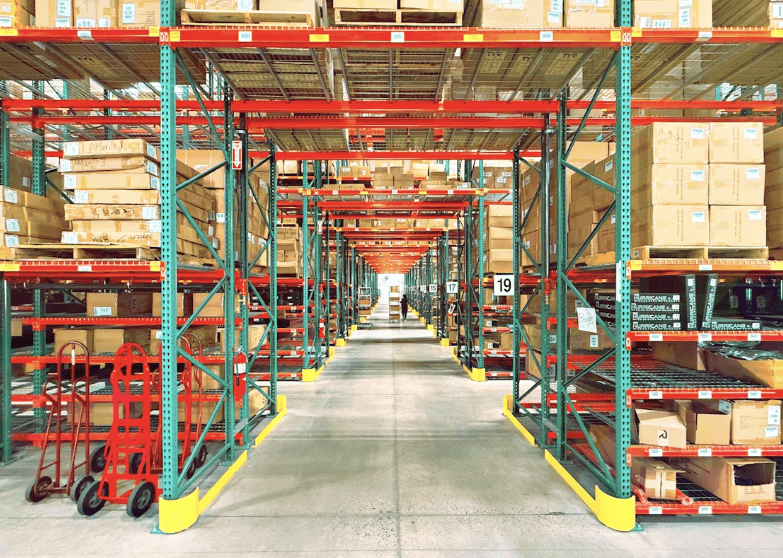
Organized warehouse shelving with boxed inventory, illustrating efficient storage and inventory management practices.
Inventory reduction plan: How to build one step-by-step
Quick inventory reduction plan checklist
Use this checklist to guide your process:
- Review inventory and identify dead or slow-moving products
- Set clear reduction goals and timelines
- Segment inventory using ABC analysis
- Apply the most appropriate reduction methods
- Monitor key metrics and adjust your strategy
A strong inventory reduction plan helps you cut excess stock without risking stockouts or lost sales. Instead of making random cuts, follow a structured process to identify what to reduce, set clear targets, and monitor results.
Step 1: Audit your current inventory
Start by understanding what you currently have and how it’s performing. The goal is to identify which products are tying up cash without generating revenue. Focus on:
- Dead stock: Items that haven’t sold in months and are unlikely to move
- Slow-moving SKUs: Products with low turnover that tie up space and cash
Tip: Run inventory reports to identify SKUs with low sales velocity or long shelf times.
Step 2: Set reduction goals
Once you know what needs to go, define clear and realistic targets. This ensures your efforts are measurable and aligned with your business needs. Set:
- Percentage reduction goals (e.g., reduce inventory by 15%-25%)
- Timeline (e.g., within 60-90 days)
Tip: Tie your goals to specific outcomes, like freeing up cash or reducing storage costs.
Step 3: Segment inventory (ABC analysis)
Not all products should be reduced equally. Segmenting your inventory helps you prioritize what to keep and what to cut.
- A items: High-value, fast-moving products (keep well-stocked)
- B items: Medium-demand items (monitor and adjust)
- C items: Low-value or slow-moving products (reduce aggressively)
Tip: Start with C items to reduce excess inventory with minimal impact on sales.
Step 4: Choose the right inventory reduction methods
With your priorities set, apply the right strategies to reduce stock efficiently. You’ll apply specific methods based on your situation.
- Running promotions or clearance sales
- Adjusting order quantities
- Switching to just-in-time (JIT) inventory
Tip: Match the method to the problem — clearance works for overstock, while ordering changes prevent future excess.
Step 5: Track and adjust
Inventory reduction isn’t a one-time effort. You need to monitor performance and adjust your approach to avoid understocking. Track key metrics like:
- Inventory turnover ratio: How often inventory is sold and replaced
- Sell-through rate: Percentage of inventory sold within a period
- Stockout rate: How often you run out of products

Warehouse staff reviewing inventory and stock levels to improve accuracy and reduce excess inventory.
Tip: Review your data regularly and adjust purchasing or pricing strategies as needed.
Inventory reduction methods
There are several proven inventory reduction methods you can use to lower excess stock without disrupting operations. The right approach depends on your business model, sales patterns, and the type of inventory you carry.
Below are the most effective methods, and when to use (or avoid) each one.
Inventory reduction techniques: Quick action checklist
Use this checklist to quickly identify and apply the right techniques based on your inventory challenges:
If you have excess or dead stock:
☐ Bundle slow-moving items with bestsellers
☐ Run targeted discounts or clearance sales
☐ Discontinue low-performing SKUs
If you’re overordering inventory:
☐ Reduce minimum order quantities (MOQs)
☐ Set reorder points based on sales velocity
☐ Order smaller quantities more frequently
If your inventory data is inaccurate:
☐ Implement regular cycle counting
☐ Audit inventory for discrepancies
☐ Use inventory management software for tracking
If demand is inconsistent or seasonal:
☐ Adjust pricing to move excess stock (dynamic pricing)
☐ Plan purchasing around seasonal trends
☐ Scale orders up or down based on demand patterns
Tip: Start with the issue that’s tying up the most cash (usually dead stock or overordering) to see the fastest impact.
Inventory reduction strategy: Choosing the right approach
The best inventory reduction strategy depends on your business model, inventory challenges, and stage of growth. Instead of applying a one-size-fits-all approach, use the frameworks below to choose the right strategy for your situation.
Based on business type
Your inventory reduction strategy should align with how you sell and fulfill products.
- Retail: Focus on clearing seasonal stock, optimizing shelf space, and using promotions or bundling to move slow items
- Ecommerce: Prioritize demand forecasting, smaller order quantities, and flexible fulfillment options like dropshipping
- Manufacturing: Emphasize just-in-time (JIT) inventory, supplier coordination, and reducing raw material overstock
Based on inventory challenges
Your biggest inventory issue should determine your primary strategy.
- Overstock: Use clearance sales, discounts, and bundling to quickly reduce excess inventory
- Slow-moving inventory: Adjust pricing, improve merchandising, or reduce future purchase quantities
- Obsolete inventory: Discontinue products and liquidate remaining stock to recover cash
Based on growth stage
Your business stage also affects how aggressively you should reduce inventory.
- Startup: Keep inventory lean, avoid bulk buying, and test products with small quantities
- Scaling business: Balance availability with efficiency using forecasting and supplier optimization
- Mature business: Focus on fine-tuning inventory levels and reducing carrying costs through data-driven decisions
Inventory reduction strategy decision table
Use this table to quickly identify the best approach for your situation:
Tip: The most effective inventory reduction strategy usually combines multiple approaches — start with your biggest problem (e.g., overstock or cash flow constraints), then layer in methods that prevent excess inventory from building up again.
Inventory reduction formula and key metrics
Tracking your progress is essential to any inventory reduction plan. Using a simple inventory reduction formula, along with a few key metrics, helps you measure how much inventory you’ve reduced and whether your strategy is working.
Basic inventory reduction formula
The most common way to measure inventory reduction is by calculating the percentage decrease in inventory over a specific period.
| Inventory Reduction % | = | Old Inventory – New Inventory | x | 100 |
| Old Inventory |
Example:
- Old inventory value: $50,000
- New inventory value: $35,000
| 50,000 + 35,000 | x | 100 | = | 30% |
| 50,000 |
In this case, you’ve reduced your inventory by 30%, freeing up $15,000 in cash.
Supporting metrics
While the formula shows how much inventory you’ve reduced, these metrics help you understand efficiency and performance over time:
- Inventory turnover ratio: Measures how often inventory is sold and replaced over a period. A higher turnover indicates efficient inventory management.
- Days inventory outstanding (DIO): Shows the average number of days inventory sits before being sold. Lower DIO means faster movement and less excess stock.
- Sell-through rate: Calculates the percentage of inventory sold within a given timeframe. Higher sell-through rates indicate better demand alignment.
How to use these metrics together
Use the inventory reduction formula to track your progress, then monitor turnover, DIO, and sell-through rates to ensure you’re not reducing inventory at the expense of sales. A successful inventory reduction strategy should result in:
- Higher inventory turnover
- Lower DIO
- Stable or improved sell-through rates
This combination signals that you’re reducing excess inventory while maintaining healthy sales performance.
Inventory reduction examples (Real-world scenarios)
Seeing how inventory reduction works in practice can make it easier to apply the right approach to your business. Below are real-world inventory reduction examples across different industries.
A clothing boutique ends the holiday season with $20,000 in unsold winter inventory. Instead of holding it until next year, the owner runs a clearance sale and bundles slow-moving items.
- Result: Sold 75% of excess stock within 30 days
- Inventory reduced by $15,000
- Freed up cash to purchase spring inventory
An online store carries $40,000 in inventory, with several products selling inconsistently. The owner shifts 50% of the catalog to a dropshipping model.
- Result: Reduced on-hand inventory to $20,000
- Cut storage costs by 30%
- Improved cash flow while still offering the same products
A small restaurant notices frequent spoilage of perishable ingredients worth $2,000 per month. By improving demand forecasting and ordering smaller quantities more frequently:
- Result: Reduced food waste by 40%
- Saved $800 per month
- Improved inventory turnover for fresh ingredients
A small manufacturer holds $100,000 in raw materials, leading to high storage costs. By coordinating with suppliers and adopting JIT ordering:
- Result: Reduced inventory levels by 30%
- Freed up $30,000 in working capital
- Lowered warehousing costs and improved production efficiency
Key takeaway: Inventory reduction doesn’t always mean selling everything off — it can also mean changing how you order, store, and fulfill products to keep inventory lean over time.
Common mistakes to avoid when reducing inventory
Reducing inventory can improve cash flow and efficiency but if done incorrectly, it can lead to lost sales and operational issues. Avoid these common mistakes when implementing your inventory reduction plan:
- Cutting inventory too aggressively. Reducing stock too quickly can lead to frequent stockouts, missed sales, and frustrated customers. You can avoid this by reducing gradually and monitoring demand to maintain product availability.
- Poor demand forecasting. Without accurate forecasting, you risk understocking high-demand items while overcorrecting on others. Instead, use historical sales data and trends to guide purchasing decisions.
- Ignoring supplier lead times. If you don’t account for how long it takes to restock, you may run out of products before new inventory arrives. To avoid this, factor in lead times when setting reorder points and adjusting order quantities.
- Over-reliance on discounts. While discounts can clear excess stock, relying on them too often can hurt margins and train customers to wait for sales. Instead, use a mix of strategies like bundling, pricing adjustments, and better ordering practices.
Inventory reduction vs inventory optimization
Inventory reduction and inventory optimization are closely related, but they serve different purposes. Understanding when to use each helps you avoid cutting too much or holding more inventory than necessary. Here’s a quick comparison:
When to focus on inventory reduction
Inventory reduction is best when you need to quickly correct inefficiencies or free up cash. Focus on inventory reduction if:
- You have excess or dead stock
- Cash is tied up in unsold inventory
- Storage costs are too high
- You’re preparing for new or seasonal inventory
When to focus on inventory optimization
Inventory optimization is a long-term strategy for maintaining the right stock levels. Focus on inventory optimization if:
- Your inventory levels are stable but need fine-tuning
- You want to improve forecasting accuracy
- You’re scaling operations and need better systems
- You want to prevent future overstock or stockouts
Key takeaway: Inventory reduction is a short-term fix to eliminate excess stock, while inventory optimization is a long-term strategy to keep inventory at the right levels. Most businesses need both — start with reduction, then shift to optimization to maintain efficiency.
Inventory reduction frequently asked questions (FAQs)
Click through the sections below to read answers to common questions about inventory reduction:
Inventory reduction is the process of lowering excess or unnecessary stock to free up cash, reduce costs, and improve efficiency without hurting your ability to meet customer demand.
A common target is 10% to 30%, depending on how much excess inventory you have. Businesses with significant overstock may aim higher, but reductions should be gradual to avoid stockouts.
Not always. Reducing inventory too aggressively can lead to stockouts and lost sales. The goal is to eliminate excess stock, not reduce inventory below what your business needs to operate smoothly.
Inventory reduction focuses on cutting excess stock, while inventory optimization focuses on maintaining the right stock levels over time using forecasting and data.
Most small businesses should review inventory monthly or quarterly, depending on sales volume. Fast-moving businesses may need weekly reviews, while slower operations can review less frequently.
Bottom line
Inventory reduction helps small businesses free up cash, lower costs, and run more efficiently, but it needs to be done strategically. The goal isn’t to cut inventory across the board, but to eliminate excess stock while maintaining enough supply to meet demand.
Start with a clear inventory reduction plan, apply the right methods and techniques, and track your results using key metrics. Once you’ve reduced excess inventory, shift your focus to optimization to keep stock levels balanced over the long term.
Done right, inventory reduction not only improves your cash flow — it also sets your business up for more sustainable growth.
Source link